
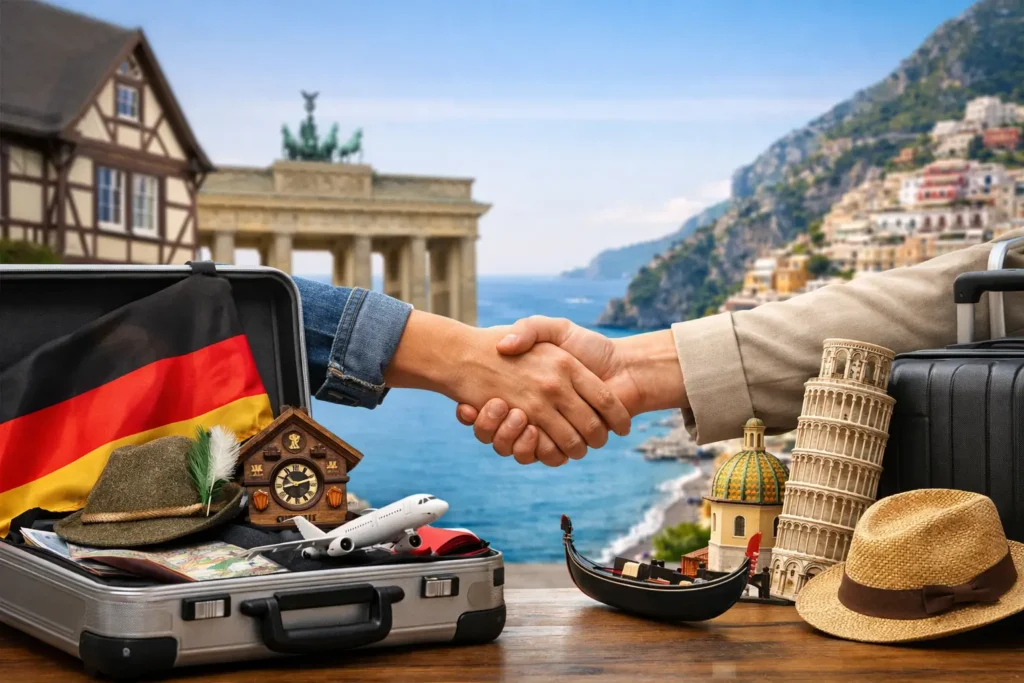
A move from Germany to Italy can look remarkably simple on paper. Both are founding EU members, and the “Schengen” reality means no visas are required.
But when you are actually moving to Italy from Germany, the hard part is rarely the border. It is the “Culture Shock of Systems”.
Germany is a land of Ordnung — structured, predictable, and quiet.
Italy operates on a rhythm of Flessibilità (flexibility) and social closeness.
Understanding these deep-seated cultural shifts is the key to turning your relocation into a permanent home.
1. The “Ruhetag” Paradox: Sunday in Italy
In Germany, Sunday is a sacred Ruhetag (Quiet Day).
Law and custom dictate that shops are closed, and noise — be it a lawnmower or a loud gathering — is strictly forbidden.
The Italian Reality: In Italy, there is no Ruhetag:
- Shopping: Most large supermarkets and shopping malls in Abruzzo are open on Sundays and holidays. While family-run shops in smaller villages might close for the afternoon, the convenience of Sunday commerce is a significant shift for Germans used to planning groceries by Saturday evening.
- Noise Levels: Sunday is the day of the Pranzo della Domenica (Sunday Lunch). It is a day for house cleaning, family gatherings, and loud celebrations. If you are living in an apartment or a close-knit neighborhood, expect the sound of music, laughter, and high-volume conversation. In Italy, noise is often viewed as a sign of life and community, not a violation of peace.
2. From “The Rules” to “The Flow”: Driving in Italy as an Expat
German driving is defined by strict adherence to the Straßenverkehrs-Ordnung.
If a sign says 50, you drive 50. In Italy, the logic is situational rather than absolute.
- The Communication: In Italy, driving is a form of non-verbal communication. Blinkers are often “suggestions”, and eye contact with other drivers is frequently more important than the right-of-way.
- The Pace: In regions like Abruzzo, you may find drivers who are slower and more relaxed on country roads, but more assertive in the coastal cities like Pescara.
- Parking: The German concept of “perfectly aligned parking” is rare. In Italy, space is a premium, and “creative” parking is a local skill you will need to learn (or at least tolerate).
3. The Administrative “Language Trap”
In Germany, you may be used to clear procedures and punctual appointments.
In Italy, the “Human Factor” reigns.
- Relationships Matter: If a clerk at the Comune tells you a document is missing, it isn’t always a “No”. Often, it’s an invitation to clarify or seek a local workaround.
- The Language Barrier: Even with some kind of English proficiency among younger Italians, the language of bureaucracy is strictly Italian. A misunderstanding in a contract or at the tax office can lead to months of delays.
4. 2026 Updates: The 7% Tax Advantage for German Retirees
For German retirees, 2026 has brought a significant financial incentive. The 7% Flat Tax Regime has officially expanded.
- The Update: Previously limited to towns of 20,000 people, the population cap has been raised to 30,000 residents.
- The Benefit: If you receive a German pension and move to a qualifying town in Abruzzo, you pay a flat 7% tax on all foreign-sourced income for 10 years. This makes vibrant coastal towns with better infrastructure much more accessible.
5. What to Organize Before You Leave Germany
- Deregistration (Abmeldung): You will need your Abmeldebescheinigung to prove your change of residence for German tax purposes.
- Health Insurance: As an EU citizen, your EHIC card provides emergency cover, but for long-term statutory healthcare in Italy, you will need the S1 form (for pensioners) or proof of employment to register with the ASL. Once you are registered in the Italian system, you should inform your German Krankenkasse. If you are a pensioner, the S1 form allows the German state to reimburse the Italian state for your care, allowing you to access the Italian SSN for free.
- Digital Identity: If you have a German eID, it is increasingly useful under the eIDAS regulation, but most Italian portals will eventually require you to set up SPID or CIE (Carta di Identità Elettronica).
- Document Readiness: Ensure your residency paperwork is in a dedicated folder, including certified translations where necessary.
6. Cost of Living: Germany vs. Italy
While Germany remains one of the more expensive EU nations, Italy offers a “High Quality/Lower Cost” ratio, especially in regions like Abruzzo.
- Housing: Rent in a city center like Frankfurt or Munich currently averages €1,800–€2,500. In Abruzzo, you can find a high-standard apartment for €600–€1,000, offering a 30-50% saving on your largest monthly expense.
- Utilities: Expect a shock here. German electricity is efficient but expensive; however, the Italian utility setup can be complex. The cost per kWh is comparable, but Italian “Non-Resident” rates are significantly higher. Finalizing your residency is the only way to unlock “Resident” pricing.
—
How Wanderlust Abruzzo Supports German Expats Relocating to Abruzzo
Moving to Abruzzo from Germany is a lifestyle upgrade, but the cultural transition phase is where the “Bürokratie-Schock” hides.
At Wanderlust Abruzzo, we act as your local “Integration Partner”.
We speak the language of the Comune, we help you find your new property in Abruzzo, we assist you with the bureaucratic steps, and ensure your German standards of efficiency are met with Italian local expertise.
—
Frequently Asked Questions (FAQs)
Do I really need to pay 7% tax on my German pension?
If you move your tax residency to a qualifying Abruzzo municipality, yes. The Double Taxation Treaty between Germany and Italy prevents you from being taxed twice, and the 7% flat rate applies to all foreign income.
Is Sunday really as loud as they say?
In residential areas, yes. Sunday is family day. It is common to hear people cleaning, vacuuming, and hosting large lunches. If you are looking for absolute silence, you may prefer a more rural, detached property in the Abruzzo interior.
Can I keep my German-plated car in Italy?
No. You must register your car with Italian plates within 3 months of obtaining residency. Keeping German plates longer can result in significant fines. We can help you with the process of registering your German car in Abruzzo.
How do I handle the Italian “flexible” punctuality?
For social events, being 10–15 minutes late is standard. However, for medical appointments and official bank appointments, you should still arrive on time.
Are shops really open on Sundays?
Yes, most large retail chains (Ipercoop, Conad) and malls (Megaló, Centro d’Abruzzo) are open on Sundays. Independent village shops may close, but you will never be stuck without groceries on a Sunday in Italy.

 English
 Deutsch