
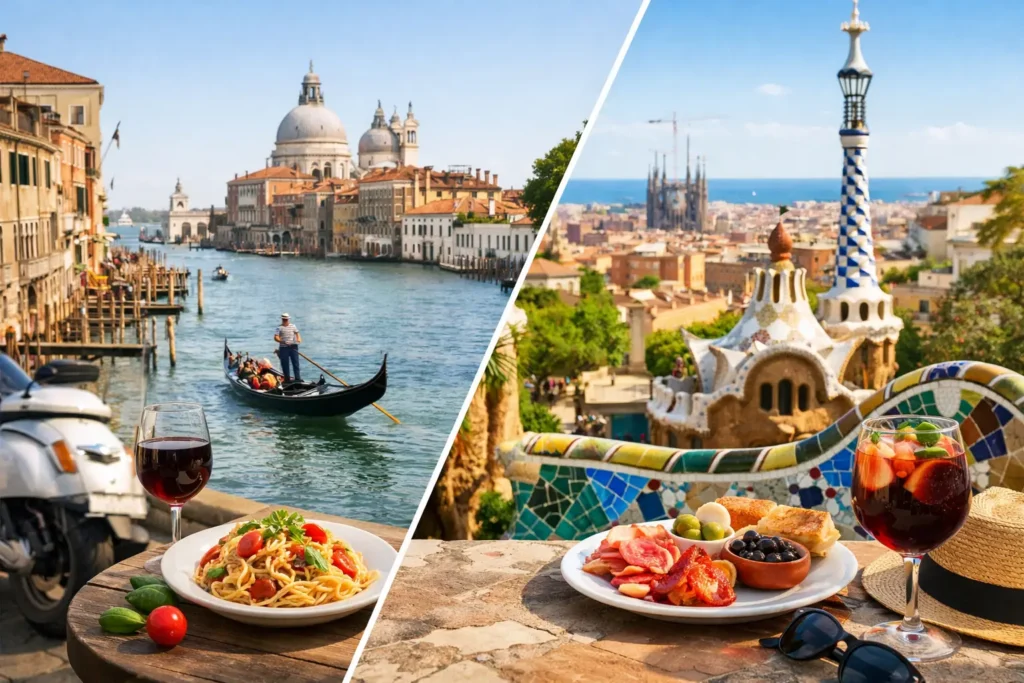
You can love both countries and still need to choose one real life. That is usually the hardest part of deciding whether to move to Italy or Spain — not the dream, but the details.
For many people, these two giants sit in the same mental folder: sunshine, slow lunches, and a chance to reset.
But as someone who lives the Italian system every day, I can tell you that the postcard versions are twins, but the daily realities are cousins at best (and I can tell it because my partner is Spanish).
If you are stuck between them, you need to compare how they feel when the honeymoon phase ends and the paperwork begins.
1. The Administrative Reality: “Soft Landing” vs. “High Effort”
The biggest difference is this: Spain often feels easier at first, while Italy often feels deeper over time.
The Spain Experience: Spain is generally more outward-facing. Systems are often more predictable, and large international communities in places like the Costa del Sol create a “softer landing”.
For remote workers, Spain’s Digital Nomad Visa (updated in 2026 to a €2,849 income requirement) is highly streamlined.
The Italy Experience: Italy asks more of you upfront. The bureaucracy can be a patchwork — what works in a seaside town in Abruzzo might be handled differently in a Tuscan village.
But many choose Italy because they want that “unfiltered” local connection.
If you are willing to push through the early friction, Italy offers a more rooted, authentic daily rhythm that doesn’t feel “packaged” for foreigners.
2. Tax Incentives: The Retiree’s Crossroads
In 2026, the financial math for retirees has shifted significantly in Italy’s favor.
- Italy’s 7% Regime: Under Law 34/2026, the 7% flat tax for foreign pensioners has expanded to towns of up to 30,000 residents. This means you can now live in larger coastal hubs in Abruzzo with better healthcare and transport while only paying 7% tax on your foreign income for 10 years.
- Spain’s Beckham Law: Spain’s famous tax break is excellent for high-earning workers but less impactful for those living on a pension. While Spain is generally 3-5% cheaper in daily consumer costs (like utilities), Italy’s tax incentives in the south often create more “disposable wealth” for expats.
3. Cost of Living: Beyond the Headline Cities
Don’t compare Milan to a Spanish village, or Barcelona to an Italian village. It’s a waste of your time.
- Rent: In 2026, Italy actually offers lower rent in non-tourist regions. In central Abruzzo, you can find a high-standard apartment for 15-20% less than in equivalent Spanish coastal areas like Malaga or Alicante.
- Utilities: Spain wins here. Electricity and heating costs in Spain are consistently lower (approx. €130/month vs. Italy’s €190+ for a standard flat). Finalizing your residency in Italy is the only way to unlock the “Resident Rate” and bridge this gap.
4. Healthcare: The Quality Debate
Both countries offer universal healthcare, but the experience is different.
- Italy’s SSN: Often ranked higher in OECD reports for quality of care. Enrollment is mandatory for residents, and for retirees, healthcare voluntary enrollment provides access to an incredible network of specialists for a calculated annual fee.
- Spain’s SNS: Widely considered more efficient and “expat-friendly” in terms of booking systems and English-speaking staff in coastal hubs.
5. Culture: “La Dolce Vita” vs. “La Fiesta”
This is personal.
Italy is intimate, place-specific, and deeply traditional.
Life revolves around the Piazza and the family unit.
There is an emphasis on La Dolce Vita — enjoying the slow pace with the community.
Spain feels more public and social.
Streets are animated late into the night, and there is a visible, outward energy.
If you want instant social activity, Spain gives it to you.
If you want a sense of belonging with historical depth, Italy rewards the “long game”.
—
Bridging the Gap in the Italian Transition
If you are leaning toward Italy but are terrified of the bureaucracy, you aren’t alone.
That fear is exactly why we do what we do.
At Wanderlust Abruzzo, we take the “High Effort” out of the Italian move.
We act as your on-the-ground bilingual advocate, ensuring your Italian residency paperwork is flawless, and your transition into the Italian system is as soft as a Spanish landing.
We help you find that specific “micro-world” in Abruzzo that fits your budget and your soul.
If Italy still feels like the “right” kind of home despite the hurdles, let’s build your roadmap.
Stop asking which country is better and start asking where you want your “Ordinary Tuesday” to happen.
If the answer is an Italian piazza in Abruzzo, we are here to clear the path.
Book Your Free Relocation Strategy Call Here
—
Frequently Asked Questions (FAQs)
Which country has a better Digital Nomad Visa?
Spain’s Digital Nomad Visa is more established, but Italy’s new “Visto per lavoratore da remoto” (for non-EU expats) offers tax incentives for new residents, making it a strong contender for those looking for value.
Can I live in Italy without speaking Italian?
In tourist hubs, yes. For daily life and bureaucracy, it is much harder to live in Italy without speaking Italian than in Spain. Having a relocation bilingual assistant is almost mandatory for the first 12 months in Italy.
Is the 7% flat tax available in all of Italy?
No. It is restricted to municipalities with fewer than 30,000 residents in the South (Abruzzo, Puglia, Sicily, etc.) or specific seismic-crater zones in Central Italy.
How does the weather compare?
Spain has less seasonal variation and more consistent winter sun. Italy offers a kaleidoscope of climates — in Abruzzo, you can ski in the morning and be at the Adriatic coast by the afternoon.
Which country is safer for expats?
Both are significantly safer than North America. Spain often scores slightly higher for progressive social attitudes, while Italy is prized for its deep-rooted, family-safe environment.



 English
 Deutsch