
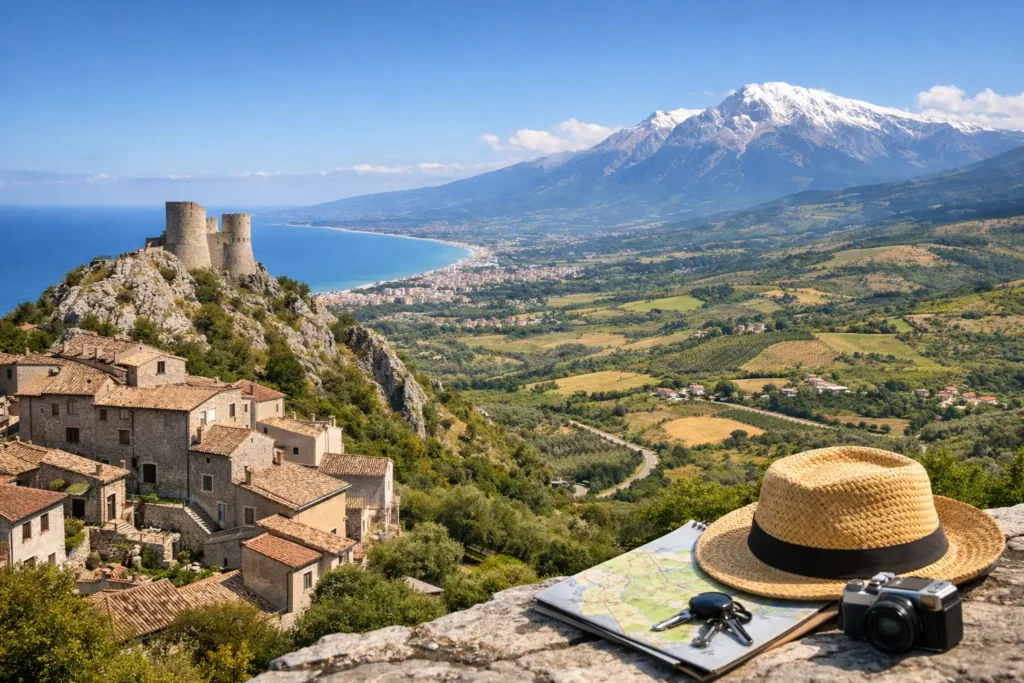
If you’re searching for what to know before moving to Abruzzo, Italy, here’s the most honest thing I can tell you: life here can be wonderfully calm, but the move itself rarely feels that way at first.
Abruzzo attracts people for very good reasons:
- lower living costs
- a beautiful coast and mountains within the same region
- slower rhythms
- towns that still feel genuinely local
But the dream gets tested quickly when you start looking for housing, making appointments, or trying to understand what’s actually required versus what people on forums assume is required.
That doesn’t mean the move is a bad idea.
It means Abruzzo rewards people who arrive with realistic expectations, some patience, and support on the ground.
Lifestyle Fit Matters as Much as Logistics
Many people start with the practical questions, which makes sense.
But the lifestyle fit matters just as much — and it’s worth being honest with yourself before you start booking viewings.
Abruzzo is not Florence, Milan, or Rome.
That’s exactly the appeal for most expats, but it also comes with real trade-offs.
You’ll find more space, more quiet, and often better value for money than almost anywhere else in Italy.
As International Living notes, Abruzzo has managed to stay off the expat and trendy radar despite all its appeal — and that’s part of what keeps it affordable and authentic.
But you may also find fewer English speakers, shorter business hours, and less of the polished convenience people expect in larger international cities.
In some towns, daily life still follows very local rhythms.
- Shops close in the afternoon.
- Things move at their own pace.
- Social integration tends to happen through repeated contact — the same bar, the same market, the same neighbours — not through fast expat networks.
If what you want is authenticity, nature, and a more grounded pace of life, Abruzzo can feel like a relief.
If you want constant entertainment, highly international services, and everything available on demand, some areas may feel too quiet — and it’s much better to know that before you sign a lease.
Choosing the Right Area Is One of Your Most Important Decisions
One of the biggest mistakes people make before moving is assuming Abruzzo will feel the same everywhere.
It won’t.
The right location depends entirely on how you want to live day to day — and this is a decision that deserves much more research than browsing property listings.
Coastal towns
Coastal areas tend to offer a bit more activity, walkability, and year-round services.
If being near cafés, the beach, train connections, or a more social atmosphere matters to you, the coast is likely a better fit.
Towns like Pescara, Montesilvano, and the surrounding areas have active English-speaking communities that are worth looking into before deciding where to base yourself.
Hill towns and inland villages
Inland areas often offer more charm, stronger traditional character, and lower purchase or rental prices.
But they can also bring practical challenges that are easy to underestimate from abroad:
- you’ll likely need a car for almost everything
- some areas get very quiet in winter
- renovation needs can be significant
- essential services may be further than you expect
You can explore the best towns in Abruzzo for different lifestyles to understand what suits your priorities.
A good test: ask yourself what you need on an ordinary Tuesday, not what sounds appealing on vacation.
That question changes a lot of answers.
Housing Looks Simple Online and Feels Very Different in Person
Photos rarely tell the full story — and in Abruzzo, that gap between listing and reality can be significant.
Before committing to a rental or purchase, try to understand the basics that matter in everyday living.
Heating and insulation
This is one of the most consistently underestimated factors.
A beautiful property can feel very uncomfortable in winter if it was built or renovated without modern insulation.
Older stone houses have character, but they can also have inefficient heating systems and draughty windows.
Visit in cooler months if you can, and ask specifically about the heating setup.
Internet and remote work
If you work remotely, internet reliability isn’t optional — it needs to be confirmed before you commit, not assumed.
Fibre coverage in Abruzzo has improved significantly, but rural and mountain properties can still be inconsistent.
Check the actual connection at the property, not just what the provider’s coverage map says.
The rental process itself
Rental processes in Italy can feel less standardised than newcomers expect:
- Communication may be slower.
- Listings may be outdated.
- Assumptions around deposits, contracts, or included utilities aren’t always clear unless someone asks the right questions — in Italian.
This is one of the areas where local support during your property search can save a lot of stress, because most problems appear before move-in, not after.
Bureaucracy Is Manageable, but Rarely Intuitive
This is one of the most important things to know before moving to Abruzzo — and it’s the area where most people underestimate the effort involved.
Even tasks that sound simple can become tiring when you’re dealing with a new language, unfamiliar offices, and procedures that aren’t always explained clearly.
Depending on your situation, you may need help with:
- residency registration
- your Codice Fiscale
- utility transfers
- health card setup
- opening basic day-to-day services
None of this is impossible.
But it can feel overwhelming when every office uses a different language, different expectations, and sometimes different interpretations of the same rules.
It also helps to know that progress isn’t always linear.
You may think one appointment will solve everything, only to learn that another document or another office is also involved.
That’s normal.
The goal isn’t to force the system to move faster — it’s to know the sequence, bring the right paperwork, and avoid preventable delays.
A good local guide doesn’t just help you with individual tasks.
They help you understand which step unlocks the next one.
⚠️ A note on procedures: Italian administrative requirements can vary by municipality and change over time. Always verify what’s needed for your specific situation with a local professional before booking appointments or preparing documents.
Language Matters More Than Most People Expect
You can absolutely build a life in Abruzzo without fluent Italian on day one.
Plenty of newcomers do.
But daily life becomes significantly easier — and more enjoyable — if you don’t assume English will carry you through everything.
Outside the most internationally visible places, English may be limited in local offices, utility conversations, healthcare reception desks, and neighbourhood interactions.
Even when people genuinely want to help, they may not have the language confidence to explain complicated things clearly.
That’s why learning practical Italian early pays off faster than most people expect.
You don’t need perfection.
You need enough to greet people warmly, ask basic questions, confirm appointments, and follow common daily exchanges.
More than the words themselves, trying matters.
It builds goodwill.
In Abruzzo, relationships open doors faster than formal procedures do.
The Real Cost of Living Depends on Your Habits
People often move to Abruzzo expecting a dramatically cheaper life — and in many respects, it genuinely is more affordable than major Italian cities or most of northern Europe.
According to Live and Invest Overseas, rental and property prices in Abruzzo are some of the lowest in Italy, and smaller towns near the coast offer good value without sacrificing access to services.
But affordability isn’t identical for everyone, and the first months are usually more expensive than people expect.
Where costs are genuinely lower
Housing can be a much better value, especially compared with more famous regions like Tuscany or Puglia.
Eating locally and seasonally keeps grocery costs very reasonable.
Daily life expenses — coffee, markets, local restaurants — are noticeably cheaper than in the US, the UK, Germany, or Austria.
Where costs catch people off guard
The transition period is often the most expensive phase.
Temporary accommodation, deposits, transport costs, household basics, mobile and internet setup, and repeated trips for appointments all add up quickly.
Car dependency in inland areas is another factor that surprises many people — running a car is a real ongoing cost that isn’t always factored into initial budgets.
And be aware that popular expat areas can carry price premiums, so doing your research on where to look matters financially too.
Daily Life Is Slower — and That Can Be Good or Frustrating
This is where expectations matter most.
Many people move to Abruzzo precisely because they want less pressure and more breathing room.
They get that.
They also discover that slower living applies to services, responses, scheduling, and problem-solving, too.
That pace can feel deeply human and healthy once you settle in.
At first, it may feel like resistance.
The trick is learning when patience is the right response and when a follow-up is genuinely needed.
Local life often runs on persistence, relationships, and timing rather than speed alone.
If you arrive expecting every process to work the way it did back home, you’ll probably feel frustrated.
If you arrive ready to adapt, ask questions, and accept some unpredictability, the experience is usually much smoother than you feared.
Building a Life Takes More Than Getting the Keys
Relocation doesn’t end when you have an address.
In many ways, that’s when the real settling-in begins.
You need to know where to shop, how to handle deliveries, what local routines matter, which neighbourhoods feel right at different times of year, and how to solve ordinary problems when they come up.
That practical orientation is easy to underestimate — especially if you’re moving alone, or doing everything in a second language.
There’s also the emotional side, which deserves honest attention.
Starting over can be exciting and lonely in the same week.
Even people who are thrilled with their decision hit moments of doubt when paperwork drags on, or simple tasks feel harder than they should.
That’s not a sign you made the wrong move.
It’s part of adjusting to a place that isn’t yet familiar.
This is one reason people often benefit more from hands-on local support than from generic online advice.
Someone who knows Abruzzo from the inside can bridge both the practical and human side of the move — not just telling you what should happen, but helping you handle what is actually happening, in real time.
Give Yourself a Reality Check Before You Commit
Before relocating, try to spend time in the specific area you’re considering — ideally outside peak summer months:
- Test the internet.
- Check how the house handles cold weather.
- Time the drive to essential services.
- Walk the neighbourhood in the morning and evening.
- Ask yourself what daily life looks like in February, not just August.
Leave room in your plans for delays, changes, and a learning curve.
The smoothest moves are rarely the ones with zero complications.
They’re the ones where people planned for some friction, chose their location with care, and had the right support when things got confusing.
Abruzzo can offer a genuinely beautiful quality of life.
But the best moves happen when the picture in your head matches the reality on the ground — and that honesty, before you arrive, makes settling in much less stressful and much more rewarding.
—
Ready to Move to Abruzzo — and Want to Do It Right?
Every question you’re asking right now is one we’ve helped people work through.
The housing search, the paperwork sequence, the language barrier, the moments where everything feels like too much — these are the things Wanderlust Abruzzo exists to help with.
We support English- and German-speaking expats through every practical stage of relocating to Abruzzo: from finding the right area and viewing properties, to registering your residency, setting up utilities, and getting settled into daily life.
Personal, bilingual, and on the ground.
Get in touch today and let’s talk about your move to Abruzzo
—
Frequently Asked Questions
Is Abruzzo a good place to move to as an expat?
For many people, yes, and genuinely so. Abruzzo offers a lower cost of living, a beautiful landscape that ranges from the Adriatic coast to the mountain peaks, and an authentic Italian lifestyle that larger or more famous regions have largely lost. The main things to weigh honestly are: your language comfort, your tolerance for bureaucratic processes, and whether the pace and social atmosphere of your chosen area suit your everyday needs, not just your holiday preferences.
How much does it cost to live in Abruzzo as an expat?
It depends on your lifestyle and location, but Abruzzo is generally very affordable by European standards. Rental prices in smaller towns near the coast can run around €500–€700 per month for a good-sized apartment. Groceries, local restaurants, and daily life costs are significantly lower than in the US, the UK, Germany, or northern Italy. The first months of the move, however, tend to cost more than people budget for — deposits, setup costs, and transition expenses add up quickly.
Do I need to speak Italian to live in Abruzzo?
You don’t need to be fluent, but some Italian makes a real difference. In smaller towns, especially, English is limited in offices, shops, healthcare settings, and day-to-day interactions. Learning enough Italian for basic conversations and appointments is one of the highest-return investments you can make before moving. The effort also goes a long way socially — locals notice and appreciate it, and it often determines how quickly you feel at home.
How long does it take to settle in after moving to Abruzzo?
Most expats find genuine day-to-day comfort after three to six months, though the administrative side — residency, utilities, health registration — can take longer depending on your situation and how well-prepared you are. Feeling truly settled emotionally usually takes longer than the paperwork. Planning in phases rather than expecting everything to click at once makes the process much more manageable.
Is it worth getting relocation support when moving to Abruzzo?
For most people, yes, especially in the first few months. The Italian administrative system is not difficult to navigate once you understand it, but it takes local knowledge, language skills, and familiarity with specific procedures that are hard to build from abroad. Having bilingual support that knows the region means fewer mistakes, less wasted time, and a much calmer start to your new life. It’s less about not being capable and more about not having to learn a completely unfamiliar system from scratch while simultaneously adjusting to a new country.



 English
 Deutsch