
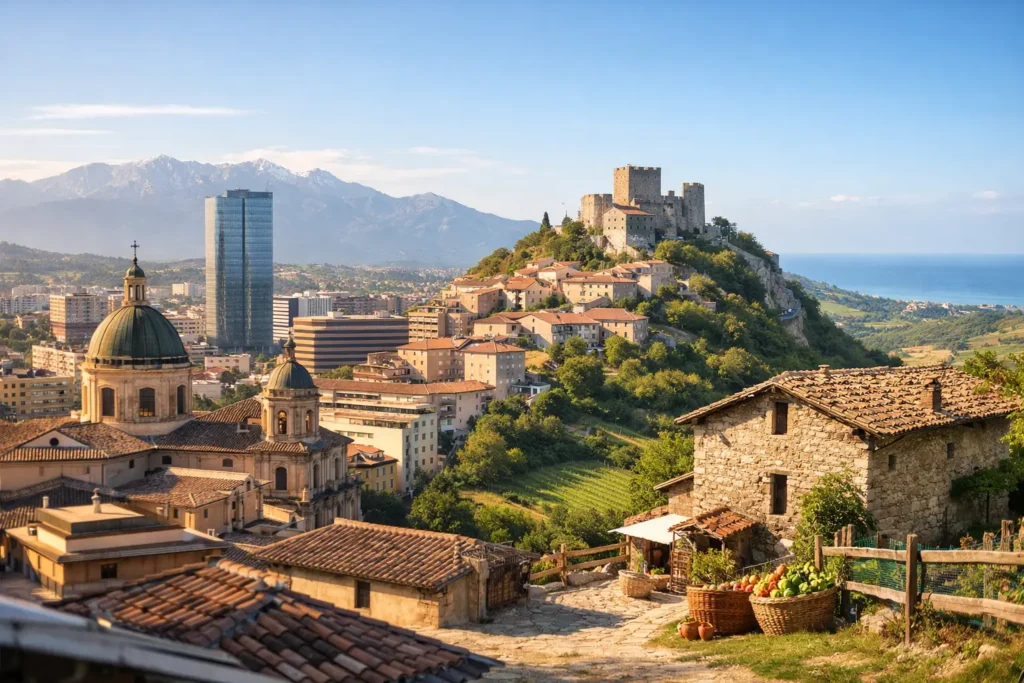
You can love Abruzzo on vacation and still choose the wrong place to live.
That’s usually the real question behind the decision of city or village life in Abruzzo.
Not which option is more beautiful — both are — but which one will actually support your daily routine once the novelty wears off.
When you’re moving from abroad, that difference matters enormously.
The place that feels charming for a weekend can feel isolating in February.
And the town that seems ordinary at first can make everyday life significantly easier.
If you’re trying to picture your future here, it helps to move past the postcard version of Abruzzo and look at how daily life actually works — in both directions.
What Really Changes Between City and Village Life in Abruzzo
The biggest difference isn’t just population size.
It’s friction.
In a city or larger town, more things happen without much planning.
You’re more likely to have nearby grocery stores, pharmacies, cafés, public offices, train access, and year-round services within walking distance or a short drive.
If your Italian is still basic, living somewhere with more infrastructure can make the settling-in period significantly less stressful.
In a village, life often feels more personal, quieter, and more rooted in local rhythms.
That’s exactly what many people are looking for.
But it also means fewer opening hours, fewer transport options, and less margin for last-minute errands.
If you need WiFi installed, a document sorted, or a household issue fixed quickly, the process requires more patience — and often more Italian.
As Italy Chronicles notes, city living provides better amenities and easier day-to-day logistics, while village living offers something harder to quantify: a close-knit community, genuine tranquillity, and a slower pace that many expats are actively seeking.
Neither is universally better.
It depends entirely on what kind of pressure you want less of.
Daily Life: Convenience Versus Calm
For many expats, the first year is shaped by practical tasks more than lifestyle dreams.
You may be arranging housing, setting up utilities, learning where to shop, understanding waste collection, and navigating appointment-based systems that feel unfamiliar.
That’s where city life often has the edge.
Why cities make the first year easier
In well-connected towns like Pescara, Chieti, or Lanciano, you can usually handle more errands in a single day.
You may not need a car for every small task.
If you work remotely, you’re more likely to find stronger and more reliable internet options, the occasional coworking space, and a daily rhythm that’s slightly more flexible.
Public services, banks, post offices, and healthcare facilities are closer and more accessible.
What villages offer that cities can’t
Village life offers something cities in Abruzzo rarely can — real quiet.
Not curated quiet, but actual silence at night, mountain views on ordinary weekdays, and a sense that people still notice each other.
For people leaving high-pressure urban environments, that shift is often the whole point.
Less noise, less traffic, fewer distractions, and a pace of life that genuinely slows down.
The trade-off is that calm often comes with more organisation:
- A quick grocery run may not be quick.
- Public transport may be limited or impractical.
- Shops close in the afternoon and don’t always reopen.
Local schedules don’t bend to your calendar — you adapt to them.
Housing: More Than Just Price
People often assume they should choose a village because it will automatically be cheaper, and sometimes that’s true.
But housing decisions in Abruzzo are not just about price.
They’re about condition, access, heating, layout, and what “livable from day one” actually means in practice.
Village properties: character and caveats
In villages, you may find beautiful older properties with views, outdoor space, and more room for your money.
You may also find homes that need updates, have older systems, or come with practical quirks that are easy to underestimate from abroad.
A place can look wonderfully romantic online and generate a long list of setup issues once you arrive.
As Italian Property Kit’s research into village living points out, success in rural Italy requires understanding that the practical challenges are just as real as the rewards — and that visiting in different seasons, not just summer, tells a very different story.
City and town properties: less charm, more function
In cities and larger towns, housing can be smaller or less picturesque.
But you’ll likely have easier access to more recently renovated apartments, better-serviced buildings, and a walkable day-to-day life.
For many newcomers, especially in the first phase of settling in, that trade is worth making.
You can always move later — with far more knowledge of the region, the language, and what you actually want.
If you’re unsure, it often helps to think in stages.
Your forever home doesn’t have to be your first home.
Community and Belonging Are Not the Same Thing
One of the strongest arguments for village life is community.
And yes, villages in Abruzzo can be genuinely warm.
People may greet you quickly, remember your name, and notice when something’s off.
That kind of human closeness can feel like exactly what you moved here for.
But belonging isn’t automatic — and it’s worth being honest about that.
In a smaller place, local relationships can be deep, but they also take time to build.
If your Italian is still limited, or you’re used to more privacy and independence, the closeness of village life can feel unfamiliar at first.
You may be seen more, asked more questions, and drawn into local patterns before you feel fully ready.
Cities and larger towns can feel more anonymous — but that’s not always a drawback.
Some expats settle better when they have a little breathing room to find their feet.
They can build community gradually, find familiar routines at their own pace, and choose their social circle without feeling instantly visible.
- If you’re naturally outgoing and want a local connection fast, a village may suit you beautifully.
- If you need time to adapt before you feel comfortable, a town or city often makes that transition gentler.
Remote Workers: Be Honest About Your Tolerance
A lot of people moving to Abruzzo picture a peaceful hilltop lifestyle while working online.
Sometimes that works perfectly.
Sometimes it becomes frustrating within weeks.
Remote work changes the city or village question fundamentally — because your home is no longer just where you sleep.
It’s your office, your internet hub, your meeting space, and your source of daily routine.
If the connection is unstable, the house is hard to heat in winter, or you need a long drive every time you want a change of scene, small inconveniences compound into real problems.
This doesn’t mean remote workers should avoid villages.
It means they should choose them carefully, and ask sharper questions before committing:
- How reliable is the internet, really — and what’s the fallback if it goes down?
- What is road access like in winter?
- How far is the nearest place for daily essentials?
- Is the home comfortable year-round, not just in August?
A village can be genuinely wonderful for focused, creative work if the practical setup is right.
Without that setup, life can feel harder rather than better, which is the opposite of why most people make the move.
Different Lifestyles, Different Needs
This is where broad, one-size-fits-all advice tends to fail.
What works well for one type of mover can be exactly wrong for another.
- A retired couple may love a quieter village with outdoor space, slower mornings, and a strong sense of local identity.
- A solo mover may want the balance of a small city or lively town to avoid feeling cut off too soon.
- And anyone trying to navigate the first months of Italian bureaucracy benefits from being closer to the offices, services, and infrastructure that make those tasks more manageable.
There’s also the emotional dimension of relocation that’s easy to underestimate.
Starting over in another country is exciting — and tiring.
When everything is new, even simple tasks take more energy than expected:
Choosing a place that supports your personality and your current bandwidth matters just as much as choosing a beautiful view.
You can read about the most common mistakes people make when moving to Italy — and location choice is consistently near the top of the list.
A Better Question Than “City or Village?”
Instead of asking which lifestyle sounds nicer, ask which one matches your real life — right now, in the first year of a big move:
- Do you want to walk to cafés, shops, and services while you get settled?
- Do you need strong transport links or flexible road access?
- Are you comfortable driving everywhere, or do you want more within reach?
- Do you want privacy or daily local contact?
- Are you ready for a slower system, or would you feel calmer with more convenience close by?
Sometimes the best answer isn’t a city or a village at all — it’s somewhere in between.
A well-connected town with character, a manageable centre, and enough daily infrastructure to make life easier without sacrificing the Abruzzo feeling.
In this region, those middle-ground places are often where newcomers feel most settled — and where the move starts to feel genuinely rewarding rather than just logistically demanding.
That’s also why local guidance matters so much at this stage.
A place can look perfect on a map and still be wrong for your routine, your work setup, or your settling-in needs.
Understanding the pros and cons of different areas before you commit — rather than after — is one of the highest-return investments you can make in the whole relocation process.
If you’re still unsure, that’s completely normal.
You don’t need to have your whole future mapped out before you move.
You just need a place that makes the first chapter feel manageable, supportive, and genuinely livable.
—
Not Sure Which Part of Abruzzo Is Right for You?
This is one of the most common conversations we have with people before their move — and one of the most valuable ones.
The difference between choosing the right location and the almost-right one can shape everything that comes after: how quickly you settle, how manageable daily life feels, and how much you enjoy being here in year one rather than just year three.
At Wanderlust Abruzzo, we help English- and German-speaking expats think through exactly this — with local knowledge, honest advice, and no pressure to choose before you’re ready.
Get in touch today and let’s talk about where you should be looking
—
Frequently Asked Questions
Is it better to live in a city or a village in Abruzzo?
There’s no universal answer — it depends on your lifestyle, Italian language level, work situation, and how much daily convenience matters to you during the settling-in period. Cities and larger towns offer easier logistics and more services. Villages offer space, quiet, and a deeper local connection. Many expats find the sweet spot in well-connected medium-sized towns that offer both character and practicality.
Which towns in Abruzzo are most popular with expats?
Expats tend to cluster around the coastal strip near Pescara and Chieti, as well as inland towns with good road access and established English-speaking communities such as Sulmona, Lanciano, Vasto, and parts of the Casoli and Penne areas. You can read a more detailed breakdown in our guide to where expats actually live in Abruzzo.
Can I work remotely from a village in Abruzzo?
Yes, but it requires careful due diligence before committing. Internet connectivity in rural Abruzzo has improved significantly, but it’s still variable depending on property location and provider coverage. Always test the actual connection at the specific property, not just the coverage map. Fibre availability, signal reliability, and backup options are all worth confirming in advance.
Is village life in Abruzzo isolating for expats?
It can be, especially in the early months, if your Italian is limited and you’re far from other English speakers. The closeness of village life is a real strength once you’re embedded in the community — but it takes time and language to get there. Expats who find village life isolating often say the issue wasn’t the village itself, but the gap between their expectations and the reality of how long a genuine connection takes to build.
Should I rent first before deciding where to buy in Abruzzo?
For most people, yes, especially if you’re still learning the region. Renting first in your shortlisted area gives you a real-life experience of the location across different seasons, before you commit financially. It also gives you time to understand the local property market, identify what you actually need day to day, and make a purchase decision from a much more informed position. That said, the rental market is complicated due to the high amount of summer rentals that exist, which limit the availability of long-term rentals. You can explore the renting vs. buying considerations in Abruzzo in more detail before deciding.



 English
 Deutsch