
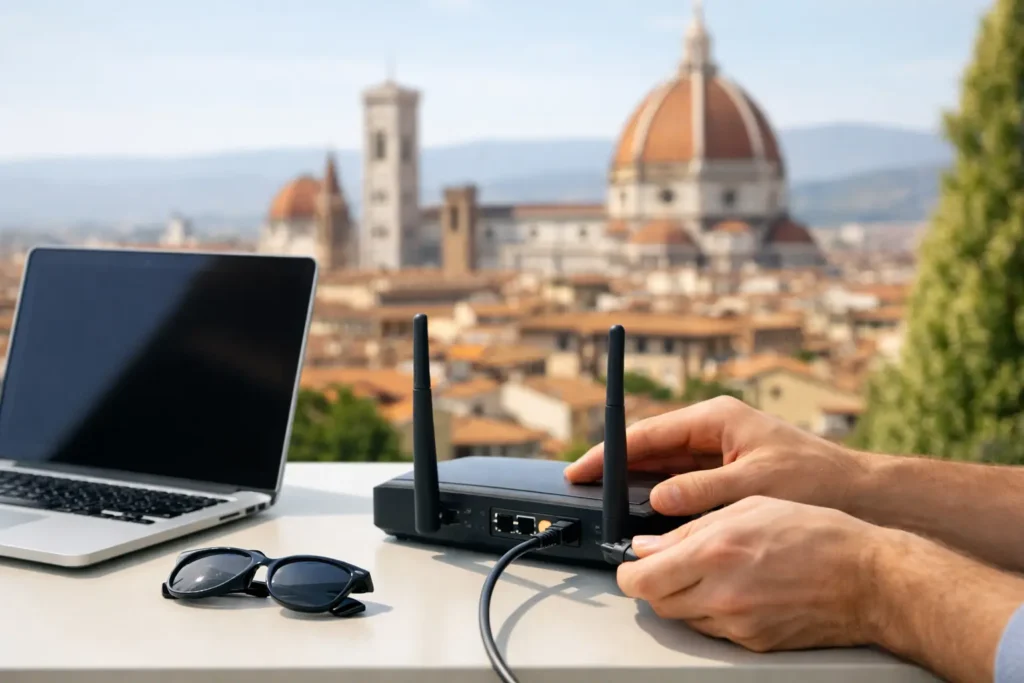
The first week in your new Abruzzo home is a whirlwind.
You can survive a few days without the perfect sofa or even a proper coffee machine.
But you probably cannot survive long without a working internet connection.
Whether it’s for Google Maps, online banking, Zoom calls for work, or simply staying in touch with family, WiFi is the invisible thread that keeps your relocation from feeling like an isolation experiment.
While setting up WiFi in Italy is manageable, it is rarely as “plug-and-play” as expats from the US, UK, or Germany expect.
What catches most newcomers off guard isn’t the technology — it’s the “Administrative Friction”.
Address errors, landlord permissions, and the dreaded Italian-only technician phone call can turn a simple task into a two-week headache.
Coverage is Hyper-Local: Check Your Address, Not the Ad
In Italy, internet providers market “Hyper-Fiber” speeds in broad, glowing terms.
But here is the reality: two apartments on the same street in Pescara can have vastly different speeds. One might have lightning-fast Fiber, while the neighbor is stuck on a shaky copper line from the 90s.
The Rule of Gold: Never choose a package based on a TV ad. Always check coverage by exact address. If you are renting in Abruzzo, ask the landlord or the previous tenant which provider they used. If a line was recently active, your “activation” might be remote and instant. If not, you’re looking at a technician visit.
Comparing the Major Operators in Abruzzo
Choosing an operator depends heavily on whether you are in a coastal city or a mountain village.
- The Big Three (TIM, Vodafone, WindTre): Best for urban centers like Pescara or Chieti. They offer high-speed Fiber (FTTH) packages often bundled with mobile SIMs. TIM is the historical owner of the infrastructure, which sometimes makes them faster for new line installations.
- Fastweb: Known for transparent pricing (fewer hidden “bill surprises”) and excellent 5G-based home internet options in larger towns.
- Eolo: The king of the Abruzzo hills. Eolo uses FWA (Fixed Wireless Access), sending internet via radio waves from a local tower to a small dish on your roof. If you are in a medieval village where cables can’t reach, Eolo is often your best bet for 100Mbps+ speeds.
- Starlink: The ultimate solution for remote rural housing. If you’ve bought a villa in the deep countryside of the Majella, Starlink provides high-speed satellite internet with zero reliance on local Italian infrastructure. It is more expensive (around €29–€40/month plus hardware costs), but it removes the “Technician Trap” entirely as you set it up yourself.
Documents You Need to Get Online
To sign an internet contract, providers will treat you like a resident.
You should have these ready:
- Passport or ID Card: Clear digital copies.
- Codice Fiscale: Your Italian tax code is mandatory. No code, no WiFi.
- Italian Address: Be precise — include the stairwell (scala), floor (piano), and the name on the intercom (citofono).
- Italian Bank Account (IBAN): Most competitive monthly deals require automatic billing (domiciliazione).
The Setup Process: Avoiding the “Technician Trap”
Once you select a plan, the provider will check if they can activate the line remotely.
If they can’t, they will schedule a technician visit.
This is the moment where the Language Trap usually snaps shut.
Technicians often call you 10 minutes before arrival — in fast, technical Italian — to ask for building access.
If you don’t answer or can’t communicate, they often mark the appointment as “failed”, sending you back to the end of the queue.
—
Is it Better to DIY or Get Support?
If you speak intermediate Italian and your apartment is in a modern building in a city, you can likely handle the setup yourself.
However, if you are moving into a rural property, a shared building with an uncooperative administrator, or simply don’t want your first week in Italy to be defined by hold music and technical jargon, support can save your momentum.
At Wanderlust Abruzzo, we act as your “Bilingual Bridge“.
We don’t just find the plan; we handle the technician’s calls, verify the contract fine print (avoiding hidden “exit fees”), and ensure your digital life starts the same day your physical life does.
—
Frequently Asked Questions
How long does it take to get internet in Italy?
Typically, activation takes 7 to 14 business days. If the building already has a Fiber connection and a modem, it can be as fast as 48 hours. However, in rural areas, it can take up to a month if a new line installation is required.
Can I get WiFi in Italy without an Italian bank account?
Some providers, like Iliad or certain prepaid FWA services, allow you to pay via credit card. However, the most competitive plans usually require an Italian IBAN for monthly direct debits.
What is the best internet provider for remote work in Abruzzo?
For stability in cities, Fiber (FTTH) from Fastweb or TIM is ideal. For rural remote work, Starlink is increasingly the preferred choice for expats because it offers high speeds without the typical “rural lag” of older copper lines.
Are there hidden fees in Italian internet contracts?
Yes. Watch out for Costi di Attivazione (activation fees) and Penale per Recesso (early cancellation fees). Many “low-cost” deals require a 24-month commitment.
Do I need the landlord’s permission to install Fiber?
If the building is already wired, no. If the technician needs to drill new holes or run cables through common areas, it is legally required and polite to inform the landlord or building administrator (amministratore) beforehand.


 English
 Deutsch