
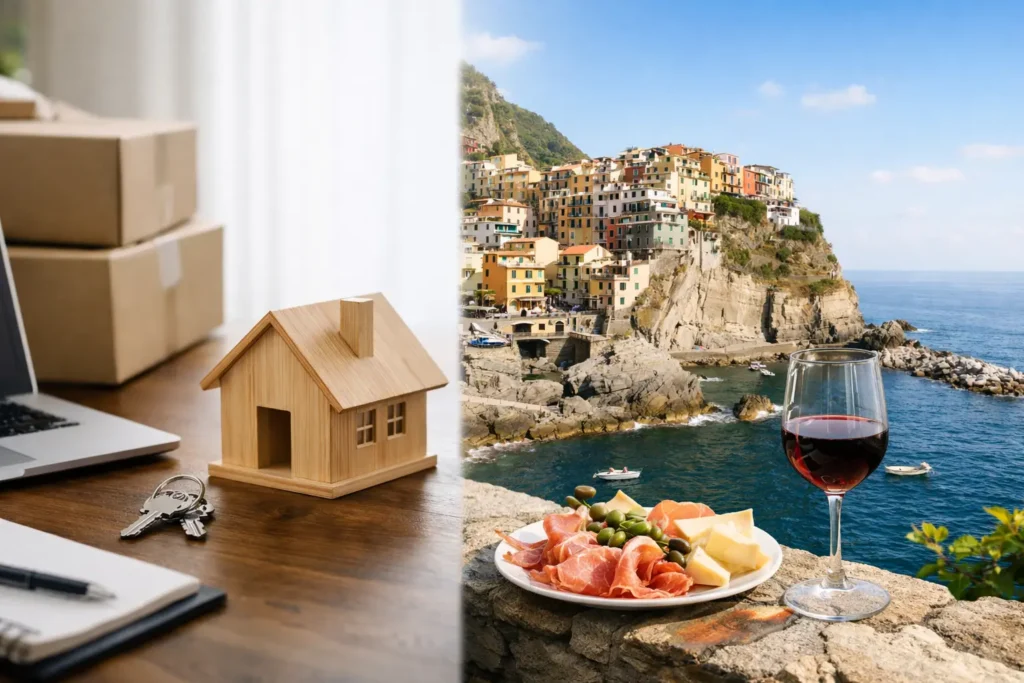
If you are seriously weighing the pros and cons of moving to Italy, you’ve likely moved past the vacation daydream.
You aren’t thinking about the perfect gelato anymore; you’re thinking about registered leases, residency appointments, and why the internet technician hasn’t called you back.
That is the right place to be.
Italy rewards the realist and punishes the unprepared.
For many, the biggest surprise is that both the dream and the struggle are true at the same time.
Italy offers a rhythm of life that feels more human, yet its systems can test your patience to the breaking point.
Whether the move is “worth it” depends entirely on your tolerance for the trade-offs.
The “Pros” of Life in Italy: Why We Stay
1. A Superior Daily Quality of Life
In Italy, beauty is not a luxury; it’s the backdrop of ordinary life.
Whether it’s the morning walk to the bakery or the evening passeggiata in the piazza, life is built around human connection.
In regions like Abruzzo, you get the “Triple Win”: the Adriatic sea, the Apennine mountains, and historic hill towns all within a one-hour drive.
2. Exceptional Cost of Living (Abruzzo Focus)
Italy is not uniformly cheap, but it offers incredible value if you look beyond the “Big Three” (Rome, Florence, Venice).
In Abruzzo, you can find spacious homes for a fraction of the cost of Northern Europe.
This lower “financial floor” allows expats to work less and live more, enjoying world-class wine and food without the “tourist tax”.
3. Accessible and High-Quality Healthcare
Once you are a registered resident, you gain access to the Servizio Sanitario Nazionale (SSN).
While wait times for non-urgent specialists exist, the quality of hospital care is world-class, and the costs are negligible compared to private systems in the US or UK.
4. Generous Tax Incentives for New Residents
Italy is actively courting expats with regimes like the 7% Flat Tax for Pensioners (valid in many Abruzzo comuni) and the Impatriate Workers Regime.
These incentives can dramatically increase your disposable income during your first few years.
5. A Safe, Family-Centric Environment
Italy remains one of the safest countries in Europe.
In the towns of Abruzzo, children still play in the piazzas until dusk, and the elderly are respected pillars of the community.
It is an environment where “slow living” isn’t a trend — it’s the inherited way of life.
The “Cons” of Life in Italy: The Reality Check
1. The “Bureaucracy Trap” is Real
Italian administration is decentralized and paper-heavy.
The rules can change depending on which clerk is behind the desk.
From getting your Codice Fiscale to securing legal residency, expect to be asked for “one more document” just when you think you’re finished.
2. The “Administrative Dark Age” of Setup
Setting up utilities, WiFi, and bank accounts require a sequence of steps that trigger a circular logic.
You need a bank account for WiFi, but the bank wants residency, which sometimes you can’t get without a lease.
This “Setup Gap” is where most relocations feel most overwhelming for “DIY” expats.
3. The Language Trap in High-Stakes Moments
Ordering a coffee in English is easy (unless it’s a Cappuccino after 11 AM).
Negotiating the fine print of an Italian rental contract or explaining a plumbing emergency is not.
In authentic regions like Abruzzo, the “Language Trap” snaps shut in official offices, where English or German are rarely spoken.
4. Slower Professional and Digital Pace
If you come from a high-efficiency culture (Germany, US, UK), the Italian pace can feel like “stagnation”.
Responses to emails can take days, and many businesses still prefer phone calls or in-person visits over digital forms.
If you work on tight deadlines, the “Technician Trap” (waiting for repairs) will test your nerves.
5. Seasonality and “Hidden” Infrastructure Costs
Many expats buy the summer dream and forget the winter reality.
Coastal towns can feel like “ghost towns” in January, and many historic stone homes in the hills are poorly insulated.
If you don’t audit your energy efficiency, your winter heating bills can become a “Hidden Tax”.
Pros vs. Cons: At a Glance
| The Benefit (PRO) | The Trade-off (CON) |
|---|---|
| Piazza Life: Deep social roots and a supportive community. | Limited Privacy: In small Abruzzo villages, everyone knows your business. |
| Authentic Food: Fresh, seasonal ingredients and very affordable dining. | Inconvenient Hours: The pausa pranzo (midday closing) is strictly observed. |
| Geographic Diversity: You can reach the mountains and the sea in the same day. | Car Dependency: Public transport is limited; a car is essential for daily life. |
| Low Property Tax: Owning a home is significantly cheaper than in the US/UK/Germany. | Maintenance Debt: Historic stone houses require constant care and attention. |
| Tax Incentives: Access to the 7% flat tax or Impatriate tax regimes. | Lower Local Wages: The local job market pays much less than Northern Europe. |
—
Is Moving to Italy a Good Idea for You?
If you need everything to be fast, digital, and available in English, Italy will frustrate you.
But if you can tolerate a little inefficiency in exchange for sunsets over vineyards, better daily habits, and a more grounded way of living, Italy is deeply rewarding.
At Wanderlust Abruzzo, we provide the practical local support needed to bridge the gap between the “Pros” and the “Cons”.
We support you in handling the paperwork and the “Language Trap”, so you can focus on the life you moved here to build.
—
Frequently Asked Questions
Is it expensive to move to Italy?
The move itself has high upfront costs — factor in rental deposits, agency fees, and shipping. However, the long-term cost of living in Abruzzo is often 30-50% lower than in major German or American cities.
Can I work remotely in Italy?
Yes! With the new Digital Nomad Visa and the Impatriate Tax Regime, Italy is becoming very friendly to remote workers. However, you must ensure your housing has reliable internet, which can be a challenge in rural areas.
What is the biggest mistake expats make?
Trying to DIY the residency and utility process without knowing the local “order of operations”. Small sequencing errors can lead to months of delays in getting a health card or resident tax rates.
Is Abruzzo a good place for expat families?
Yes. Abruzzo is safe, family-oriented, and offers a great outdoor lifestyle for children. However, be prepared for a “full immersion” experience in local schools, as English-speaking international schools are rare in the region.
Do I need a car to live in Italy?
In the center of Pescara or other major cities, no. In the rest of Abruzzo, yes. Public transport is decent between major hubs, but to manage daily life, groceries, and administrative visits in smaller towns, a car is essential.

 English
 Deutsch