
If you move to Abruzzo, one of the first things you notice is that food here doesn’t feel staged for visitors.
It feels lived in.
More often than not, menus in local restaurants don’t have English translations.
Market stalls don’t lean into the tourist aesthetic.
The food is just what people eat — and have always eaten.
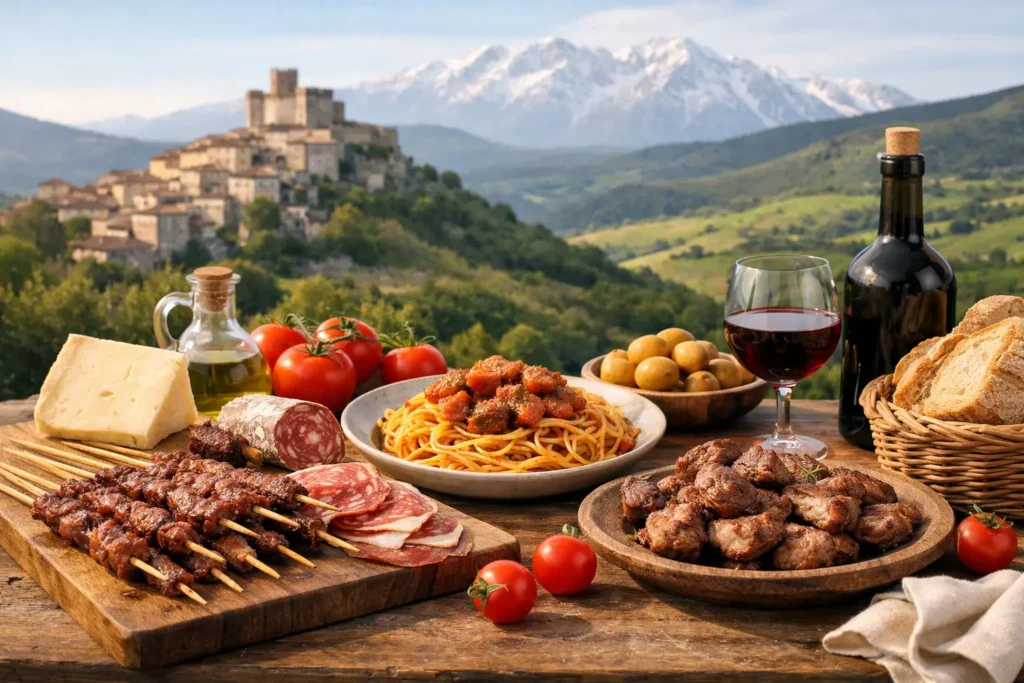
So if you’re asking what food is famous in Abruzzo, the short answer is this: simple, deeply regional dishes built around lamb, pasta, mountain cooking, seafood on the coast, and ingredients people are genuinely proud of.
That matters more than it might seem when you’re settling somewhere new.
Food is often the fastest way to understand local rhythms, local identity, and even local conversation.
In Abruzzo, what lands on the table tells you a lot about the region itself — rugged, generous, practical, and not especially interested in showing off.
Arrosticini: The Dish That Defines the Region
If there’s one food most people associate with Abruzzo, it’s arrosticini.
These are small skewers of lamb — traditionally cut so each piece contains a little fat — cooked over a long, narrow charcoal grill called a fornacella and eaten hot, often in quick succession.
According to Italia.it’s guide to Abruzzo cuisine, arrosticini originated in the pastoral traditions of the Gran Sasso foothills and are now considered the most iconic street food in the region.
They are not fancy — and that is entirely the point.
You’ll see them everywhere:
- casual local gatherings
- village festivals
- restaurants that specialize in traditional food
- roadside stops that exist purely to serve them
The best versions are beautifully simple:
- tender meat
- enough salt
- bread brushed with olive oil on the side
- and a glass of Montepulciano d’Abruzzo
For many newcomers, arrosticini become the dish that makes Abruzzo feel real.
One honest note: if you don’t eat lamb, the region’s most iconic dish won’t be your go-to. That doesn’t mean Abruzzo is a difficult place to eat well — far from it — but the food culture here has deep roots in pastoral traditions, especially inland, and it’s worth knowing that before you arrive.
Pasta in Abruzzo: Its Own Shape, Texture, and Logic
People sometimes arrive in Italy expecting every region to serve the same familiar pasta dishes.
Abruzzo corrects that assumption quickly.
Pasta here has its own character — born partly from the region’s pure mountain spring water, which gave towns like Fara San Martino, in the heart of the Maiella national park, a centuries-old reputation for pasta production (a brand famously known as De Cecco).
Pasta alla chitarra
The most famous is spaghetti alla chitarra — or simply pasta alla chitarra.
It’s made using a wooden frame strung with tight metal wires that resemble guitar strings (chitarra means guitar in Italian), which cut sheets of egg dough into square-edged strands.
As Italy Segreta explains in their food guide, the pasta is traditionally served with a slow-cooked meat sauce — often pork, beef, and lamb combined — or in the Teramo tradition, with pallottine: tiny meatballs in tomato sauce.
The result is a pasta with more bite than standard spaghetti, a texture that holds sauce beautifully, and a shape that tells you this region values substance over fuss.
Scrippelle and timballo
Another local classic is scrippelle — very thin, crêpe-like sheets that can be served in broth (scrippelle ‘mbusse) or layered into a timballo: a baked dish that sits somewhere between lasagne, pasta, a savoury pie, and celebration food.
Timballo varies from family to family, from province to province, which is exactly why it matters.
If you’re relocating rather than visiting for a weekend, this is the kind of dish to pay attention to.
It tends to appear at holidays and larger family gatherings — so understanding it gives you a better feel for home cooking and local traditions than restaurant trends ever will.
Other pasta worth knowing
- Sagne e fagioli — a rustic pasta and bean soup, simple, filling, and very typical of everyday home cooking
- Ceppe — handmade pasta without eggs, often served with wild boar ragù in mountain areas
- Rintrocele — a pasta typical of the Lanciano area, traditionally served with sheep sauce
- Pallotte cacio e ova — not pasta itself, but often served with it: bread, pecorino, and egg shaped into balls and cooked in tomato sauce — a brilliantly economical, deeply satisfying dish
Mountain Cooking: Hearty, Practical, Uncompromising
Abruzzo is often described through its landscapes — mountains, national parks, hill towns, coastline — but those landscapes also explain the cooking.
Inland cuisine is filling, tied to farming and shepherding traditions, and built to sustain people who worked hard outdoors in all seasons.
Lamb appears often.
So do sausages, hearty soups, beans, lentils, preserved meats, and strong cheeses.
There is a real comfort to this food that many expats end up loving, especially those who arrive during the colder months and discover that winter here is more real than the glossy Italy stereotype suggests.
Pecorino and scamorza
Cheese is a genuine pillar of the inland food culture.
Pecorino d’Abruzzo — made from sheep’s milk — varies in texture and flavour depending on how long it’s aged:
- young versions are soft and mild
- aged versions are sharper and crumblier
Scamorza affumicata, a smoked cow’s milk cheese shaped like a small pear, is another local favourite with a distinct smoky flavour that works beautifully grilled or melted.
Saffron from the Navelli plateau
Abruzzo’s most prestigious ingredient is saffron — specifically Zafferano dell’Aquila, grown on the Navelli plateau near L’Aquila and considered among the finest in the world.
It holds a protected denomination of origin (DOP) and is known for its exceptionally long stigmas, intense aroma, and deep colour.
According to The Pasta Project’s guide to Abruzzo, producing just two pounds of L’Aquila saffron requires around 200,000 flowers and 500 hours of work, which explains why it sells for more than €200 an ounce.
It appears in dishes with a lighter hand than some people expect.
Sometimes it colours a pasta sauce or a broth.
Sometimes it elevates a simple dish into something quietly extraordinary.
This is true of a lot of Abruzzo’s food culture: the prestige ingredients exist, but they’re used to enhance rather than to show off.
The Coastal Side: Seafood and the Adriatic Tradition
When people ask what food is famous in Abruzzo, they often hear about meat first.
That makes sense — but it leaves out a significant part of the picture.
Abruzzo has a long Adriatic coastline, and seafood is just as essential to the regional table as lamb and pasta.
Brodetto alla vastese
The best-known coastal dish is brodetto — a rich fish soup made from the day’s catch, cooked in tomato and broth and served in an earthenware pot.
The brodetto alla vastese version, from the Vasto area, is the most famous.
Each coastal town tends to have its own interpretation, which is one of the pleasures of eating along the Adriatic coast.
Scapece alla vastese
Another coastal classic is scapece alla vastese: fish (typically dogfish or similar) marinated with white vinegar and saffron, an ancient dish that bridges the sea and inland traditions through that characteristic Abruzzo use of zafferano.
Trabocchi: where the coast meets the table
Along the Costa dei Trabocchi — the stretch of Adriatic coastline known for its ancient wooden fishing structures — many of these traditional fishing platforms (trabocchi) have been converted into restaurants.
Eating on a trabocco is genuinely unlike anywhere else:
- the food is simple and fresh
- the setting is extraordinary
- the whole experience feels very specifically Abruzzese
If you’re deciding where to live in the region, the coast-versus-inland food distinction matters more than most people expect.
Daily eating life near the sea is very different from daily eating life in a hill town — and both are excellent, just in completely different ways.
Drinks, Wine, and the Table
No guide to Abruzzo food is complete without mentioning Montepulciano d’Abruzzo — the region’s most famous red wine, made from the Montepulciano grape and known for its deep colour, full body, and reasonable price even at good quality levels.
Trebbiano d’Abruzzo is the main white.
Neither is hard to find — they’re the default house wine in most local restaurants.
Local olive oil is also worth seeking out.
Abruzzo produces some excellent extra virgin olive oil, often sold directly from farms or at local markets.
If you’re settling into the region, building a relationship with a local market or producer early on is one of the best things you can do — both for the quality and for the connection it creates.
Confetti: Not What English Speakers Expect
One small but important note for newcomers: confetti in Italy are not paper party pieces.
In Abruzzo — especially around Sulmona — confetti are sugar-coated almonds, and they’re a major regional specialty with a history stretching back centuries.
They’re tied to celebrations, gifts, and weddings, presented in elaborate displays and given as favours at every significant occasion.
The confetti di Sulmona are considered among the finest in Italy, and today they come in all colours, flavours, and decorative forms.
If you only know the English meaning of the word, this will be a confusing moment the first time you encounter it — and also a perfect example of how food in Abruzzo is woven into language, ritual, and identity, not just meals.
Why Abruzzo’s Food Matters When You’re Moving Here
This might sound bigger than a simple question about regional dishes — but food genuinely makes settling in easier.
When you know what locals are proud of, menus become less intimidating.
Market shopping gets easier.
Restaurant choices feel less random.
You start recognising what’s seasonal, what’s celebratory, and what’s just Tuesday.
For many expats, that shift reduces a lot of the low-level stress of starting over in an unfamiliar place.
Instead of feeling like a visitor decoding everything from scratch, you start to understand the patterns — why one area is known for lamb, why another talks about fish, why a particular pasta shape appears at every family gathering.
That kind of understanding helps you belong, even before you feel fluent in Italian.
And in Abruzzo, where food is one of the most natural ways to connect with local life, it’s worth taking seriously as part of how you build a sense of home here.
What to Try First
If you want a practical starting point as a newcomer:
- eat arrosticini once
- pasta alla chitarra with ragù once
- and a seafood dish near the coast once
Add pecorino, local olive oil, and something with saffron when the opportunity comes.
Not every famous dish will become a favourite — and that’s completely normal.
Some people fall hard for the grilled lamb culture immediately.
Others end up more attached to the pasta, the coastal fish, or the pastries and sweets.
Living somewhere is different from sampling it on a long weekend.
You don’t need to love every specialty to understand what it says about the place.
What food is famous in Abruzzo?
Food with a strong sense of place.
Food that comes from mountains, coast, farms, and family tables — and that doesn’t need much explanation once you taste it.
If you’re building a life here, let yourself learn the region one meal at a time.
It’s one of the gentlest ways to feel at home.
—
Moving to Abruzzo and Want to Know What Daily Life Really Looks Like?
Food is one piece of the picture — but settling in well means understanding the whole region: where to live, how services work, what to expect from bureaucracy, and where to find the kind of local support that makes the difference between a stressful start and a smooth one.
At Wanderlust Abruzzo, we help English- and German-speaking expats navigate every practical stage of moving to Abruzzo — from finding a home and registering your residency to understanding local rhythms and feeling genuinely settled.
If you’re in the planning stage or already on your way, we’d love to help.
Get in touch today and let’s talk about your move to Abruzzo
—
Frequently Asked Questions
What is the most famous dish in Abruzzo?
Arrosticini — small lamb skewers cooked over a charcoal grill — are the dish most closely associated with Abruzzo. They’re eaten everywhere, from village festivals to local restaurants, and have become something of a symbol for the region’s pastoral food culture. Pasta alla chitarra (square-cut egg pasta) runs a very close second.
Is Abruzzo’s food mostly meat-based?
Inland, yes — the food culture has deep roots in pastoral and farming traditions, with lamb, sausages, preserved meats, and hearty pulses and soups all featuring prominently. On the coast, seafood is equally central: fish soups like brodetto, grilled fish, and shellfish dishes are everyday staples. The region genuinely offers both traditions, and where you live in Abruzzo shapes which one becomes part of your daily life.
What is pasta alla chitarra?
It’s a fresh egg pasta unique to Abruzzo, made by pressing sheets of dough through a wooden frame strung with metal wires — the chitarra (Italian for guitar). The wires cut the dough into square-edged strands with more bite and texture than standard spaghetti. It’s traditionally served with a hearty meat ragù or, in the Teramo tradition, with tiny meatballs (pallottine) in tomato sauce.
What is Abruzzo saffron and why is it famous?
Zafferano dell’Aquila is grown on the Navelli plateau near L’Aquila and is widely considered among the finest saffrons in the world. It holds a protected denomination of origin (DOP), is known for its exceptionally intense aroma and deep colour, and is used in a range of local dishes. It’s also sometimes called the “red gold of Abruzzo” — which gives you a sense of how seriously the region takes it.
What are confetti di Sulmona?
They’re sugar-coated almonds produced in and around Sulmona, one of Abruzzo’s most distinctive and celebrated food specialties. Nothing to do with the paper kind — in Italy, confetti always refers to these almond sweets, which are given at weddings, baptisms, and other celebrations and displayed in elaborate decorative arrangements. Sulmona’s version is considered among the finest in Italy and has been produced there for several centuries.


 English
 Deutsch