
The first time you realise trash collection in Italy isn’t as simple as “take the bin out on Tuesday”, it usually happens at the worst possible moment — after a big grocery run, with cardboard piling up, food scraps in hand, and no idea which bag goes where.
If you’re newly settling in, this guide is here to make one small but surprisingly stressful part of daily life feel much easier.
For many expats, waste collection is one of those systems nobody explains properly.
Your rental contract may mention bins.
A neighbour may gesture vaguely toward the street.
The town may have a calendar posted somewhere online — in Italian, and only if you know what to search for.
Then there’s the deeper layer: in Abruzzo, the rules can vary not just by province, but by comune, building type, and collection provider.
The smartest approach is to accept from the start that there’s no single regional rulebook.
There’s a clear pattern — and this guide will walk you through it — but the local details always come first.
How Waste Collection Works in Abruzzo
Italy takes waste separation seriously.
According to Portale Italy’s recycling guide, most Italian comuni use a door-to-door system called porta a porta, where each waste type is collected on specific days and must be placed outside at the right time — typically the evening before or early morning of collection day.
Putting out the wrong type on the wrong day means it simply won’t be collected.
Residents receive (or collect) a set of bins or bags, separate waste into the required categories, and follow a weekly schedule.
Some larger apartment buildings use a shared bin system (cassonetti) instead, often now requiring an electronic key linked to your TARI account.
Some towns use a combination of both.
The five core waste categories
As Italy Handbook explains in their full recycling guide, the standard categories across Italy are:
- Organico (organic waste) — food scraps, fruit and vegetable peels, coffee grounds, tea bags, small amounts of compostable kitchen waste
- Carta e cartone (paper and cardboard) — clean paper, dry boxes, packaging not contaminated with food
- Plastica e metalli (plastic and metal) — bottles, containers, cans, tins, lightweight packaging. Some comuni ask for these separately, others combine them — check locally
- Vetro (glass) — bottles and jars
- Indifferenziato (non-recyclable/residual waste) — whatever can’t go into the above categories
What catches people out
The grey areas are where mistakes happen:
- Greasy pizza boxes → indifferenziato, not paper (food contamination)
- Plastic bags → indifferenziato, not plastic (wrong type)
- Batteries, medicines, electronics → dedicated drop-off points, never in regular bins
- Bulky items (furniture, appliances) → booked pickup or local drop-off centre (isola ecologica)
- Broken glass or ceramics → indifferenziato, not vetro
If you’re unsure about a specific item, the Junker app gives you an instant answer — just search or scan the product and it tells you exactly which bin it goes in, based on your specific comune.
The Junker App: Your Best Practical Tool
This is genuinely the most useful thing you can download when you move to a new town in Abruzzo.
Junker is a free Italian app that works for hundreds of comuni across Abruzzo and the rest of Italy.
Select your town, and it gives you:
- Your local waste collection calendar — which category is collected on which day
- A searchable and scannable product database — scan a barcode or search an item and it tells you exactly which bin it belongs in, for your specific comune
- Notifications and reminders so you don’t miss collection days
For expats navigating a system that’s partly in Italian and highly localised, Junker removes a surprising amount of daily uncertainty.
It’s available on iOS and Android, entirely free, and directly addresses the two main questions newcomers ask:
- when does my bin go out?
- and where does this item go?
Bin Colours: A Starting Point, Not a Guarantee
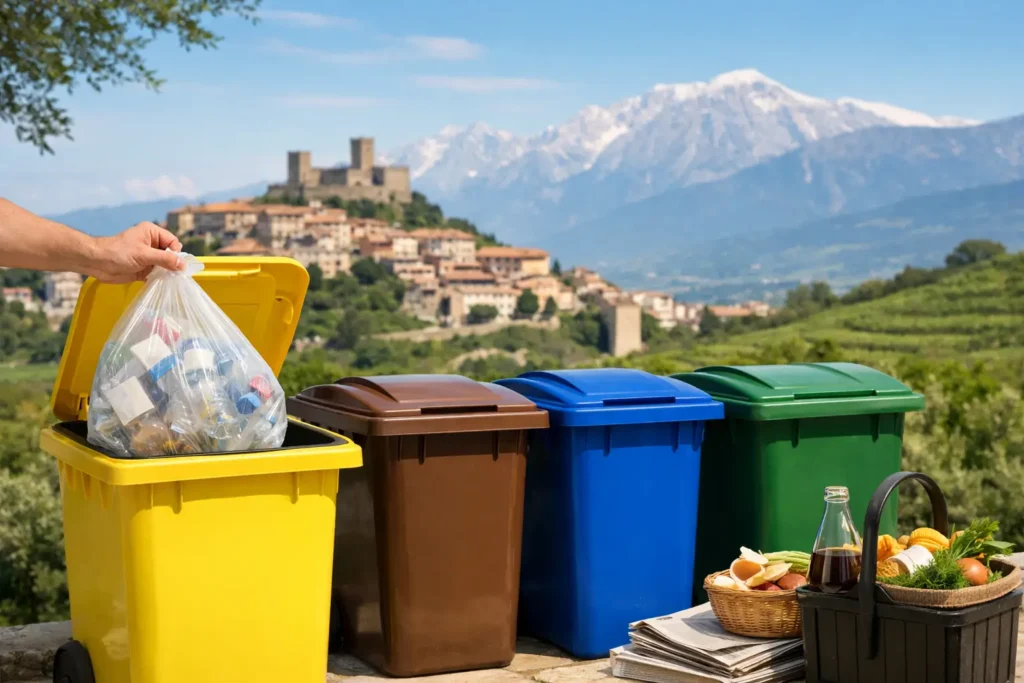
In many towns, bins are colour-coded — but the colours are not nationally standardised, so treat this as a rough guide only:
- Brown — organic waste (organico)
- Blue — paper and cardboard (carta e cartone)
- Yellow — plastic and/or metal (plastica e metalli)
- Green — glass (vetro)
- Grey or black — non-recyclable waste (indifferenziato)
Your actual bins may differ.
When in doubt, check your local calendar, ask a neighbour directly, or look it up in Junker.
Getting Your Bins in the First Place
If your property uses porta a porta, you may need to collect or request your bins rather than finding them already in place.
- In some towns, landlords leave them for new tenants.
- In others, you need to contact the local collection provider or the ufficio tributi at the Comune.
This is where expats often lose unnecessary time — assuming the bins should already be there, while the landlord assumes you know how to request them.
As a practical tip, ask this specific question rather than a general one: “Which bins are mine, where are they kept, and which evenings do I put them outside?”
Specific questions get specific answers.
Broad ones often get a shrug.
For apartment buildings, also ask:
- whether bins are private or shared
- where they’re stored
- whether collection is at your door or at a central point in the building or street
Understanding TARI: The Waste Tax
TARI (Tassa sui Rifiuti) is the municipal waste tax that funds collection services.
As a resident, you’re responsible for registering and paying it — and if you’re renting, it’s generally your responsibility as the occupant unless your contract says otherwise.
According to Taxing.it’s guide to TARI, the amount is calculated based on:
- The floor area of your home (in square metres — only habitable surface)
- The number of occupants
Rates vary significantly between comuni.
A reasonable estimate for a standard apartment is roughly €150–€400 per year, billed in two to four instalments annually.
After your registration and payment in the first year, you will get a letter with the F24 (state payment notice) every year in your mailbox.
You can usually pay it at the post office (physically or digitally), or digitally through your Italian banking app using the F24 payments feature, if your bank has it.
When and how to register
You should register for TARI when you set up your residency — either at the ufficio tributi within your Comune or through the local waste management provider.
Wanderlust Abruzzo can help with TARI registration as part of the settling-in process, which is often one of those small tasks that gets forgotten until the bill arrives unexpectedly.
⚠️ TARI rates, registration procedures, and collection schedules vary by comune and change annually. Always verify current requirements with your local municipality.
Schedules and Timing: Why They Matter More Than You Think
In most porta a porta areas, bins are not supposed to sit on the street all week.
You put them out on the designated evening or early morning, collection happens, and then the bins come back in.
Missing the schedule creates a fast domino effect — especially in summer, when an uncollected organic bin becomes a smell problem within 24 hours.
Most local calendars are organised by day of the week and waste category.
Some change seasonally, especially in coastal areas where population swings in summer affect collection frequency.
A simple settling-in habit: save your current schedule somewhere visible from day one.
Put it on the fridge, set it up in Junker with notifications, or keep a photo on your phone.
Don’t rely on memory in your first few weeks.
Waste Collection in Houses vs. Apartments
In a standalone house, the system is usually straightforward — your bins and collection point are clearly yours.
In an apartment building, there can be more grey areas.
Some buildings have shared rules set by an amministratore di condominio (building manager).
Some have informal habits built up by residents over time.
Others are technically on porta a porta but operate practically as a group.
The most useful question to ask during a property viewing — unglamorous but genuinely important — is: “Where does the waste go and how is it organised here?”
You want to know whether bins are private or shared, whether there’s a storage room, and whether you’ll need anything from the Comune to get started.
What to Do If Nobody Has Explained the System
If you’ve moved in and still don’t understand how waste collection works, don’t guess for weeks and hope it resolves itself:
- Start with your landlord or property contact.
- Then ask a neighbour.
- Then download Junker and see if your comune is listed — it probably is.
This is exactly the kind of everyday obstacle that sounds minor from the outside and feels draining from the inside.
When everything is new at once — utility setup, residency paperwork, grocery routines, daily language barriers — even basic household admin can wear you down.
That’s one reason relocation support in Abruzzo often ends up covering much more than just paperwork.
Practical local orientation matters because daily life is built from exactly these kinds of details.
A Simple Way to Get Comfortable Faster
Give yourself one week to map the system in your new town.
Identify your bins, download Junker and confirm your schedule, learn the disposal rules for special items, and watch what your neighbours do.
After that, it usually clicks.
Once you know your local setup, waste collection stops being a source of daily uncertainty and becomes just another rhythm of living in Abruzzo — alongside market mornings, coffee at the bar, and figuring out which bakery has the best bread.
And if you’re still in those early weeks when every small task feels bigger than it should, be patient with yourself.
Settling in isn’t only about the big milestones.
Sometimes feeling at home starts with knowing exactly which bin to put out tonight.
—
Settling Into Abruzzo and Want the Practical Setup Handled Properly?
Waste collection is one small piece of the picture — but there are quite a few of these small pieces, and they add up.
Getting them all sorted quickly, without the guesswork, is exactly what hands-on local support is for.
At Wanderlust Abruzzo, we help English- and German-speaking expats navigate every practical step of settling in — from residency and utilities to TARI registration and daily orientation.
Personal, bilingual, and on the ground.
Get in touch today and let’s talk about your move to Abruzzo
—
Frequently Asked Questions
How does waste collection work in Abruzzo?
Most towns in Abruzzo use a door-to-door porta a porta system, where you separate waste into categories — organic, paper, plastic and metal, glass, and non-recyclable — and put the correct bin or bag outside on designated days. Schedules and exact rules vary by comune. The free Junker app (junkerapp.it) is the most practical way to find your local schedule and learn exactly where each item goes.
What is TARI and do I have to pay it?
TARI is Italy’s annual municipal waste tax, calculated based on your home’s floor area and number of occupants. If you’re a resident or long-term tenant, yes — you’re responsible for registering and paying it. Rates vary by comune but typically run between €150–€400 per year for a standard apartment, billed in instalments. You register at the local ufficio tributi or through your waste management provider, usually at the same time as your residency registration.
What is the Junker app, and is it useful for expats in Abruzzo?
Junker (junkerapp.it) is a free app that gives you your local waste collection calendar and lets you search or scan any item to find out which bin it goes in — based on your specific comune. It’s available in Italian but easy to navigate, and it covers hundreds of towns across Abruzzo. It’s one of the first things worth downloading when you move to a new area.
What bin do I use for pizza boxes and other tricky items?
Greasy pizza boxes go in indifferenziato (non-recyclable), not paper — food contamination disqualifies them. Plastic bags also go in indifferenziato, not plastica. Batteries, medicines, and electronics need dedicated drop-off points. Broken glass or ceramics go in indifferenziato, not vetro. When in doubt, check Junker for your specific comune‘s rules.
What happens if I put the wrong waste out or miss a collection day?
Wrong waste on the wrong day simply won’t be collected — the collection team will leave it. Repeated or deliberate mis-sorting can result in fines, and in smaller towns, inspectors do occasionally check bag contents for compliance. Missing a collection isn’t dramatic, but organic waste in summer becomes a hygiene issue quickly. Setting up calendar reminders through Junker is the simplest way to avoid missing days.



 English
 Deutsch