
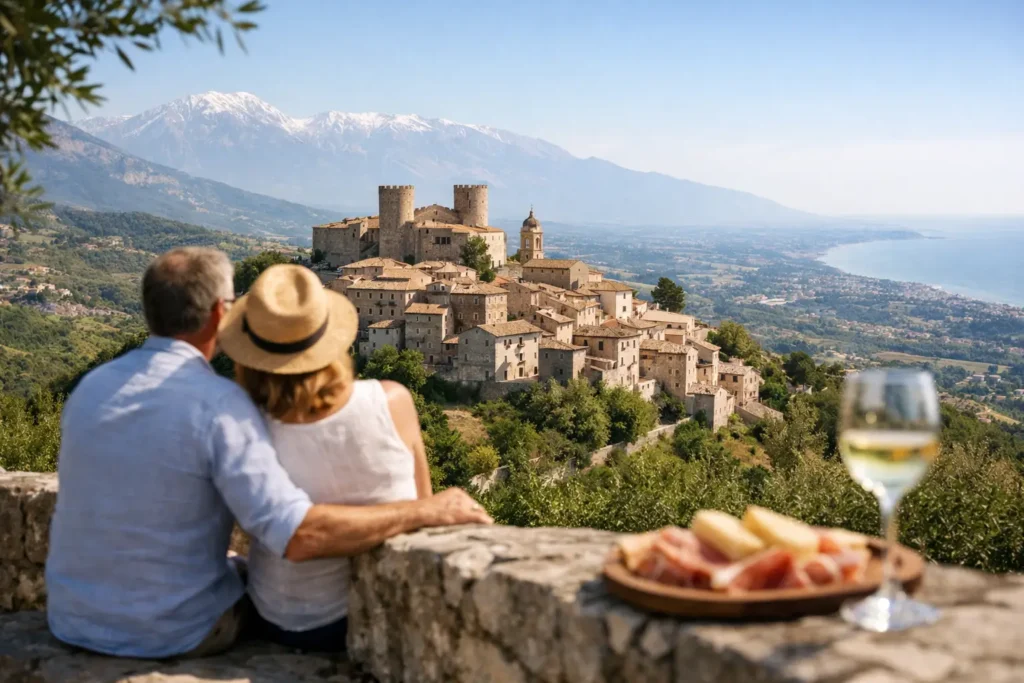
This question came up directly in an expat Facebook group recently, and it’s a genuinely interesting one to answer properly — because the honest answer isn’t one single reason.
It’s five or six factors converging at the same time, and understanding them tells you a lot about whether Abruzzo is right for you, too.
Abruzzo Is No Longer “Undiscovered” — and the Numbers Prove It
For years, Abruzzo was the Italy that even well-travelled people hadn’t heard of.
That’s changing fast, and it’s measurable.
According to Impatria’s 2026 guide to living in Abruzzo, based on an analysis of international property portal data, Abruzzo now ranks second nationally for foreign buyer interest, accounting for 19.1% of all property listings viewed by overseas purchasers — ahead of Umbria, Puglia, and Liguria, and trailing only Tuscany.
That’s a genuinely remarkable shift for a region that, a decade ago, barely registered on most people’s radar.
The Price Gap Is Simply Too Large to Ignore
This is the most obvious driver, and it’s worth putting real numbers next to it.
As of mid-2026, the average asking price for residential property in Abruzzo sits around €1,345–€1,391 per square metre, according to Green Acres’ regional market analysis and Immobiliare.it’s market data.
Compare that to Tuscany, where prices in popular areas regularly exceed €3,000–€4,000/m², or to the national average of around €2,188/m² reported by Global Property Guide.
In some inland Abruzzo provinces like L’Aquila, prices can drop to €700–€1,000/m² — genuinely some of the lowest in mainland Italy.
Rental prices follow the same pattern: a one-bedroom apartment in Abruzzo typically starts from €450–€600 per month, and houses with gardens in smaller villages can be found under €900/month.
Obviously, if you look at places like Pescara or other coastal cities, the prices will be much higher than that.
For people comparing Abruzzo against Tuscany, Puglia, or the Amalfi Coast, the calculation is increasingly simple: similar landscape variety, similar food culture, similar authenticity — at roughly a third of the price.
You can explore this comparison more directly in our guide to Abruzzo versus Tuscany for expat life.
The 7% Flat Tax Is Quietly Reshaping Who Retires Here
This is one of the most underappreciated drivers of Abruzzo’s growth, and it specifically targets retirees.
Foreign pensioners who move their tax residency to a qualifying small Italian municipality — and Abruzzo has a significant number of these — can apply for a flat 7% tax rate on all foreign-sourced income for up to ten years, instead of Italy’s standard progressive tax rates.
This single policy has made Abruzzo a genuine contender against Portugal, Spain, and other long-favoured retirement destinations for foreign pensioners, particularly those with substantial pension or investment income who would otherwise pay considerably more tax elsewhere.
Combined with the region’s lower cost of living and relaxed pace, it’s not surprising that retirees are one of the fastest-growing groups choosing Abruzzo.
A trend reflected in our growing number of conversations with people exploring retirement in Italy and weighing up where in the country actually makes financial sense.
Remote Work Made Location a Genuine Choice, Not a Compromise
Before remote work became normalised, choosing where to live was largely dictated by where the job was.
That constraint has loosened dramatically — and Abruzzo benefits directly from it.
Italy’s Digital Nomad Visa, launched in 2024 and still uncapped in 2026, allows non-EU remote workers and freelancers to legally live in Italy while working for foreign clients or employers, provided they meet an income threshold (currently €28,000/year) and have at least six months of remote work experience, according to Global Citizen Solutions’ 2026 guide.
EU citizens, of course, don’t need any visa at all to make the same move.
For remote workers no longer tied to Milan, Rome, or a home country, the question shifted from “where’s the job?” to “where do I actually want to live?”.
The answer for people seeking quality of life over status-symbol addresses has been a region like Abruzzo: sea, mountains, lower costs, and a community that isn’t yet saturated with other remote workers competing for the same cafés and coworking spots.
You can read more about what working remotely from Abruzzo actually involves in terms of practical setup.
L’Aquila’s Capital of Culture Status Is Putting the Region on the Map
2026 is a genuinely significant year for Abruzzo’s visibility: L’Aquila has been named Italy’s Capital of Culture for 2026.
This designation brings national funding, cultural programming, infrastructure investment, and — critically — international media attention that the region has rarely received before.
Capital of Culture status has historically had a measurable effect on tourism, property interest, and general awareness for the cities that receive it.
For Abruzzo, a region that has spent decades quietly under the radar, this is likely to accelerate a trend that was already building.
A Real, Growing Word-of-Mouth Network
This is harder to quantify but genuinely significant: Abruzzo now has active, organised English-speaking expat communities in multiple towns — Pescara, Sulmona, Lanciano, Casoli, and others — something that simply didn’t exist at scale a decade ago.
Once a region reaches a certain density of expats who are happy, settled, and willing to talk about their experience in Facebook groups, blogs, and casual conversations with friends back home, growth tends to compound.
People considering a move research more confidently when they can find real testimony from people already living the answer, rather than relying purely on guides and forecasts.
This is part of why direct conversations in groups like Abruzzo Expats on Facebook have become such a valuable resource for people in the research phase.
The Lifestyle Case Was Always There — Now People Are Finding It
Strip away the financial and bureaucratic incentives, and there’s a simpler explanation underneath all of this: Abruzzo offers something genuinely rare in Europe, and the people choosing it aren’t just running spreadsheets.
They’re responding to how the place actually feels to live in.
The weather is genuinely good, without the extremes
Abruzzo’s dual climate means mild, sunny winters on the coast and real seasonal variety inland — without the punishing summer heat that increasingly defines parts of southern Spain or inland Puglia.
You can be on the beach in July and skiing in the mountains by December, often within the same hour-long drive.
For people moving from grey, wet climates in northern Europe or the UK, that combination of reliable sunshine and genuine seasons is a major, often underestimated, draw.
You can read more about what the weather is actually like in Abruzzo throughout the year.
The food culture is the real thing, not a tourist version of it
Abruzzo’s cuisine — arrosticini, pasta alla chitarra, saffron from the Navelli plateau, fresh seafood along the Adriatic — is rustic, regional, and largely untouched by the kind of tourist-facing reinvention that’s happened in more famous food regions.
People who move here for the food aren’t disappointed once they arrive, because the food culture wasn’t built for visitors in the first place.
It’s simply how people already eat.
You can explore what food is famous in Abruzzo and why it matters so much to daily life here.
Slow living is a genuine, daily reality — not a marketing phrase
A lot of regions market themselves around “slow living” without much behind it.
In Abruzzo, the slower pace is structural: shops still close midday, lunch is still a real event, and daily rhythms follow the seasons rather than a constant push for efficiency.
For people exhausted by the pace of life in bigger cities or more competitive economies, that shift is often the single biggest quality-of-life change they experience after moving.
We’ve written in detail about what slow living in Abruzzo actually feels like, including the genuine trade-offs involved.
The people are warm, in a way that surprises newcomers
Community here still functions in a visible, human way — people greet each other in the street, remember faces, and notice when someone new arrives.
It takes a little time and consistency to be fully welcomed in, but once that happens, the connections tend to be sincere rather than transactional.
This is one of the most mentioned reasons people give for staying long-term, beyond the initial financial or lifestyle calculations.
You can read more about what the people of Abruzzo are actually like and what to expect from social integration here.
For years, this lifestyle case existed quietly, known mostly to people who’d visited by chance or had family ties to the region.
What’s changed is visibility — through property data, tax incentives, remote work flexibility, cultural recognition, and a critical mass of expats willing to share their experience.
The lifestyle argument for Abruzzo isn’t new.
What’s new is that more people are finally hearing it.
Is This Growth a Good Thing or a Warning Sign?
It’s worth asking honestly, because rapid growth in any region eventually changes it.
So far, the data suggests Abruzzo’s growth remains measured rather than explosive — property price increases have been modest (around 0.4–2.7% annually depending on the source and period), nothing close to the speculative surges seen in parts of Tuscany or coastal Puglia.
Italy as a whole has also introduced measures aimed at moderating foreign-driven price pressure in the most affected areas, suggesting authorities are watching this trend nationally.
For now, Abruzzo remains genuinely good value relative to what it offers — but as with any region experiencing rising interest, earlier movers tend to get better prices and more choice than those who wait.
If you’re seriously considering the move, that’s worth factoring into your timeline.
—
Curious Whether Abruzzo Is the Right Move for You?
Understanding why so many people are choosing Abruzzo is one thing.
Understanding whether it’s the right choice for your specific situation — your budget, your lifestyle, your work, your stage of life — is a more personal question, and one we’re happy to help you think through.
At Wanderlust Abruzzo, we help English- and German-speaking expats navigate every stage of the move, from understanding the real numbers behind the headlines to finding the right town and settling in with confidence.
Get in touch today and let’s talk about your move to Abruzzo
—
Frequently Asked Questions
Why is Abruzzo becoming so popular with expats?
A combination of factors: significantly lower property and living costs than better-known Italian regions, a 7% flat tax incentive for foreign retirees, the rise of remote work and Italy’s Digital Nomad Visa removing location constraints, L’Aquila’s 2026 Capital of Culture designation bringing new visibility, and a growing, vocal community of expats already settled in the region sharing positive experiences.
Is Abruzzo cheaper than Tuscany or Puglia for expats?
Yes, considerably. Average property prices in Abruzzo sit around €1,300–€1,400/m², compared to €3,000-plus in popular parts of Tuscany. Rental prices follow the same pattern, with one-bedroom apartments available from roughly €450–€600/month in Abruzzo (not in the main or coastal cities, though). The lifestyle and landscape variety are comparable, which is exactly why more people are discovering the value gap.
What is the 7% flat tax for retirees in Abruzzo?
It’s a tax incentive available to foreign pensioners who move their tax residency to a qualifying small Italian municipality, including many towns in Abruzzo. It allows a flat 7% tax rate on foreign-sourced income (rather than Italy’s standard progressive rates) for up to ten years. It’s one of the more significant financial incentives drawing retirees to the region specifically.
Can remote workers legally move to Abruzzo?
Yes. EU citizens can move and work remotely from Abruzzo without a visa. Non-EU citizens can apply for Italy’s Digital Nomad Visa, which requires a minimum annual income (currently €28,000), at least six months of prior remote work experience, and health insurance, among other requirements. The visa is renewable and not currently capped.
Is Abruzzo’s growing popularity likely to push prices up significantly?
Based on current data, growth has been measured rather than explosive — annual price increases have generally been in the low single digits, not the sharp surges seen in some other Italian regions experiencing rapid foreign-buyer interest. That said, regions that gain visibility tend to see prices rise over time, so earlier movers typically have more choice and better value than those who wait several years.


 English
 Deutsch