
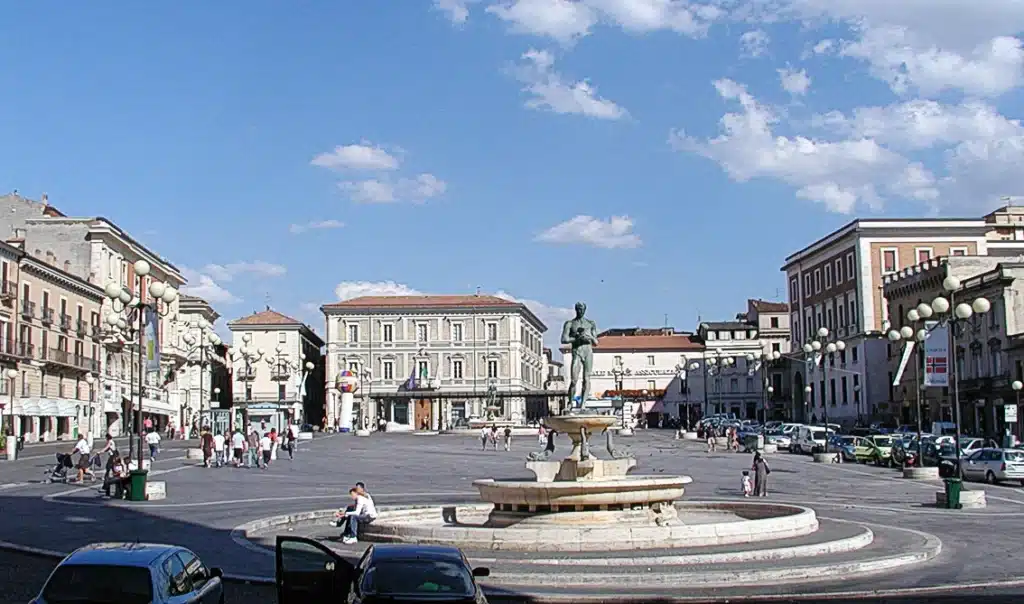
If you’ve been watching Abruzzo from afar, waiting for the “right time” to make your move, 2026 just handed you a deadline.
L’Aquila has been named the Italian Capital of Culture for 2026.
This isn’t just about a few concerts and art exhibits.
For savvy future residents and expats, this title is a high-level signal of infrastructure investment, urban regeneration, and a surge in property demand.
L’Aquila’s journey from earthquake recovery to national cultural protagonist is the ultimate proof of the region’s resilience — and its potential.
Wondering if you should move to L’Aquila, in Abruzzo, as part of your Dolce Vita dream?
Here you have some more info for you to consider why it might be the right choice.
The Renaissance of the Mountain Capital
L’Aquila is currently the site of one of the most ambitious architectural restorations in Europe.
The city center has been reborn as a “smart city” that blends medieval and Baroque heritage with state-of-the-art seismic safety.
Being the Capital of Culture 2026 has accelerated this.
Millions in state funding are currently being poured into transport links, digital connectivity (High-Speed Fiber), and the reopening of historic venues that have been closed for years.
You aren’t just moving to a mountain city; you are moving to a city that is being “polished” for the world stage.
Why This Matters for Your Wallet
In early 2026, we are seeing a distinct shift in the local market.
Property Value: While Abruzzo remains one of the most affordable regions in Italy, L’Aquila is seeing a steady appreciation. Buying now in the L’Aquila province is a strategic “buy low” opportunity before the global spotlight of 2026 drives prices higher.
Infrastructure & Services: As a resident, you benefit from the upgrades meant for tourists. This includes better-maintained roads, improved rail connections to Rome (which is just 90 minutes away), and revitalized public parks and piazzas.
Rental Demand: If you are looking to invest, the demand for high-quality rentals in the city is peaking, driven by cultural professionals and digital nomads drawn to the 2026 events.
A Year of Unprecedented Access
The “Multiverse City” theme of 2026 means culture is being brought into the streets.
For residents, this offers a lifestyle you simply cannot find elsewhere:
Open Palaces (Palazzi Aperti): One Sunday a month, private historic mansions and noble courtyards that are usually closed to the public are opening their doors to residents.
MAXXI L’Aquila: The National Museum of 21st Century Art is hosting world-class exhibitions (including the major Ai Weiwei “Aftershock” show) right in the heart of the city.
The “Halo Effect”: The funding isn’t just for the city center. Nearby villages like Santo Stefano di Sessanio and Rocca Calascio are part of the “network”, meaning better services and more events in the rural areas expats love.
Navigating the 2026 “Rush”
While the cultural vibrancy is a plus, the administrative side of 2026 will be busy.
As more people are drawn to the region, local Comuni (town halls) and the Questura (police headquarters for immigration) will face a higher volume of applications.
If you plan to move to Abruzzo in 2026, you cannot afford to “wing it”.
You need to secure your residency and housing before the peak of the festival season (Spring/Summer 2026).
The “Sequence of Success” is more critical than ever: securing your Codice Fiscale, finding a registered rental, and filing for residency before the summer crowds arrive.
—
Don’t Wait for the Crowd.
The 2026 title is putting L’Aquila on the map for thousands of international buyers.
If you want to secure your piece of the Abruzzo dream while prices are still grounded and bureaucracy is still navigable, you need a plan.
From property scouting in the Aterno Valley to handling your residency in the heart of the city, we ensure your move is as smooth as the local wine.
Start Your Move to Abruzzo Roadmap: Book a Free Strategy Call with us
—
FAQs
Q: Is L’Aquila safe to live in after the 2009 earthquake?
A: Yes. L’Aquila is now one of the most seismically monitored and safely rebuilt cities in the world. Modern reconstruction has focused on “seismic isolation,” meaning historic buildings are now arguably safer than many unrenovated homes in other parts of Italy.
Q: How far is L’Aquila from Rome?
It’s perfectly positioned — roughly 90 minutes from Rome via the A24 motorway and about 1 hour and 15 minutes from the Adriatic coast.
Q: Will the cost of living rise in 2026?
A: While short-term rentals and dining may see a temporary bump, the overall cost of living remains much lower than in northern Italy. However, property prices are expected to appreciate.
Q: Do I need a car in the L’Aquila province?
A: In the city center, walking is easy. However, to enjoy the surrounding national parks and 2026 cultural events in nearby villages, a car is essential.
Q: Is internet access good in the city?
A: Actually, it’s excellent. Because of the modern reconstruction, much of L’Aquila’s historic center is fitted with brand-new high-speed fiber optics, making it a premier destination for remote workers in 2026.

 English
 Deutsch