
If you’ve spent more than five minutes researching your move to Italy, you’ve probably already hit a wall called codice fiscale. But what is it, really — and why does everyone keep telling you to get it first?
Think of it as your administrative DNA.
It’s a 16-character alphanumeric code that the Italian government uses to identify you across every public and private institution in the country.
While it’s technically a tax code, it’s used for almost everything in your daily life that goes well beyond taxes — from signing a lease to getting a SIM card or connecting your WiFi.
This code is the master key that unlocks your life in Italy, and without it, very little else can move forward.
What the Codice Fiscale Actually Is
Codice fiscale is your Italian tax identification code, issued by Italy’s Revenue Agency (Agenzia delle Entrate).
It’s used by public offices, landlords, banks, utility companies, employers, and healthcare providers to identify you in the system.
It is not the same thing as a residence permit, and it is not proof of residency.
Think of it as a personal ID code for administrative and financial life in Italy.
You may need it long before you complete other parts of your move — in fact, for most people relocating to Abruzzo, it’s one of the very first documents to sort out because so many later steps depend on it.
As The Traveler’s 2026 guide to the codice fiscale confirms, the code is far more broadly used in Italian daily administration than equivalent identifiers in most other countries — it’s required for everything from property purchases to phone contracts to gym memberships.
Who Needs a Codice Fiscale?
If you’re moving to Italy, you will need a codice fiscale for:
- Signing a rental contract or buying a property
- Opening an Italian bank account
- Setting up utilities (electricity, gas, water, internet)
- Getting a local SIM card
- Registering with the national health service (SSN) and getting your Italian health card (tessera sanitaria)
- Working or running a business in Italy
- Studying at an Italian institution
- Inheriting property or handling most official legal transactions
Even people who are not yet full-time residents often need one early.
If you’re house hunting in Abruzzo and want to sign a rental contract before your permanent move, a codice fiscale is typically required before the paperwork can proceed.
Children can also have one, so families relocating together often need to apply for more than one at a time.
Decoding the 16 Characters: What Do They Mean?
Unlike tax numbers in many countries, which are purely random, the Italian codice fiscale is built directly from your personal data.
Here’s how the 16 characters are constructed:
- First 3 letters: Derived from your surname (usually the first three consonants)
- Next 3 letters: Derived from your first name
- First 2 numbers: The last two digits of your birth year (e.g. 1985 becomes “85”)
- The 9th character: A letter representing your birth month (January = A, February = B, etc.)
- Next 2 numbers: Your day of birth plus gender. For men, it’s the date (01–31). For women, 40 is added (so a woman born on the 5th would show “45”)
- Next 4 characters: Your place of birth. For those born outside Italy, this starts with “Z” followed by a specific country code (e.g. Z112 for Germany)
- The last letter: A control character used to verify the entire string is correct
One important note: cases of omocodia (two people generating the same code from their data) do occur, and the Agenzia delle Entrate uses internal disambiguation mechanisms to resolve them. This is part of why unofficial online generators are not a substitute for an officially issued code — and why you should always obtain yours through the proper channels.
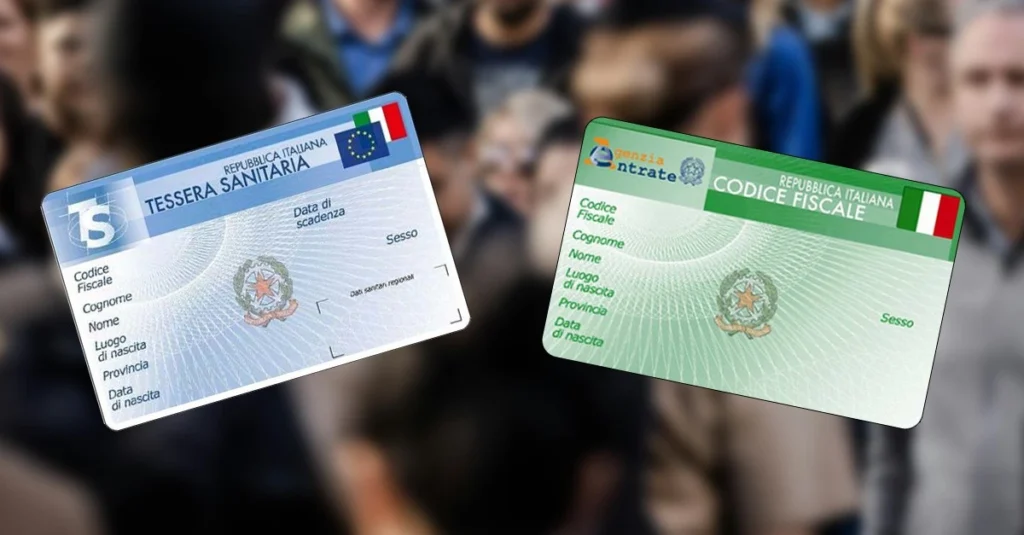
Codice Fiscale vs. Tessera Sanitaria: What’s the Difference?
This is one of the most common points of confusion for expats.
Are the fiscal code (codice fiscale) and the health card (tessera sanitaria) the same thing?
Yes and no.
- Codice Fiscale: The number itself. It never expires. You can have it printed on a plain paper certificate and it’s legally valid for life.
- Tessera Sanitaria: A plastic card with a microchip. It contains your codice fiscale printed on the front, but it also links you to the National Health System (SSN) and functions as a European Health Insurance Card (EHIC) on the reverse side.
The key distinction: you can get a codice fiscale certificate as a non-resident. You can only get the tessera sanitaria plastic card once you’ve officially registered your residency in Italy and completed your ASL health registration.
For your first weeks in Italy, the paper certificate is completely sufficient — you’ll see the plastic card only after residency is confirmed.
Full details on the health card process are in our tessera sanitaria guide.
How to Get Your Codice Fiscale: Three Routes
There are three main ways to apply, and the right one depends on where you are and your timeline.
Route 1: In person at the Agenzia delle Entrate (most reliable and free of charge)
If you’re already in Italy — or visiting before your move — this is the most direct and reliable route.
Go to your nearest Agenzia delle Entrate office, bring your identification documents and a completed Form AA4/8, and in most cases you’ll walk out with your paper certificate the same day.
Offices typically open at 8:30am — but you’ll typically need to set an appointment in advance (arriving early helps avoid queues, particularly in busier offices, even if you have an appointment).
According to Your Business in Italy’s 2026 guide, processing times have improved significantly since 2025 — most applications are now resolved within the same visit if documentation is complete.
The most common cause of delays is a name discrepancy between your passport and other documents, so always double-check consistency before you go.
You will need:
- Valid passport or EU national ID card
- Completed Form AA4/8 (download in advance or collect at the office)
- For non-EU citizens: visa or permesso di soggiorno documentation if available
- Supporting paperwork for your request (rental agreement draft, property documents, or other relevant evidence) — not always required, but helpful if asked
We offer a a bilingual codice fiscale accompaniment service for expats who’d like someone to attend this appointment alongside them in Abruzzo — managing the Italian forms, the queue, and any questions on the day.
Route 2: Through an online delegated partner (paid alternative)
If you’re still outside Italy and need your codice fiscale before arriving, the most practical route is to delegate someone in Italy to apply on your behalf.
This is one of the official legal mechanisms for non-residents — confirmed by multiple Italian consular offices — and it’s exactly what our partner service Italy Law Firms (ILF) provides.
You submit your documents remotely, they handle the application at the Agenzia delle Entrate in Italy, and send you the official certificate digitally.
You handle everything online, but you pay for the service.
Route 3: Through an Italian consulate (limited availability, free of charge)
Italian consulates abroad can technically process codice fiscale requests for non-residents — but only in specific circumstances: primarily where the code is needed for online procedures and the applicant genuinely cannot delegate someone in Italy.
As the Italian Consulate in Boston’s 2025 guidance confirms, non-Italians who don’t reside in Italy are generally directed to use the delegation route instead.
Some consulates still process requests via email; others have stopped entirely.
Check your specific consulate’s current procedure before relying on this option.
What Happens After You Apply
The delivery process has two stages:
- Immediate (the paper certificate): Whether you apply in person at the Agenzia delle Entrate or use a delegation service, you receive an official stamped paper certificate. This is all you need to sign housing contracts, set up utilities, open a bank account, or complete any other administrative task. In the eyes of a landlord or utility provider, this paper is fully valid.
- Delayed (the plastic card): The physical card is sent by post from Rome to your registered Italian address. It typically arrives within 2–6 weeks. If you are not yet a resident in Italy, the plastic card may not be triggered automatically — but the paper certificate is sufficient in the meantime.
Apply early, before your other steps depend on it.
A delayed codice fiscale can postpone a lease, which delays residency registration, which delays utility setup and health registration.
It sits at the front of the essential documents chain — getting it right, early, removes friction from everything that follows.
—
How Wanderlust Abruzzo Can Help
We believe you should spend your first week in Abruzzo looking at sunsets, not queuing at government offices.
At Wanderlust Abruzzo, we help English- and German-speaking expats get their codice fiscale sorted — whether that means accompanying you to the local Agenzia delle Entrate in Abruzzo, or connecting you with our trusted ILF partner for a remote application if you’re still abroad.
We’ll help you work through the paperwork in the right order so you can focus on building the life you came for.
Get in touch today and let’s talk about your move to Abruzzo.
—
Frequently Asked Questions
Do I need to be an Italian citizen to get a codice fiscale?
No. Anyone can apply — tourists, students, workers, retirees, or foreign residents. The codice fiscale is issued to any individual who needs to interact with Italian public or private institutions, regardless of nationality or residency status.
How much does it cost to get a codice fiscale?
The codice fiscale itself is completely free when applied for at the Agenzia delle Entrate or through your Italian Consulate. Associated costs can arise around the process — certified copies, translations, travel to the office, or professional support — but the code itself costs nothing. Some consulates may charge a small administrative fee; if using a delegation service, the service provider’s fee applies.
Can I use an online codice fiscale calculator to generate mine?
No. Online calculators are useful for understanding the structure or checking that a code looks correct — but they have no legal validity. Banks, landlords, and utility companies cross-reference your code with the official Agenzia delle Entrate database. If it hasn’t been officially assigned and registered, it doesn’t exist in the system.
Does the codice fiscale expire?
No. Your codice fiscale is permanent. Even if you leave Italy and return years later, or move between regions, your code remains exactly the same for life.
Do I need to update my code if I move to a different town in Abruzzo?
No. Your codice fiscale is tied to you personally, not to your address. Whether you move from Pescara to Sulmona or to Rome, it stays the same. What changes is your registered address in other systems — but the code itself never needs updating.
What if I lose my paper certificate?
You can request a duplicate at any Agenzia delle Entrate office, or online via the Agenzia delle Entrate portal if you have SPID or CIE credentials. In the meantime, keep a high-quality digital scan stored in your email or cloud — it’s sufficient for most purposes while you wait for a replacement. Our codice fiscale support service can also assist with duplicate requests if needed.
How does the codice fiscale connect to my other relocation steps?
It’s the first domino. You’ll need it before you can sign a rental contract or purchase a property, open a bank account, set up utilities, or register with the health service. Getting it sorted early — ideally before or immediately on arrival — removes friction from every subsequent step. Our full first month in Abruzzo checklist and essential documents guide cover how it fits into the broader sequence.


 English
 Deutsch