
If you’re asking whether it’s worth coming to Abruzzo, suchst du wahrscheinlich nicht nach einer glanzvollen Antwort aus einem Reisekatalog.
You want the honest version.
Not just whether Abruzzo is beautiful — it is — but whether it actually works for real life, especially if you’re thinking about staying longer, buying time before a move, or starting over somewhere that feels more manageable than the usual Italian hotspots.
The short answer is yes, for a lot of people it is.
But Abruzzo is not for everyone — and that is exactly why the right people tend to love it.
Is It Worth Coming to Abruzzo for Real Life, Not Just a Vacation?
Abruzzo appeals to people who feel worn out by noise, cost, crowds, and the constant pace of bigger places.
It offers something many parts of Italy no longer do so easily — room to breathe.
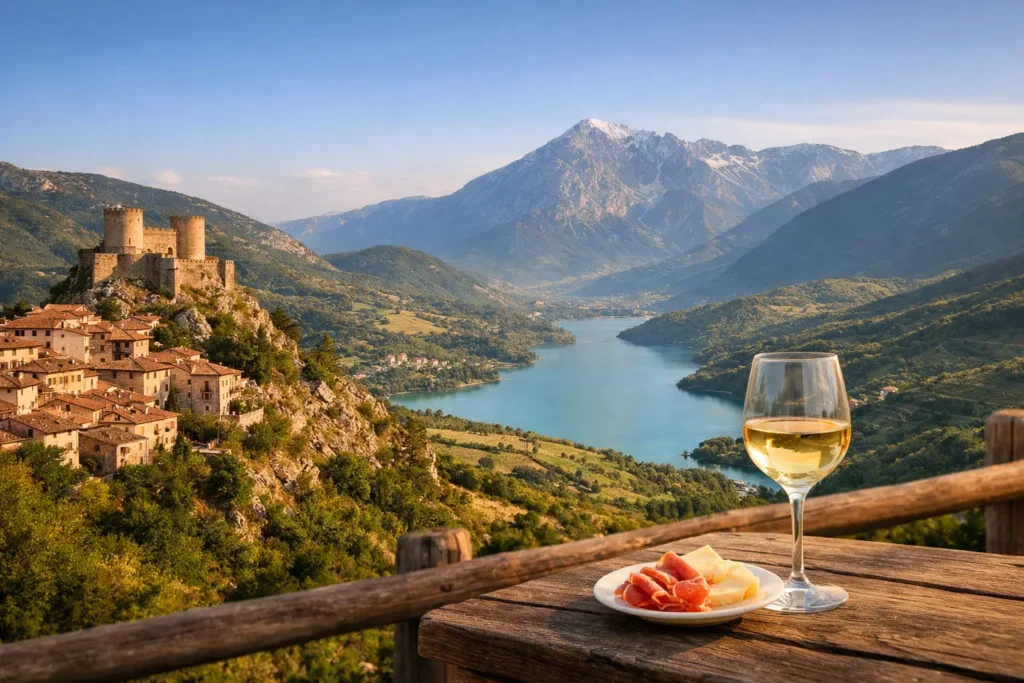
You can be near the sea, close to the mountains, and still find towns where daily life feels grounded rather than performative.
That matters more than it sounds.
A place can be stunning for a week and frustrating after three months.
Abruzzo often works in the opposite direction.
It may not always impress immediately in the same polished way as Toskana or the Amalfi Coast — but it tends to grow on people who value authenticity, affordability, and a more livable rhythm.
Laut dem Auswanderer-Leitfaden 2026 von Impatria, Abruzzo now accounts for 19.1% of all Italian property listings viewed by overseas buyers — placing it second nationally, ahead of Umbria, Puglia, and Liguria.
That’s a measurable shift, and it reflects something real: the word is getting out, even if Abruzzo hasn’t yet lost the quality that made it worth discovering in the first place.
If your dream is aperitivo in a picture-perfect piazza packed with international energy every night, you may find parts of Abruzzo too quiet.
If your dream is a practical, beautiful base where you can build a calmer life, the region starts to make a lot of sense.
What Makes Abruzzo So Appealing?
Landscape variety you can actually use
Abruzzo gives you a rare mix of coastline, hills, mountain villages, and national parks in a relatively compact region.
You can spend the morning by the Adriatic and be in a completely different setting within an hour.
For anyone craving nature as part of daily life rather than an occasional weekend plan, that’s a real advantage — and it’s the kind of thing that makes a long-term move here feel genuinely richer over time, not just on Instagram.
Cost of living that makes sense
While prices vary by area, Abruzzo is still noticeably more affordable than the places most people first think of when they imagine Italy.
Rent from €450–600/month for a one-bedroom, an average property price around €1,361/m², and everyday costs that compare well to most of northern Europe or the US.
That doesn’t mean every listing is a bargain or every process is simple — but your money generally stretches further here than almost anywhere else in central Italy.
Die 7 % Pauschalsteuer für Rentner
Many of Abruzzo’s most livable towns fall under the 30,000-resident threshold for Italiens 7%-Pauschalsteuer für ausländische Rentner, which applies a flat 7% rate on all foreign-sourced income for up to 10 years.
For retirees with substantial pension or investment income, this single incentive makes Abruzzo financially more attractive than Portugal, Spanien, or most of northern Europe’s alternatives.
It’s one of the most underreported reasons people are choosing this region right now.
Authentic local life, not a performance of it
In Abruzzo many towns are still shaped around residents rather than tourism.
- Shops close for lunch.
- People know their neighbours.
- Seasonal food still feels genuinely seasonal.
That can be deeply comforting if what you want is immersion rather than spectacle.
As many long-term expats here describe it: the things that are hardest to explain about Abruzzo are also the things that make it hardest to leave.
A softer landing than the obvious destinations
Abruzzo can give you a softer relocation entry.
You’re not competing in the same frantic housing and bureaucracy environment you’d face in Rome, Milan, or Florence.
Things can still be slow and confusing — this is Italy, after all — but the pressure is often lower and the community feel is stronger, especially once you find your feet.
What Real People Who’ve Made the Move Say
One of the most useful things you can do before deciding is to hear from people already living the answer.
The Abruzzo Expats Facebook group — which we’ve referenced throughout our blog for its genuine, region-specific knowledge — has active members across the region who answer exactly these questions with specificity and honesty.
It’s not a marketing channel; it’s real people discussing real daily life.
The Life in Abruzzo community (called “Abruzzo Expat Community”) is another excellent resource: an English-language group with over 7,000 members from across the world, ranging from people who live and work here full-time to those who’ve retired here, have holiday homes, or are still in the research phase.
It’s a broad, warm community, and the depth of experience across those members — across towns, seasons, and situations — is hard to find anywhere else.
Both groups are worth joining early, well before any decision is made.
The questions people ask, and the answers they get, give you a calibration that no guide can fully replicate.
The Trade-Offs Are Real
You’ll almost certainly need a car
Public transportation in Abruzzo is workable in well-connected coastal towns and functional in larger centres like Pescara.
In village and rural areas, it’s often inadequate for everyday life.
What looks peaceful on a map can feel genuinely isolating if you’re relying on buses, especially outside peak season or in smaller inland communities.
If you dislike driving, be honest with yourself early — choose your location accordingly or plan around it.
Language matters more than in more touristy parts of Italy
In Abruzzo you can’t rely on English for long in many everyday situations.
People are generally kind and patient, but everyday tasks — property searches, utility setup, Wohnsitzunterlagen, conversations with offices or providers — become significantly easier with at least basic Italian or someone local to help.
This isn’t a barrier to moving here, but it’s worth accounting for honestly.
Pace is a feature and a frustration
- Processes can take longer than expected.
- Replies may not come quickly.
- Clear information isn’t always handed to you in one neat step.
If you need everything fast, digital, and predictable, Abruzzo will test your patience.
If you’ve made a conscious decision to slow down, you may find that same quality surprisingly restful once you’ve adjusted.
Is It Worth Coming to Abruzzo If You Want to Move There?
For many future expats, this is the real question.
Yes, it can absolutely be worth it — especially if your priorities are lifestyle, affordability, and a stronger connection to place.
But moving here successfully depends on expectations.
Abruzzo is easier to love when you’re not trying to force it to behave like London, Berlin, Toronto, or Sydney.
A good move here is usually built on practical groundwork — not just choosing a pretty town, but asking the less romantic questions:
- How close is the nearest train station?
- Will you need a car every day?
- Are there year-round services?
- Does the town still feel alive in winter?
- Is the house actually move-in ready, or does “good condition” mean something different locally?
This is where many people either gain confidence or lose it.
On a short visit, everything can seem charming.
During a relocation, the details matter more.
The right area for one person might feel completely wrong for another.
A seaside town may suit someone who wants convenience and activity, while a hill town may be perfect for someone who values quiet and views but is ready for more self-sufficiency.
Who Tends to Be Happiest in Abruzzo?
People who settle well here are usually not chasing status.
They’re looking for substance:
- They often want a slower pace, but not complete isolation.
- They care about food, landscape, and quality of life more than trendiness.
- They’re comfortable with a place that feels local first.
- They can appreciate that some of the best parts of Abruzzo are not loudly marketed.
Remote-Workern often do well, especially if they choose their location carefully and make sure internet setup is realistic before committing.
Ruheständlern und angehenden Ruheständlern are often drawn to the balance of cost, climate, and livability — and the tax incentives sweeten the case considerably.
Familien can find excellent value too, particularly if outdoor space and a calmer environment matter more than big-city convenience.
People who struggle most are often:
- those expecting instant integration without effort
- those who romanticise rural Italy without thinking through everyday logistics
There’s a significant difference between loving a stone farmhouse on Instagram and managing deliveries, appointments, utilities, and weekly errands in a place where little happens in English.
So, Is It Worth Coming to Abruzzo?
If you want a polished version of Italy designed around visitors, maybe not.
If you want a region that still feels real, generous, and surprisingly livable, then yes — it very well might be.
Abruzzo rewards a certain mindset.
- Come here for space, not spectacle.
- For long-term quality of life, not constant entertainment.
- For mountain air, beach days, lower costs, and towns where daily routines still matter.
Come because you want a life with more texture and less noise.
And come with open eyes.
There will be trade-offs.
- Some systems will frustrate you.
- Some places will feel too quiet.
- Some tasks will be harder than they should be.
But for the right person, those aren’t deal-breakers.
They’re simply part of exchanging one kind of stress for another that feels far more worthwhile.
If Abruzzo keeps pulling at you, pay attention to that.
The best place to live isn’t always the one that photographs best.
Manchmal it’s the one where you can actually breathe, settle, and imagine yourself staying.
—
Thinking About Coming to Abruzzo — and Want to Make the Most of It?
Whether you’re visiting to test the water or already planning a move, having someone local who can answer your real questions — about areas, housing, paperwork, and daily life — makes the whole process feel less like guesswork.
Bei Wanderlust Abruzzo, we help English- and German-speaking expats make informed, confident decisions about relocating to Abruzzo — from the first visit to being fully settled.
Persönlich, zweisprachig und direkt vor Ort.
Nimm noch heute Kontakt mit uns auf und lass uns über deinen Umzug nach Abruzzo sprechen
—
Häufig gestellte Fragen (FAQs)
Ist Abruzzo ein guter Ort zum Leben für Auswanderer?
For the right person, genuinely yes. Abruzzo offers a meaningfully lower cost of living than most of Italy and most of northern Europe, a high quality of natural and daily life, a 7% flat tax incentive for foreign retirees in qualifying towns, and an authenticity that more famous Italian regions have largely lost. The practical challenges — Italian bureaucracy, language barriers, car dependency in many areas — are real but manageable with preparation and ist Unterstützung vor Ort.
What are the biggest drawbacks of living in Abruzzo?
The most consistent ones are: needing a car in most areas outside the main coastal towns, limited English in everyday settings (which makes basic Italian or local support genuinely useful), and the adjustment to a slower, less predictable administrative pace. Some coastal areas are also noticeably quieter outside summer. None of these are insurmountable — but they’re worth knowing in advance rather than discovering after you’ve moved.
Is Abruzzo better for retirees or remote workers?
Both groups tend to do well, for different reasons. Retirees benefit from the cost of living, climate, pace, and the 7% flat tax incentive available in many qualifying towns. Remote workers benefit from the lifestyle and lower costs, provided they choose a well-connected location and verify internet quality at their specific address before committing. Families also do well when outdoor space, a calmer environment, and affordability matter more than big-city convenience.
Where can I find honest first-hand accounts from expats already living in Abruzzo?
Two Facebook communities are particularly worth joining: the Abruzzo Expats group (active, region-specific, candid discussions about daily life) and die Community Life in Abruzzo (7,000+ members, broad perspective across towns and situations, from people who’ve retired here to those still researching). Both are free to join and give you the kind of granular, honest, town-by-town insight that no blog post can fully replicate.
How do I know if Abruzzo is the right fit for me specifically?
The most useful test: visit outside summer (October to April is ideal) and spend time in the specific towns you’re considering — not just the obvious tourist spots. Notice whether the area feels lived-in when it’s not performing for visitors. Talk to people who already live there. Be honest about your car confidence, your language comfort, and how much quiet you genuinely want. If you’re still drawn to it after that, it’s probably the right fit.


 English
 Deutsch