
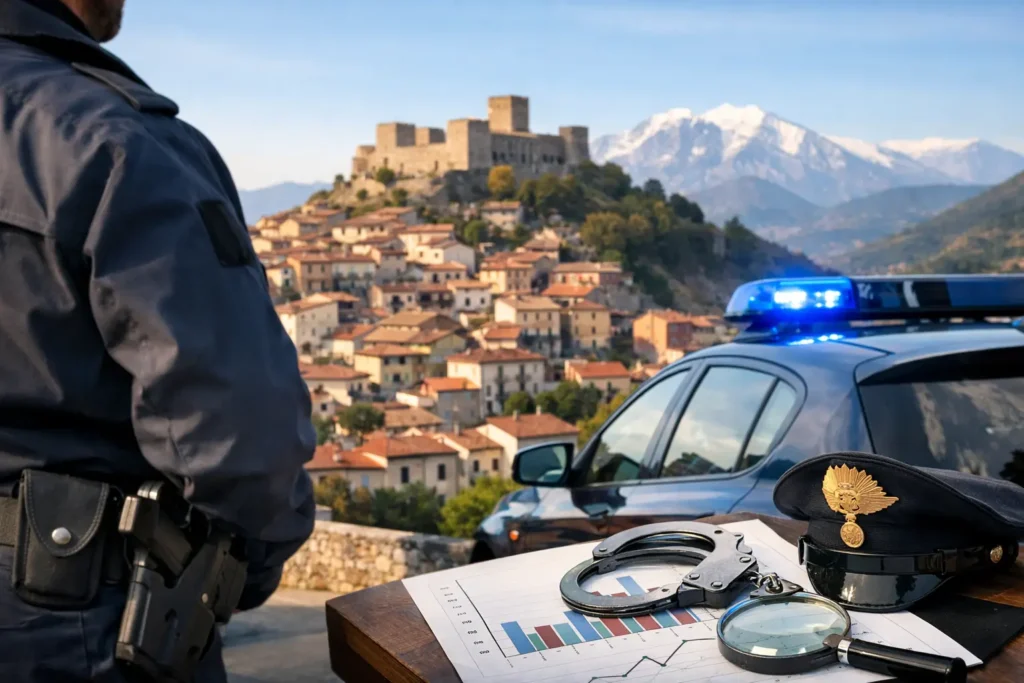
If you’re planning a move and keep asking what the crime rate in Abruzzo (Italy) is, you’re asking exactly the right question.
Beautiful scenery, lower living costs, and charming towns matter — but feeling safe where you live matters just as much.
Most people considering Abruzzo aren’t looking for dramatic statistics or crime-drama comparisons.
They want to know what daily life actually feels like: whether they can walk home comfortably, how cautious they really need to be, and whether the region will feel calm or constantly alert.
The honest answer is that Abruzzo is generally considered one of the safer regions in Italy, particularly compared with larger metropolitan areas.
That doesn’t mean crime is nonexistent, and it doesn’t mean every town has the same experience.
But for most expats and lifestyle movers, the reality on the ground feels calmer, slower, and significantly less stressful than in bigger Italian cities.
Crime by Province: The Numbers That Actually Matter
When people search for crime rates, they often expect one clean number.
Real life is less tidy — and in a region as geographically varied as Abruzzo, the differences between provinces are genuinely meaningful.
Laut the Quality of Life study published by Life in Abruzzo, which compares 107 Italian provinces across 90 indicators, including crime, the four Abruzzo provinces break down as follows:
- L’Aquila — 2,748 offences per 100,000 residents. The lowest crime rate in the region, and well below the national average of 3,430.
- Chieti — 2,821 offences per 100,000 residents. Safe and stable, the best-performing coastal province.
- Teramo — sits between Chieti and Pescara in safety terms, having slipped in overall quality-of-life rankings in recent years.
- Pescara — 3,690 offences per 100,000 residents, above the national average. Theft, car crime, and drug-related offences are the most commonly reported issues.
For context, according to ISTAT data published via Statista, Milan recorded around 7,100 felonies per 100,000 inhabitants in 2023, with Rome and Florence following at approximately 6,000.
Abruzzo’s worst-performing province sits at less than half Milan’s rate.
That is a meaningful difference for anyone calibrating their expectations.
⚠️ A note on statistics: crime data is reported differently across sources, time periods, and offence types. The figures above offer a useful frame of reference, but local conditions within a province vary considerably. Use them as a starting point, not a definitive verdict on any specific town or neighbourhood.
Safety Depends on Where and How You Live
Abruzzo is not one single living experience, and crime statistics at province level only tell part of the story.
Pescara and larger urban centres
In Pescara, you get the trade-off that comes with city life.
More services, transport connections, and expat-friendly conveniences — but also more foot traffic, more anonymity, and more opportunity for the petty theft that tends to be most common in busier areas.
Theft from cars, bags left visible, and distraction-based theft around train stations and crowded summer spots are the main things to stay aware of.
None of this makes Pescara unsafe — it simply means applying the same kind of ordinary urban alertness you’d use in any European city.
Mid-sized towns and residential areas
Many newcomers find the balance here genuinely appealing.
You still have access to daily essentials and good services, but life tends to feel more visible and community-based.
Neighbours notice who belongs.
Routines are familiar.
That social visibility is a quiet form of protection that’s hard to quantify but easy to feel.
Small villages and rural properties
Serious street crime may feel very rare in smaller villages — but that doesn’t automatically mean zero risk.
A home that sits empty for long periods, or that clearly looks unoccupied during winter months, can attract opportunistic burglary.
Rural life can feel wonderfully peaceful, and for most people it is — but peace works best when paired with practical home security measures.
The Risks That Matter Most for Expats
For someone relocating from abroad, the main concerns tend to be much more practical than dramatic headlines might suggest.
Petty theft
This is the most relevant day-to-day risk, especially in busier areas or during summer when coastal towns draw more visitors:
- Bags left visible in cars
- phones placed casually on café tables
- wallets carried loosely in crowded settings
All those situations create easy opportunities.
Simple habits — keeping valuables out of sight and staying aware in busy transport areas — go a long way.
Property crime
If you’re renting or buying, it’s worth paying attention to building entry systems, shutters, locks, outdoor lighting, and whether the home is occupied year-round by neighbours.
A charming countryside property may look perfect in photos, but if it sits isolated and empty for months at a time, your risk calculation changes.
This is especially worth thinking through for rural or renovation properties that may not be in daily use during the first phase of ownership.
Vulnerability to confusion and scams
This one surprises people, but it’s worth being honest about.
Feeling safe in a new country isn’t only about avoiding theft.
Es geht auch darum, not being in situations where you’re vulnerable because you don’t yet understand how things work.
Foreigners dealing with housing searches, utility setup, and bureaucratic appointments can be more exposed to confusion, pressure, or misinformation — less dramatic than street crime, but potentially more costly.
Jemanden zweisprachige Unterstützung during the first months specifically reduces this type of vulnerability.
How Abruzzo Compares With the Rest of Italy
One of the consistent reasons Abruzzo appeals to international movers is that it offers a gentler version of Italian daily life.
Compared with major cities such as Rome, Milan, or Naples, most of Abruzzo feels less intense — less crowding, less traffic pressure, and fewer of the petty crime concerns associated with heavy tourism and large urban populations.
The national picture is worth keeping in mind, too.
Overall reported crime in Italy has risen slightly in the post-pandemic period, with a 1.7% increase nationally year-on-year, according to Il Sole 24 Ore data reported by The Week in Italy.
Even within this trend, Abruzzo’s lower-crime provinces remain well below the national average — and significantly below the major northern and central urban centres that dominate Italy’s crime statistics.
The useful takeaway:
- If your benchmark is a major European city, Abruzzo will feel calmer and easier.
- If your benchmark is a very quiet suburb in northern Europe, some parts of Italy may still require a little more awareness than you’re used to — but nothing that should deter a thoughtful move.
What Daily Life Usually Feels Like for Newcomers
Numbers only tell part of the story.
Many expats describe Abruzzo as a place where they feel more relaxed in everyday life:
- They walk more.
- They recognise faces.
- They know their local shop owners by name.
- They spend less time navigating anonymous, high-pressure urban environments.
That local familiarity matters.
In many communities, there’s a stronger sense of who’s around and what’s normal.
For newcomers, that can be deeply reassuring once you’re settled.
At the same time, your first months can feel more uncertain simply because you’re still learning the language, local habits, and how practical systems work.
That’s not a safety risk in the criminal sense, but it’s worth acknowledging as part of the settling-in experience.
This is also why choosing the right neighbourhood and getting grounded local insight matters.
Understanding which streets feel different after dark, where to park safely, and how to recognise a situation that feels off — local knowledge closes these gaps quickly.
Du kannst hier noch mehr darüber lesen, what the first months of settling in actually look like and how to navigate them with more confidence.
Practical Precautions Without Living in Fear
The goal isn’t to arrive suspicious of everything.
It’s to arrive with realistic expectations and sensible habits.
When viewing or renting a property
Pay attention to the area at different times of day, not just on a sunny morning viewing.
Ask whether the building has secure entry, whether neighbours live there year-round, and how parking works at night.
If you’re considering a rural property, think carefully about shutters, outdoor lighting, and how often the home will be left empty.
In daily life
Keep valuables out of sight in the car.
Stay aware in crowded transport areas.
Take your time with paperwork, contracts, or deposits when you don’t fully understand what’s being asked.
Most problems newcomers run into are preventable with a bit of local guidance and a slower decision-making pace, which is exactly the kind of local pace Abruzzo tends to encourage anyway.
If you’re thinking about retiring to Abruzzo, safety in the broader sense — good street lighting, reliable neighbours, walkable amenities, and proximity to healthcare — matters just as much as headline crime statistics.
These quality-of-life factors shape how safe daily life genuinely feels, far more than any single number.
Should Crime Concerns Stop You From Moving to Abruzzo?
For most people, no.
If you’re asking about the crime rate in Abruzzo because you’re trying to avoid a risky move, the region is unlikely to raise major red flags.
Abruzzo genuinely has a reputation for being safe and livable, especially in the ways that matter most to people building a new daily routine.
The honest answer is that no region is crime-free, and no relocation decision should be based on postcards alone.
But Abruzzo — and particularly its inland and southern provinces — consistently performs well below the Italian national average on crime, and far below the major urban centres that dominate Italy’s statistics.
The real difference in quality of experience comes from choosing your location carefully and getting the right support early, before small uncertainties become bigger stress points.
The safest place for you may not be the quietest dot on a map.
It may be the town where you can manage daily life confidently, understand your surroundings, and feel connected rather than isolated.
Starting over in another country always comes with questions, and safety should absolutely be one of them.
But in Abruzzo, the answer is usually more reassuring than people expect — and with the right town, the right home, and a bit of grounded local insight, daily life here can feel not only manageable, but genuinely calm.
—
Thinking About Safety as Part of Your Move to Abruzzo?
Choosing the right location is one of the most important decisions in the whole relocation process — and safety is a completely legitimate part of that conversation.
We talk about this with almost every person we support.
At Wanderlust Abruzzo, we help English- and German-speaking expats understand not just the numbers, but what different areas actually feel like to live in — from the most walkable coastal towns to quieter inland villages.
If you want an honest, on-the-ground perspective before you commit to a location, we’re here.
Get in touch today and let’s talk about finding the right place for you
—
Häufig gestellte Fragen (FAQs)
Ist Abruzzo sicher für Auswanderer?
Generally, yes. Abruzzo is considered one of the safer regions in Italy, with most of its provinces sitting well below the national average for reported crime. The main risks for expats are practical rather than dramatic: petty theft in busier areas, property crime for homes left unoccupied, and the vulnerability that comes from navigating unfamiliar systems without local language or knowledge. These are manageable with sensible habits and good local support.
Which province in Abruzzo has the lowest crime rate?
L’Aquila has the lowest crime rate in Abruzzo, at around 2,748 offences per 100,000 residents — significantly below the Italian national average of approximately 3,430. Chieti is the next safest province at around 2,821 offences per 100,000 residents. Pescara, as the most urban province, has the highest rate in the region at 3,690 — still well below major Italian cities like Milan or Rome.
Is Pescara safe to live in?
Yes, for the most part. Pescara is the most urban part of Abruzzo, and like any city, it has higher levels of petty theft and car crime than smaller towns. That said, its crime rate remains below the Italian national average, and the overwhelming majority of residents and expats experience it as a comfortable, livable city. Normal urban awareness — keeping valuables secure and being alert in busy areas — is all that’s typically needed.
What is the most common type of crime in Abruzzo?
Petty theft — including theft from cars, bag snatching in crowded areas, and opportunistic burglary of unoccupied properties — is the most commonly reported type of crime in Abruzzo. Serious violent crime is rare by both Italian and European standards. The provinces with the highest reported crime (Pescara) cite theft and car crime as the dominant categories.
How can I stay safe while settling into Abruzzo?
The most effective things are also the most straightforward: choose your neighbourhood with care, get to know your area at different times of day before committing, keep valuables out of sight in public and in your car, and don’t rush decisions around housing, paperwork, or payments when you don’t yet fully understand the process. Having local, bilingual support during the first months specifically reduces the kind of confusion-based vulnerability that affects many new arrivals.



 English
 Deutsch