Ask ten people what’s a fun fact about Abruzzo, and you might get ten different answers.
That’s part of the charm.
This region is full of the kind of details that make people stop mid-scroll and say, wait, really?
But if you’re thinking about moving here, the best fun facts aren’t just trivia.
They tell you something real about what everyday life in Abruzzo actually feels like — and why so many people who discover it start picturing themselves here.
Abruzzo Is Often Called the Greenest Region in Europe
This is the one that surprises people most — and it deserves proper context, not just repetition.
Over a third of Abruzzo’s territory is protected as national parks and reserves, making it the region with the highest proportion of protected land in Italy, and one of the highest in all of Europe.
The three national parks are:
- Gran Sasso e Monti della Laga
- Maiella
- Abruzzo, Lazio & Molise
Each has its own character, but together they create something rare: a region where protected nature is not tucked into one remote corner.
It shapes the whole identity of the place.
Wie the eco conservation charity Rewilding Apennines puts it, “they say the region is the greenest in Europe, because such a big portion of the land is protected by parks or reserves”.
Over 37% of Abruzzo is protected — with three national parks, more than 30 nature reserves, 14 lakes, and 10 waterfalls.
It’s home to more than 3,500 plant species, representing 25% of Italy’s entire flora.
For many people considering a move here, this is not just an interesting statistic.
It’s part of what makes daily life feel different — the sense that wild, undisturbed landscape is the backdrop to ordinary routines, not a destination you visit on weekends.
Wolves and Bears Still Roam Here Freely
If you hear that Abruzzo has wolves and bears, it can sound like tourism copy.
Then you spend time here and realise it’s simply true.
Abruzzo is home to approximately 300 Marsican brown bears (as of the 2025 estimate) and Apennine wolves, and the region hosts around 70% of Europe’s mammal species.
The Marsican brown bear is one of the rarest bear populations in the world — found almost exclusively in and around the Abruzzo, Lazio and Molise National Park, which was established in 1922 as the first national park in Italy.
That doesn’t mean you’ll encounter a bear on your grocery run.
Daily life is still daily life.
People argue about parking, kids go to school, and someone is always discussing the weather.
But the surrounding landscape has a genuinely untamed quality that many newcomers don’t expect from Italy.
For people relocating from busier, denser places, that wildness is often part of why Abruzzo feels like breathing room.
Not empty in a lonely way — spacious in a way that changes your pace.
You Can Ski in the Morning and Reach the Sea in Under an Hour
This is perhaps the most practically relevant fun fact for anyone considering a move.
The Apennine mountain chain stretches 1,400 km across Italy — but its four tallest summits are all in Abruzzo.
Corno Grande, the highest peak in the Apennines, sits at 2,912 metres.
And yet the Adriatic coast — with its long sandy beaches, fishing villages, and the extraordinary trabocchi (ancient wooden fishing structures, many now converted into seafood restaurants) — is within easy reach of most inland towns.
That contrast is part of normal life here, not a marketing pitch.
You might hike in mountain air on a Saturday and be eating fresh seafood on the coast by Sunday evening.
For anyone deciding where to live in Abruzzo, this geographic compactness creates real lifestyle options that don’t exist in most Italian regions.
There’s a Particle Physics Laboratory Buried Under the Mountain
This one surprises almost everyone.
Beneath Gran Sasso, the Laboratori Nazionali del Gran Sasso span 180,000 m³ — three massive halls sitting 1,400 metres underground, where researchers study neutrino physics and dark matter.
It’s one of the most important particle physics facilities in the world, located not in a city or a university campus, but inside an Apennine mountain in a region many people have never heard of.
It’s a good metaphor for Abruzzo more generally.
Depth where you don’t expect it.
The Highest Castle in Italy Is Here
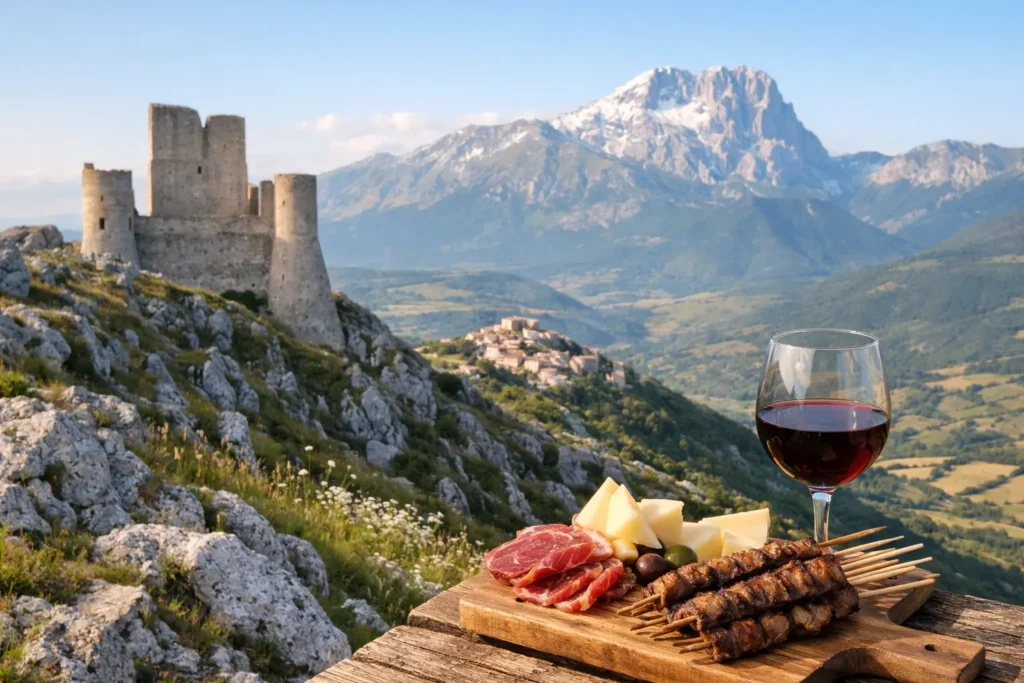
Rocca Calascio, built around the 12th century, sits at 1,460 metres — the highest castle in Italy.
National Geographic ranks it among the world’s 15 most beautiful.
It’s visible for miles across the high plains of the L’Aquila province, and it’s entirely real, not a reconstruction.
It also appeared in the 1985 film Ladyhawke and several other productions — which is part of why Abruzzo has a quietly cinematic quality that surprises first-time visitors.
But as with the bears and the parks, the beauty here is functional rather than staged.
It’s a working landscape, not a film set.
The Food Has a Distinct Identity
Yes, the food is excellent — this is Italy, so that would be strange if it weren’t.
Aber Abruzzo’s food culture is stronger and more distinctive than many outsiders expect.
Arrosticini — small lamb skewers, grilled over a long charcoal grate — are arguably the most iconic street food in central Italy.
Saffron from the Navelli plateau near L’Aquila is considered among the finest in the world and holds a protected denomination of origin.
Montepulciano d’Abruzzo is a full-bodied red wine that’s excellent at a price point most regions can’t match.
And the division between mountain food and coastal food gives local cuisine a real range — hearty lamb and pasta inland, fresh seafood and brodetto on the Adriatic.
If you’re relocating, food becomes one of the fastest ways to feel connected.
Even when your Italian is still shaky, and the paperwork is piling up, knowing what’s in season and finding your favourite bakery can make a place start to feel like yours.
Abruzzo Is One of Italy’s Least Densely Populated Regions
With roughly 1.29 million residents and a population density of 117 people per km², Abruzzo is one of Italy’s least densely populated regions — compared with Lombardy’s 400+ per km².
Das bedeutet, dass uncrowded hiking, genuine village life, and a pace that’s actually slower rather than performatively slow.
It also means that if you want Italy to feel like Italy — not like a tourist version of it — Abruzzo delivers in a way that busier or better-known regions often can’t.
You can shop at neighbourhood stores, hear church bells that aren’t there for ambience, and slowly become part of a place rather than hovering outside it.
The Villages Are Real Communities, Not Movie Sets
Abruzzo is full of beautiful hilltop villages that can look almost impossibly cinematic.
Stone streets, mountain backdrops, church bells, laundry in the sun — yes, that version exists.
It’s not fake.
But the more useful fun fact is that these are communities first:
- Some are lively year-round.
- Some are quieter in winter than people expect.
- Some are ideal for a lower-cost, slower lifestyle.
- Others may feel too isolated if you need frequent services, reliable transport connections, or an easier social network.
The prettiest village on Instagram is not always the best fit for your daily reality in January.
This is where the fun facts start to matter practically.
Zu verstehen, what daily life in different types of Abruzzo towns actually looks like — and asking the right questions before you commit — is the kind of local knowledge that makes a real difference.
The Best Fun Fact Is That Abruzzo Changes People’s Idea of Italy
Many people arrive expecting a backup version of more famous regions — less known, less expensive, less crowded.
All of that may be true in some ways, but it misses the point.
Abruzzo is not interesting because it’s a substitute for somewhere else.
It’s interesting because it offers a version of Italy that’s still grounded in landscape, community, and ordinary life:
- Dramatic without being showy.
- Beautiful without trying too hard.
- Traditional, but still livable.
So if someone asks what’s a fun fact about Abruzzo, you could mention:
- the bears
- the parks
- the mountain-to-sea contrast
- or the particle physics lab
All good answers.
But the most meaningful one might be this: Abruzzo is the kind of place that starts as trivia and ends as a plan.
And if you’re already imagining yourself here, that’s probably not random.
—
Thinking About More Than a Visit — and Wondering If Abruzzo Could Be Home?
The facts are the starting point.
What comes next — finding the right area, understanding the practical side of moving, and having someone local to guide you through it — is where the real story begins.
Bei Wanderlust Abruzzo, we help English- and German-speaking expats turn the idea of living here into something real and manageable.
If you’re in the early stages of exploring or are already ready to plan, we’d love to talk.
Nimm noch heute Kontakt mit uns auf und lass uns über deinen Umzug nach Abruzzo sprechen
—
Häufig gestellte Fragen (FAQs)
What is Abruzzo best known for?
Abruzzo is best known for its extraordinary natural environment — three national parks covering over a third of the region’s territory, the highest peaks in the Apennines, and a coastline along the Adriatic. It’s also known for its wildlife (including wolves and the rare Marsican brown bear), its distinctive cuisine (arrosticini, saffron, Montepulciano d’Abruzzo wine), and its authentic, unhurried character compared with more tourist-heavy parts of Italy.
Why is Abruzzo called the greenest region in Europe?
Because more than 37% of its territory is officially protected through national parks, nature reserves, and conservation areas — the highest proportion of any region in Italy and one of the highest in Europe. The three national parks (Gran Sasso e Monti della Laga, Maiella, and Abruzzo, Lazio & Molise) together form one of the most significant conservation networks on the continent, home to thousands of plant species and rare wildlife, including the Marsican brown bear and Apennine wolf.
Are there really bears in Abruzzo?
Yes. The Marsican brown bear — one of the world’s rarest bear subspecies — lives primarily in and around the Abruzzo, Lazio and Molise National Park. The current population is estimated at around 300 individuals. They are wild animals that generally avoid human contact, but their presence in the region is real and well-documented. Local communities and conservation organisations work together to ensure both bear welfare and human safety.
Is Abruzzo good for outdoor activities?
Very much so. Skiing is available at resorts including Roccaraso, Campo Felice, and Ovindoli from winter through early spring. Hiking trails range from gentle walks to serious mountain routes across all three national parks. The Adriatic coast offers beaches, water sports, and the unique trabocchi coast experience. The region’s geographic range — from sea level to nearly 3,000 metres — makes it genuinely versatile for outdoor enthusiasts year-round.
Is Abruzzo worth moving to?
For the right person, genuinely yes. Abruzzo offers lower costs than most of Italy, a high quality of natural and daily life, strong food and wine culture, and an authenticity that busier regions have largely lost. The practical challenges — Italian bureaucracy, language barriers, local systems — are real but manageable with the right preparation and local support. The people who thrive here tend to be those who want to participate in local life rather than observe it from a distance.

 English
 Deutsch