
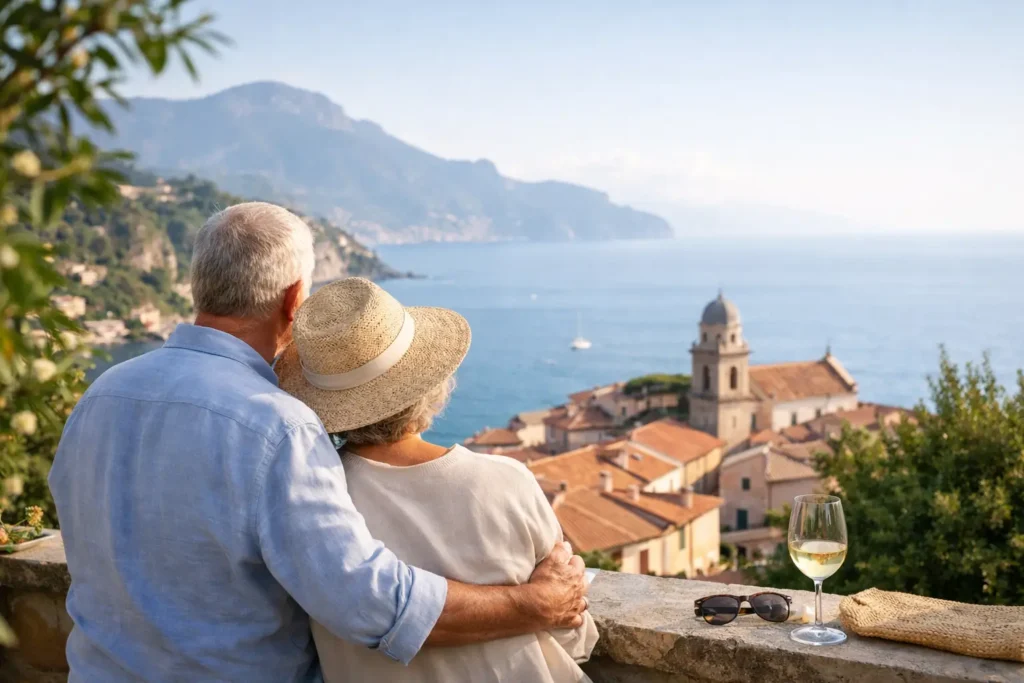
Retiring to Italy sounds like the ultimate reward — until the “Postcard Phase” meets the “Administrative Reality”.
Can you actually afford daily life there?
Will the winter mountain air feel refreshing or isolating?
How hard is it to navigate residency, healthcare, and utilities in a language you’re still learning?
If you’re wondering where in Italy one can live well as a retiree, the honest answer is: not everywhere suits every retirement.
The best choice depends on how you want your ordinary Tuesdays to feel.
Living well isn’t just about the view; it’s about how much “friction” exists between you and your morning espresso.
1. Defining “Living Well”: The Five Practical Pillars
Before you choose a region, you must look past the stone walls and vineyard views.
For retirees, “Living Well” usually comes down to five factors:
- Healthcare Proximity: Is there a world-class hospital or specialist within a 30-minute drive?
- Financial Floor: Does your pension cover the “setup costs” and still leave room for travel and dining?
- Walkability: Can you reach a pharmacy, a bakery, and a post office without needing a car for every trip?
- Climate Comfort: Can you handle the damp winters of the north or the intense summer humidity of the far south?
- Tax Efficiency: Does the region qualify for the 7% Flat Tax for Pensioners?
2. Comparing the Regions: Where Does Your Dream Fit?
Northern Italy: Efficiency at a Premium
Regions like Lombardy and Veneto offer top-tier infrastructure and healthcare.
It feels “European” and organized.
However, the cost of living — especially real estate in cities like Milano, Verona, or Treviso — can be double what you’ll find in central Italy.
Tuscany: The International Standard
These are the most “expat-ready” regions.
You’ll find English-speaking doctors and established foreign communities.
The trade-off? You are paying a “Prestige Tax” on everything from rent to a glass of wine in the piazza.
Puglia & Sicily: The Slow South
The South offers dramatic coastlines and incredible value.
The pace is famously slow, which is perfect for retirement, but the infrastructure can be less polished.
Bureaucracy in the deep south often requires a much higher level of patience and local intermediation.
3. Why Abruzzo is the “Goldilocks” Zone for Retirees
Abruzzo is often overlooked by those focused on the “headline” regions, but for savvy retirees, it offers a balance that is hard to beat.
- Authenticity Without Isolation: You can find a home near the sea in Pescara oder Vasto that feels grounded and residential year-round, not just in the summer.
- The Mountains-to-Sea Advantage: In Abruzzo, you aren’t forced to choose. You can hike in a National Park in the morning and be at an Adriatic beach club by the afternoon.
- The 7% Tax Magnet: This is the “Secret Weapon” for retirees. Many small towns in Abruzzo qualify for the 7% flat tax on all foreign income for ten years. This incentive can turn a modest pension into a very comfortable lifestyle.
4. The “Friction Tax”: Budgeting for Setup
A “cheap” town in the hills can become expensive if you have to drive an hour for every medical appointment or if the historic stone house has zero insulation.
This is why many retirees thrive in medium-sized towns like Sulmona oder Chieti.
You pay slightly more for the home but gain easier access to services and fewer logistical headaches.
When you are building a new life, saving “energy” is often more important than saving a few Euros on rent.
5. Community: The Deciding Factor
A retiree can live affordably in a beautiful village and still feel isolated.
Building a social circle in Italy takes intention.
If you do not speak much Italian yet, the "Sprachfalle" can turn simple errands into stressful events.
In Abruzzo, community is built through the Piazza Life.
It’s about being seen at the same bar every morning and offering a warm “Buongiorno” to your neighbors.
But in the first 90 days, having a “Bilingual Bridge” to handle your residency and utilities is what prevents relocation fatigue.
—
Choosing Your Abruzzo Lifestyle
The best move isn’t choosing a region first — it’s choosing a lifestyle.
- Do you want the coastal convenience of Francavilla al Mare?
- The historic, mountain-framed community of Sulmona?
- The cultural renaissance of L’Aquila?
Bei Wanderlust Abruzzo, we specialize in helping English- and German-speaking retirees find their “perfect fit”.
We don’t just find the house; we help you handle the paperwork, the tax code, and the technical setups so you can focus on the reason you moved here: to live well.
—
Häufig gestellte Fragen (FAQs)
Can I really pay only 7% tax on my pension in Italy?
Yes, if you move your tax residency to an Italian municipality with fewer than 20,000 inhabitants located in specific regions, including Abruzzo. This applies to all foreign income (pensions, rentals, dividends) for 10 years.
Is the healthcare in Abruzzo good for seniors?
Abruzzo has several major university hospitals (Pescara, Chieti) and a network of local health offices. While public wait times for elective procedures exist, the quality of care is high. Many retirees supplement the SSN with affordable private specialist visits.
Do I need to buy a house to get residency?
No. A registered rental lease is perfectly sufficient for residency registration and the Elective Residency Visa. In fact, we recommend renting for the first year to ensure the town fits your lifestyle.
How much does a couple need per month to live well in Abruzzo?
While it depends on your lifestyle, a couple can live a very high-quality life in Abruzzo for €1,800–€2,500 per month. This covers a nice rental, utilities, a car, and frequent dining out.
Is it hard to find English-speaking help in Abruzzo?
Outside of the major coastal cities, English is not widely spoken in public offices. This is why having zweisprachige Relocation-Unterstützung on the ground is essential for handling the initial administrative setup.
 English
 Deutsch