
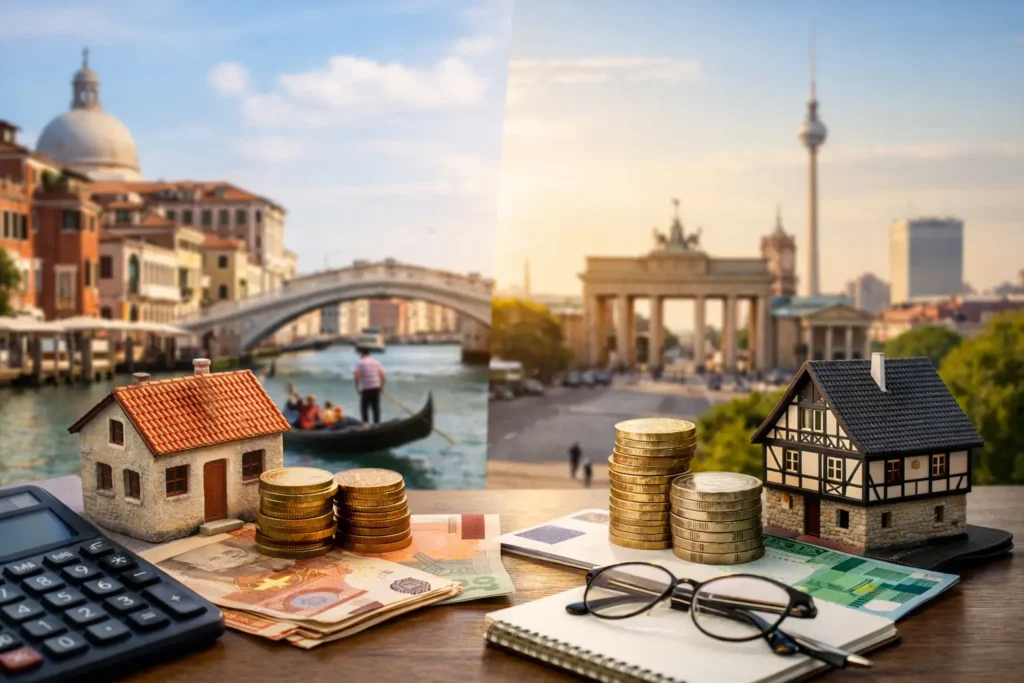
If you are weighing a move and asking, is it cheaper to live in Italy or Germany, you are standing at a financial crossroads.
In Germany, life is defined by high, predictable costs balanced by high, structured salaries.
In Italy, the budget is a “choose your own adventure” story where the town you pick determines whether you feel wealthy or squeezed.
This guide provides an approximate general cost comparison for the two countries, with a special focus on Abruzzo, one of the most financially strategic regions for expats.
To build a real budget, we have to look past the postcard and into the daily “Administrative DNA” of each system.
1. The Housing Market Cost Comparison: Renting vs. Purchasing
Housing is the single largest variable in your move.
In Germany, the rental market is highly regulated but incredibly competitive.
In Italy, the challenge is not just the price, but the availability of long-term contracts (12+ months) over seasonal rentals.
Renting Realities
In big Italian hubs like Milan or Rome, you will face prices that rival or exceed Munich’s.
However, Abruzzo offers a massive reprieve.
The catch? In coastal Abruzzo, owners often prefer summer rentals where a single month (August) can cost as much as four months of winter rent.
Securing a long-term, registered contract is essential for residency but requires local negotiation skills.
Purchasing Property
If you are looking to buy, Italy is the clear winner for value per square meter, especially in regional areas.
In Abruzzo, you can purchase a habitable village home for the price of a small garage in Stuttgart.
However, the best deals are often in quieter areas, further from international hubs — a trade-off you must weigh against your lifestyle needs.
| Category | Germany (Avg) | Big Italian Hubs | Abruzzo (Regional) |
|---|---|---|---|
| Rent (1-Bed Center) | €1,200 – €1,600 | €1,400 – €1,950 | €550 – €850 |
| Summer Rent (Monthly) | €1,500 – €2,000 | €3,000+ | €1,500 – €2,800 |
| Purchase (per m²) | €5,000 – €8,500 | €6,500 – €12,000 | €1,150 – €1,600 |
2. Healthcare Cost Comparison: Workers, Retirees, and the “Ticket”
Healthcare works very differently depending on your employment status.
Remote Workers & Employees
If you are a remote worker for a German company living in Italy, your employer must handle Italian paperwork, often through an Employer of Record (EoR).
In this scenario, your healthcare is funded via your IRPEF (Income Tax) and social contributions, similar to a local employee.
In Germany, you are used to a direct 14.6% salary deduction; in Italy, it is “baked into” your general tax burden.
Retirees and the “Ticket” System
For retirees, the S1 form allows for a seamless transition.
For others, Voluntary SSN Enrollment currently requires a minimum of €2,000/year.
Unlike Germany, where the premium covers most things, Italy uses the “Ticket” (co-pay) for specialist visits and tests (approx. €25–€46).
| Healthcare Scenario | Germany | Big Italian Hubs | Abruzzo |
|---|---|---|---|
| Employee Deduction | ~14.6% Salary | Included in IRPEF | Included in IRPEF |
| Retiree Buy-in | High Premiums | €2,000 (Min) | €2,000 (Min) |
| Private Specialist Visit | €150 – €220 | €120 – €180 | €80 – €130 |
3. Food: Discount Markets vs. Local Rhythms
A family of four in Germany budgets roughly €950–€1,100 for groceries.
In Italy, the same basket is roughly €750–€850, but only if you adapt to local habits.
- Discount Chains: Italy’s Eurospin, Lidl, and MD offer prices that rival Aldi. Shopping here keeps your budget 15-20% lower than in Germany.
- The High-End: If you do groceries at the main chains (Carrefour, Ipercoop, and Esselunga), the prices will be pretty similar to the ones you find in German supermarkets like Edeka or Kaufland.
- The Abruzzo Advantage: In Abruzzo, the culture of “KM 0” (zero-kilometer) food is real. Buying wine, olive oil, and vegetables directly from local producers or weekly markets isn’t just a romantic cliché — it’s a financial hack that can save a family €100/month compared to supermarket prices.
- Dining Out: In Abruzzo, dining is a social right, not a luxury. A family of four can have a high-quality dinner with wine for €60–€80, a scenario that would cost €120+ in Berlin or Milan.
| Household Type (Monthly) | Germany | Big Italian Hubs | Abruzzo |
|---|---|---|---|
| Couple | €500 – €650 | €550 – €700 | €400 – €500 |
| Family of 4 | €950 – €1,100 | €1,000 – €1,200 | €750 – €900 |
| Espresso at a Bar | €3.50 | €1.50 | €1.20 |
4. Transportation: The Hidden Italian Surcharge
This is the only category where Germany is arguably cheaper and more efficient.
- Fuel & Tax: Italy’s fuel is consistently €0.10 higher per liter. Additionally, the Bollo (Car Tax) is a mandatory annual fee based on kW power — expect €150–€350/year.
- Insurance: Italian motor insurance averages €500–€800/year, nearly double the German average for new residents.
- Public Transport: Germany’s €58 ticket is world-class. In Abruzzo, public transport is affordable (approx. €40/month) but fragmented; in rural areas, a car is not optional.
| Transport Cost | Germany | Big Italian Hubs | Abruzzo |
|---|---|---|---|
| Gasoline (per Liter) | ~€1.85 – €2.10 | ~€1.95 | ~€1.95 |
| Monthly Transit Pass | €58 (Nationwide) | €35 – €50 | €35 – €45 |
| Basic Car Insurance (Yearly) | €250 – €450 | €700 – €1,000 | €450 – €750 |
5. Utilities: The Internet Surprise
In 2026, Italy has some of the highest energy costs in Europe, but some of the cheapest internet.
- The Resident Rate: Until you finalize your residency paperwork, you are billed at a “Non-Resident” tariff, which adds about 30% to your electricity and gas bills.
- Internet: Italy is a winner here. High-speed fiber (1Gbps) in Abruzzo costs €25–€30/month, whereas similar speeds in Germany often exceed €55. In 2026, even rural “White Areas” in Abruzzo now have reliable fiber rollout.
| Service (Monthly) | Germany | Big Italian Hubs | Abruzzo |
|---|---|---|---|
| Electricity & Gas (85m²) | €220 – €280 | €260 – €350 | €190 – €250 |
| Water | Included/Low | €40 – €60 | €25 – €40 |
| Fiber Internet | €45 – €60 | €30 | €25 – €30 |
| Mobile Plan | €20 – €40 | €10 – €20 | €10 – €20 |
6. Taxes: Comparing the Bureaucracy of Payments
In Germany, the government sends you a bill. In Italy, you are expected to know what you owe.
- 7% Flat Tax: This massive incentive for retirees has expanded in 2026 to towns of up to 30,000 residents (e.g., Sulmona, Francavilla). It allows you to pay just 7% on all foreign income for 10 years.
- Self-Assessed Taxes: IMU (Property Tax) and TARI (Waste Tax) do not always arrive in the mail. You must calculate and pay them yourself via F24 forms to avoid steep fines.
| Tax Type | Germany | Italy (General) | Abruzzo Advantage |
|---|---|---|---|
| Income Tax | Progressive (High) | Progressive (High) | Progressive (7% for some retirees) |
| Property Tax (IMU) | Moderate (Billed) | Moderate (Self-Assessed) | Moderate (Self-Assessed) |
| Car Tax (Bollo) | Moderate | €150 – €350/yr (Mandatory) | €150 – €350/yr (Mandatory) |
| Waste Tax (TARI) | Moderate | €150 – €400/yr (Self-Assessed) | €150 – €400/yr (Self-Assessed) |
—
Which Country Gives You More Value for Your Money?
Is it cheaper to live in Italy or Germany?
The regional value in Abruzzo makes the answer a clear yes, but the “Administrative Gap” can be costly if you navigate it without local knowledge.
Wanderlust Abruzzo is your dedicated bilingual support partner, ensuring that your relocation doesn’t involve expensive trial and error.
We help you manage the logistics of your move from Germany to Abruzzo by finding and viewing properties, assisting with your residency registration at the Comune, and simplifying your utility setup and transfers.
From your first Codice Fiscale to the back and forth of dealing with landlords or real estate agents, we provide the language support and local presence needed to secure your lifestyle.
We turn the administrative noise into a structured plan for your success.
Ready to see how your budget fits in Abruzzo? Book your free Strategy Call with us today.
—
Frequently Asked Questions (FAQs)
Is internet cheaper in Italy?
Yes. Home fiber-optic (60Mbps+) typically costs €25–€30/month, while mobile plans with 100GB+ data are often as low as €10/month.
Can I bring my German car to Abruzzo?
Yes, but you must register it with Italian plates within 3 months of obtaining residency. The re-registration process (PRA) is complex and typically costs €500–€800 if you handle it through a service provider, or a few hundred Euro if you do it by yourself, but this implies standing long Italian queues at the Motorizzazione Civile. We can help you handle the nationalization of your German car in Italy with a partner.
Is Abruzzo really cheaper than Tuscany?
Yes. For the same quality of home and proximity to services, Abruzzo is consistently 20-30% more affordable than Tuscany or Umbria.
How do I pay the IMU property tax?
You must proactively calculate and pay it twice a year (June and December) via an F24 form. Most expats use a Commercialista or a relocation partner to ensure the math is correct.
Are there “hidden” costs in Abruzzo housing?
Older stone houses in the interior may look cheap, but can be expensive to heat. Always check the APE (Energy Performance Certificate) before signing, as heating costs can vary wildly based on insulation. And look for modern pellet stoves or heat pumps to keep winter costs manageable.



 English
 Deutsch