
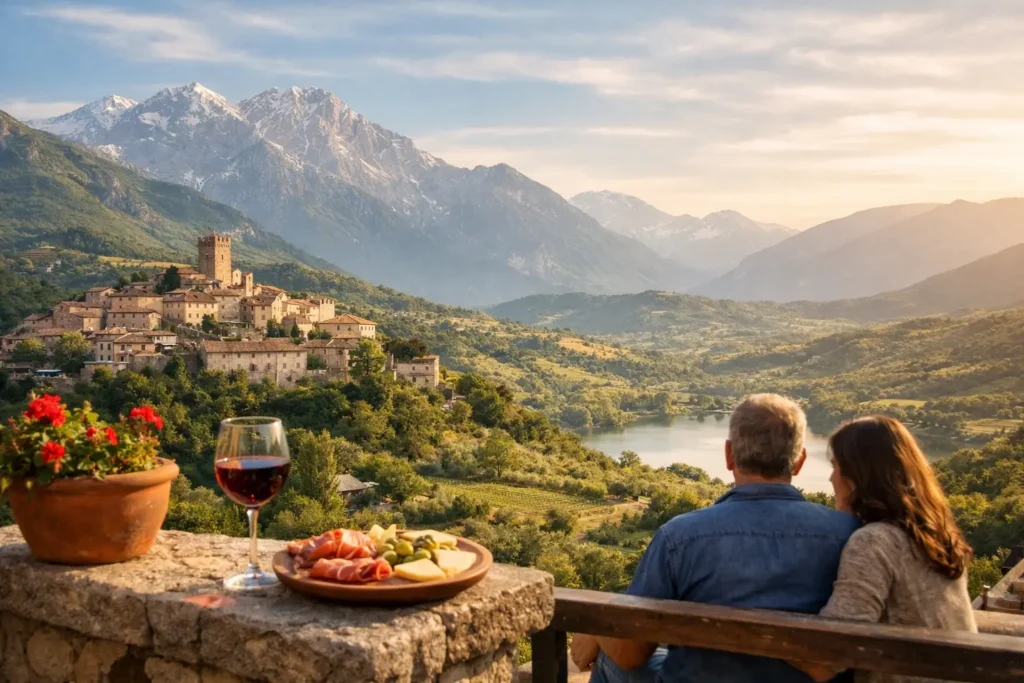
You can spot the difference almost immediately. In Abruzzo, your day is less likely to be shaped by traffic, noise, and packed schedules — and more likely to be shaped by the weather, the market, and whether the sea or the mountains are calling.
For many people considering a move, life in Abruzzo looks like the dream version of Italy: beautiful, slower, and more affordable.
The reality is often very good — but it works best when you understand both the charm and the friction before you arrive.
Abruzzo tends to attract people who want a real lifestyle shift, not just a change of address.
They want space, fresh air, better value, and a stronger sense of community.
They want Italy without the intensity, prices, or crowds of the better-known regions.
On that level, Abruzzo genuinely delivers.
But daily life here is not a polished expat bubble.
It’s real Italy — and that’s exactly why some people fall deeply in love with it, while others feel unprepared.
Why Life in Abruzzo, Italy, Appeals to So Many Movers
Abruzzo has a rare balance that’s hard to find elsewhere in Italy or Europe.
You can be near the coast, within reach of mountains, and still live in a town where daily essentials feel local and manageable.
As International Living describes it, Abruzzo has managed to stay off the expat and trendy radar despite all its appeal — and that’s precisely what keeps it affordable and authentic.
You get to discover places that aren’t full of tourists, and to feel like a resident rather than a visitor.
For people coming from the US, the UK, Germany, or northern Europe, one of the first surprises is how livable ordinary days can feel.
You don’t need an extravagant lifestyle to enjoy yourself here.
A coffee at the bar, fresh produce from a local shop, a walk through a historic town centre, lunch with a view, and an evening passeggiata can become part of normal life rather than a holiday treat.
A couple could live in Abruzzo for about €1,200 a month — roughly half of what the same lifestyle would cost in many parts of the US or northern Europe, which gives you a very different relationship with financial pressure.
That said, what feels peaceful to one person can feel too quiet to another.
If you need constant novelty, late-night urban energy, or big-city convenience on demand, some parts of Abruzzo may feel limiting.
This is one of the region’s genuine strengths — but also one of its clearest trade-offs.
The Pace Is Slower — and That Changes More Than You Expect
People often say they want a slower life.
Then they arrive and discover that slower applies to everything, not just the pleasant parts.
Yes, there’s more room to breathe.
Meals are less rushed.
Weekends feel more intentional.
Many towns still centre around family rhythms, local routines, and long-established habits.
That can be deeply comforting when you’re tired of speed and pressure.
But slower also means some things take patience.
The opening of a bank account, arranging services, or getting through paperwork may involve more steps than expected — especially if you don’t yet speak Italian well.
Appointments can require follow-up.
Offices have their own hours and their own logic.
If you’re used to highly digital, instantly responsive systems, the adjustment can be bigger than you anticipate.
The key is not to romanticise or resent the pace.
It helps to treat it as part of the move itself.
The more flexible and prepared you are, the more easily you can appreciate what this rhythm genuinely gives back.
Housing, Space, and Everyday Value
One of the most practical reasons people consider life in Abruzzo is straightforward: money goes further here than in most Italian regions.
Restored homes in villages start at around €30,000, while country houses with land can be found between €60,000–€180,000.
Rental prices are proportionally accessible — a good-sized apartment in a coastal town can run €500–€900 per month.
That’s not just a budget advantage.
It’s a quality-of-life advantage: more space, outdoor areas, and proximity to sea or countryside than most people thought possible within their budget.
What to watch out for
Cheap listings can look exciting online — but photos rarely tell the full story.
Heating systems, insulation, internet quality, parking, year-round livability, and proximity to shops all matter far more once you’re actually living there.
A home that feels perfect in August can feel very different in January.
It’s worth reading our guide to the most costly mistakes when buying property in Abruzzo before committing — and ensuring you visit in cooler months, not just summer.
If you’re renting first — which is often the wiser approach — our guide to finding a flat in Abruzzo walks through what to look for, what to ask, and how to avoid common traps.
Community Life Can Be Wonderful — If You Engage With It
Many expats move to Italy hoping for a genuine human connection.
In Abruzzo, that’s possible — but it rarely happens automatically.
Local communities can be warm, generous, and genuinely curious about newcomers.
Small gestures go a very long way.
Learning basic Italian, greeting people consistently, shopping locally, and showing up reliably matter more than trying to impress anyone.
Once people sense you’re serious about being here — not just passing through — relationships tend to deepen naturally.
The social experience varies a lot by location and personality.
In some towns, you may quickly become part of local life.
In others, especially where language is a barrier, it can feel isolating at first.
This is one reason many new arrivals benefit from practical local guidance early on.
Knowing where to go, how things work, and who to ask can dramatically reduce that sense of being on the outside.
Active English-speaking communities in towns like Casoli, Sulmona, and the Pescara area provide a useful social bridge during the first months.
You can read more about how expats build community in Abruzzo and what actually works versus what people assume will work.
Daily Logistics: Where the Fantasy Meets Real Life
This is the part most people underestimate.
Moving to Abruzzo isn’t just about choosing a beautiful town.
It’s about getting your day-to-day life functioning.
You need a home that suits your actual needs, not just your wishlist.
You need utilities, reliable internet, realistic transport, grocery routines, healthcare access, and an honest understanding of how far you are from the places you’ll use most.
If you’re relocating full-time, these details shape your experience far more than the view from your balcony.
The Italian bureaucracy can feel confusing even when everything is going smoothly.
Forms, appointments, office procedures, and language gaps can turn tasks that sound simple into genuinely stressful ones.
This is often the moment when the emotional side of relocation hits hardest — you’re not just dealing with logistics, you’re trying to build a normal life while still feeling new, tired, and unsure.
That’s why practical, local support makes such a difference.
For many newcomers, having someone on the ground who understands both the system and the emotional weight of the move can turn a draining process into a manageable one.
You can explore what relocation support in Abruzzo actually looks like and whether it might be the right fit for your move.
Who Tends to Thrive Here
Life in Abruzzo works well for a range of people — but for different reasons, and it’s worth being honest about which situation matches yours.
Families
The appeal is obvious: outdoor life, calmer routines, more space, and a stronger sense of local tradition.
But families also need to think carefully about schools, transport connections, language support for children, and how much daily driving the location will involve.
A beautiful rural property can become tiring if every school run, activity, or appointment requires a 30-minute drive.
Remote workers
Many remote workers love the lifestyle side of Abruzzo — the quiet, the nature, the lower cost.
But the practical questions matter just as much: internet reliability needs to be confirmed at the specific property, travel connections matter for occasional trips, and the social pace of a smaller town should feel supportive rather than isolating over the long term.
Our guide to working remotely from Abruzzo covers what to check before you commit.
Retirees
Pescara, Casoli, and Sulmona host active English-speaking communities that support newcomers, and retirees in particular tend to integrate well in these kinds of established communities.
The main question is usually not whether Abruzzo is beautiful enough, but whether the specific location matches your mobility needs, proximity to healthcare, and preferred level of daily convenience.
What Surprises New Arrivals Most
Usually, it’s not the scenery.
It’s how ordinary life starts to feel different.
People notice that meals have more structure.
Shops close in the middle of the day.
Relationships build more slowly but often more sincerely.
Seasons feel more present and more meaningful.
Towns have their own distinct personalities, and no two areas function exactly the same way.
Another consistent surprise is how emotional the move can be — even when it’s genuinely the right decision.
Starting over in a new country brings:
- excitement
- relief
- gratitude
But also:
- frustration
- homesickness
- moments of real doubt
That doesn’t mean you made a mistake.
It usually means you’re in the middle of a real transition, not a holiday.
Knowing that in advance makes the hard moments significantly easier to sit through.
So, What Is Life Here Really Like?
Life in Abruzzo is often best for people who want substance over spectacle.
It suits those who value everyday beauty, local character, and a more human pace of life.
It rewards patience, curiosity, and a genuine willingness to adapt.
The region offers a unique blend of authentic Italian traditions, breathtaking landscapes, and a slower pace of life — but making the most of it requires navigating residency, understanding the real cost of living, and approaching local life on its own terms.
If you come expecting a flawless postcard, you may struggle.
If you come ready to build a life — not just admire one — Abruzzo can offer something many people feel they’ve lost elsewhere: enough space to breathe, enough beauty to stay inspired, and enough reality to make the experience genuinely meaningful.
The move gets easier when you stop asking whether Abruzzo is perfect and start asking whether it fits the kind of life you actually want to live.
—
Thinking About Life in Abruzzo — and Want to Get the Move Right?
The lifestyle question and the practical question belong together.
Choosing the right area, getting the paperwork in order, and having someone local to guide you through the early months — these aren’t optional extras.
They’re often what makes the difference between a stressful start and a genuinely good one.
At Wanderlust Abruzzo, we help English- and German-speaking expats navigate every stage of the move: from choosing where to live and finding a home, to residency, utilities, and actually feeling settled.
Personal, bilingual, and on the ground.
Get in touch today and let’s talk about your move to Abruzzo
—
Frequently Asked Questions
Is Abruzzo a good place to live as an expat?
For the right person, yes — genuinely. Abruzzo offers a lower cost of living, beautiful and varied landscapes, strong local communities, and an authentic Italian lifestyle that more famous regions have largely lost. The main things to assess honestly are your language comfort level, tolerance for Italian administrative processes, and whether your chosen location suits your daily needs across all seasons — not just in summer.
What does daily life actually look like in Abruzzo?
In most towns, daily life centres around local rhythms: morning coffee at the bar, shopping at neighbourhood stores or the market, a quieter mid-afternoon, and evenings that revolve around food and family rather than entertainment. Nature is close and accessible rather than something you plan weeks ahead. The seasons feel more present and more varied than in many parts of northern Europe.
How much does life in Abruzzo cost?
It depends on your lifestyle and location, but Abruzzo is generally very affordable by European standards. A couple can live comfortably on around €1,200–€1,500 per month, covering rent, food, transport, and everyday costs. The first months of any move tend to cost more — deposits, setup expenses, and transition costs add up — but ongoing living costs in Abruzzo compare very favourably with most of northern Europe.
Is Italian necessary for daily life in Abruzzo?
Not for survival, but it makes a significant difference to quality of life. Outside the most internationally connected areas, English is limited in offices, shops, and healthcare settings. Learning enough Italian for everyday interactions — greetings, basic questions, appointments — is one of the highest-return investments you can make before moving. The effort also signals a genuine commitment to local life, which goes a long way socially.
What are the biggest challenges of living in Abruzzo?
The transition period is consistently the hardest part: Italian administrative processes take longer than most people expect, language barriers create friction at the wrong moments, and the emotional weight of starting over in an unfamiliar system can feel heavy even when the decision was the right one. Choosing the wrong location — based on how it looks in summer rather than how it functions year-round — is the other most common mistake. Both challenges are manageable with good preparation and the right local support.

 English
 Deutsch