
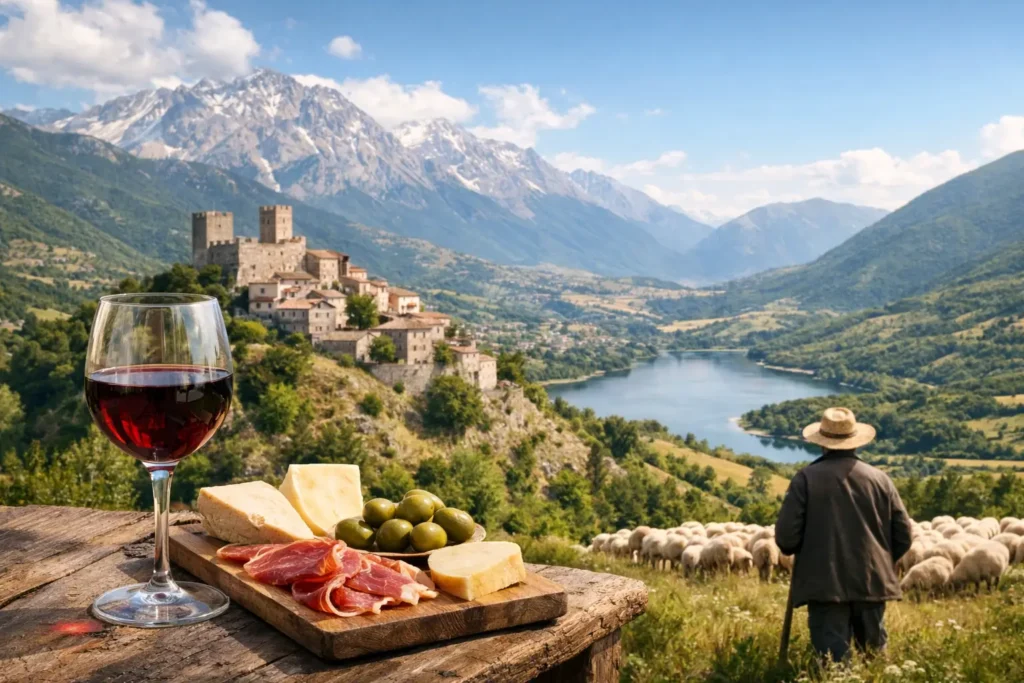
Ask someone in Italy about Abruzzo and you will often get the same slightly proud, slightly knowing reaction: ah, the green heart with strong food, real seasons, and none of the showiness.
If you are wondering what is Abruzzo, Italy famous for, the short answer is this: dramatic nature, deeply rooted food traditions, quieter tourism, and a lifestyle that still feels genuinely lived-in rather than staged for visitors.
That matters if you are not just planning a vacation, but thinking about a move.
The things a region is famous for can sound romantic on paper.
The more useful question is whether those qualities hold up in daily life.
In Abruzzo, they often do.
What Is Abruzzo, Italy, Famous For? Start With the Landscape
Abruzzo is one of those rare places where the postcard version is not exaggerated.
It is famous for having mountains, national parks, hill towns, and beaches all within a relatively compact region.
You can wake up with a sea view and still reach the mountains the same day.
This is a big part of the region’s appeal for expats.
You are not choosing between coast and countryside in the same rigid way you might elsewhere:
- Towns near Pescara and along the Adriatic offer easier access to services, train connections, and a more international feel.
- Inland, life becomes quieter, greener, and often more affordable, but also more dependent on driving and local know-how.
Abruzzo is especially well known for Gran Sasso and Majella, two mountain areas that shape both the scenery and the culture.
Winters can feel more real here than many newcomers expect, especially if they arrive imagining southern Italy as uniformly mild.
That mix is one reason people fall for the region.
It feels balanced.
There is room to breathe, but it is not cut off from ordinary life.
National Parks and Wild Nature: The Greenest Region in Europe
One of the clearest answers to what Abruzzo is famous for is its protected nature.
The region is known for its national parks and for taking them seriously.
There is a practical side to this, too.
Beautiful landscapes are wonderful, but they can also mean steeper roads, older housing stock in rural areas, and more variation between summer and winter conditions.
If you are considering a move, the dream of a stone house with a mountain view should always be balanced with questions about heating, internet reliability, and how far you want to be from basic services.
In Abruzzo, location choices really do shape your experience.
The Protected National Parks
With three National Parks and over 30 nature reserves, Abruzzo is the greenest region in Europe.
It is famous for its biodiversity, being the primary sanctuary for the Marsican Brown Bear and the Apennine Wolf.
Abruzzo, Lazio and Molise National Park is especially famous, but it is not the only one.
Wildlife, forests, hiking routes, and mountain villages are part of the identity here, not a side attraction.
For people moving from busier, more built-up places, this can be a real quality-of-life shift.
You notice the cleaner air, the quieter evenings, and the way people talk about the seasons.
Nature is more present in everyday life.
The Peaks of the Gran Sasso and Majella
Abruzzo is home to the highest peaks of the Apennines.
The Gran Sasso is famous not just for its height, but for the Campo Imperatore — a high-altitude plateau known as Italy’s Little Tibet.
These mountains aren’t just for looking at: they influence the climate, providing cool breezes in the summer and quality skiing in the winter.
Food That Feels Regional, Not Generic
Abruzzo is famous for food, but not in the polished, luxury-brand way that some Italian regions market themselves.
The cooking here tends to be hearty, direct, seasonal, and tied to local tradition.
That is part of its charm.
Arrosticini are probably the best-known example.
These small skewers of grilled lamb are closely associated with Abruzzo and are one of the dishes many newcomers hear about first.
They are simple, smoky, and social, the kind of food built around conversation and long meals rather than presentation.
The region is also known for saffron from L’Aquila province, rustic pasta dishes, strong sheep and mountain traditions, and seafood along the coast.
That contrast matters.
In one region, you get both inland food culture shaped by shepherding history and coastal cuisine shaped by the Adriatic.
For expats, this often becomes one of the happiest surprises.
The food culture feels less performative and more everyday.
Good meals are not reserved for special occasions.
At the same time, if you are used to big-city variety or international convenience foods, some smaller towns may feel limited.
It depends on where you settle and what kind of daily lifestyle you want.
Wine, Olive Oil, and Local Pride
Abruzzo is also famous for Montepulciano d’Abruzzo, one of Italy’s most recognized red wines, known for its deep ruby color and robust character.
Even people who know little else about the region often know the name from a wine list.
That reputation is well earned, but the local story is broader than one bottle.
The region produces strong wines, olive oil, and a range of agricultural products that still feel connected to place.
You see this in weekly shopping, small producers, and the local expectation that food should have a season and a source.
This can be especially appealing if part of your move is about changing pace.
Many people do not relocate to Abruzzo because they want nonstop entertainment.
They come because they want a more grounded daily life, where good ingredients, weekly markets, and community rituals still matter.
The trade-off is that slower living is not just a charming slogan:
- Shops may close midday
- Processes can take longer
- Convenience is not always the highest priority
For some people, that is exactly the point.
For others, it takes adjustment.
Beaches Without the Flash
Abruzzo’s coastline is another big reason it stands out.
The region is famous for Adriatic beaches, fishing towns, and long stretches of coast that are lively in summer without feeling as intensely commercial as some better-known Italian seaside areas.
Places such as Pescara and Francavilla al Mare offer a coastal lifestyle with more day-to-day practicality than many people expect.
You can enjoy the sea while still having access to shopping, transport, schools, and services.
That combination is one reason coastal Abruzzo appeals to people relocating full-time, not just buying a vacation home.
Still, beach life here has its own rhythm.
Summer can be busy, especially in popular towns. Winter is much quieter.
Some people love that contrast.
Others prefer a place with year-round buzz.
Again, it depends on whether you are looking for energy, calm, or a middle ground.
The Coast: The Ancient Trabocchi in Abruzzo
While Italy has many beaches, Abruzzo is famous for the Costa dei Trabocchi.
These are ancient, spider-like wooden fishing platforms reaching out into the Adriatic Sea.
Today, many of these are converted into high-end restaurants.
Lastly, living near the coast means having access to the Via Verde, a 42km cycling path built on an old railway line that hugs the turquoise water.
Something many can’t miss on their visit to Abruzzo.
Hill Towns and an Older Italy
If Abruzzo has a reputation that stays with people, it is this sense of authenticity.
The region is famous for medieval hill towns, stone streets, mountain views, and a way of life that often feels less filtered for outsiders.
That word – authentic – gets overused, but in Abruzzo it usually points to something real.
In many towns, daily life is still organized around local habits, family networks, festivals, and practical routines rather than tourism.
For newcomers, this can feel deeply appealing and occasionally frustrating.
- Appealing, because you are stepping into a place with character and continuity.
- Frustrating, because systems are not built around the assumption that everyone speaks English or wants things done quickly.
This is where local support can make an enormous difference, especially when choosing where to live.
A beautiful town in Abruzzo is not always the right town for your work style, transport needs, or comfort with Italian bureaucracy.
You should think about that before relocating here.
A Slower, More Affordable Lifestyle for Expats
For many expats, what Abruzzo is really famous for is value.
Not cheapness for its own sake, but a better quality of life for the money.
Compared with many more internationally famous parts of Italy, housing and everyday costs can be more manageable here.
That does not mean every property is a bargain or that every area suits every budget.
Coastal hotspots, renovated homes, and move-in-ready properties can still be competitive.
But overall, Abruzzo offers more room to create a life that feels spacious rather than squeezed.
This is one of the strongest reasons people choose the region over places with bigger international profiles.
You can often find a better balance between beauty, livability, and cost.
The quieter reputation can actually work in your favor.
Why This Reputation Matters if You Want to Move
So what is Abruzzo (Italy) famous for?
Nature, food, wine, beaches, hill towns, and slower living are the obvious answers.
The deeper answer is that Abruzzo is famous among people who know it for feeling real.
That reality is exactly what attracts so many lifestyle movers.
You can build a calm, rich, everyday life here.
But the same qualities that make Abruzzo special also mean the transition can feel unfamiliar at first.
Finding the right town, understanding local rhythms, and settling into Italian systems usually takes more than enthusiasm alone.
—
Planning Your Relocation Correctly with Wanderlust Abruzzo
Abruzzo is famous for many beautiful things, but for a newcomer, “authentic” can sometimes mean “administratively complex”.
The same qualities that make the region real — its deep traditions and local focus — can make the moving process feel unfamiliar.
That is why practical, bilingual guidance matters just as much as inspiration.
If you are trying to picture daily life here, not just a holiday version of it, the most useful approach is to match the region’s strengths to your own needs.
At Wanderlust Abruzzo, we bridge that gap.
We turn the things Abruzzo is famous for — its stunning hill towns and coastal rhythm — into a workable plan for your life.
We don’t just show you the view; we assist you in handling the residency registration, the utility setups, and the real estate intermediations in the housing negotiations that turn a foreign region into a true home.
Book Your Free Relocation Strategy Call with us Today
—
Frequently Asked Questions (FAQs)
Why is Abruzzo called the “Greenest Region in Europe”?
Because over one-third of its territory is protected by national and regional parks. It has the highest percentage of protected land of any administrative region in Europe.
What is a “Trabocco”?
A Trabocco is an ancient wooden structure used for fishing. They allow fishermen to catch fish without going out to sea. Most of them are located along the coast between Ortona and Vasto.
Is Montepulciano d’Abruzzo the same as Vino Nobile di Montepulciano?
No. Montepulciano d’Abruzzo is a wine made from the Montepulciano grape grown in Abruzzo. Vino Nobile is a wine made primarily from Sangiovese grapes in the town of Montepulciano in Tuscany.
Is Abruzzo safe for expats?
Abruzzo is consistently ranked as one of the safest regions in Italy. Crime rates are very low, and the community-based lifestyle means people look out for one another.
What is the most famous town in Abruzzo?
While Pescara is the largest city, L’Aquila is the historic capital. For tourism, Scanno (the most photographed village because of its view of the heart-shaped lake) and Rocca Calascio (featured in many films) are the most famous.
 English
 Deutsch