
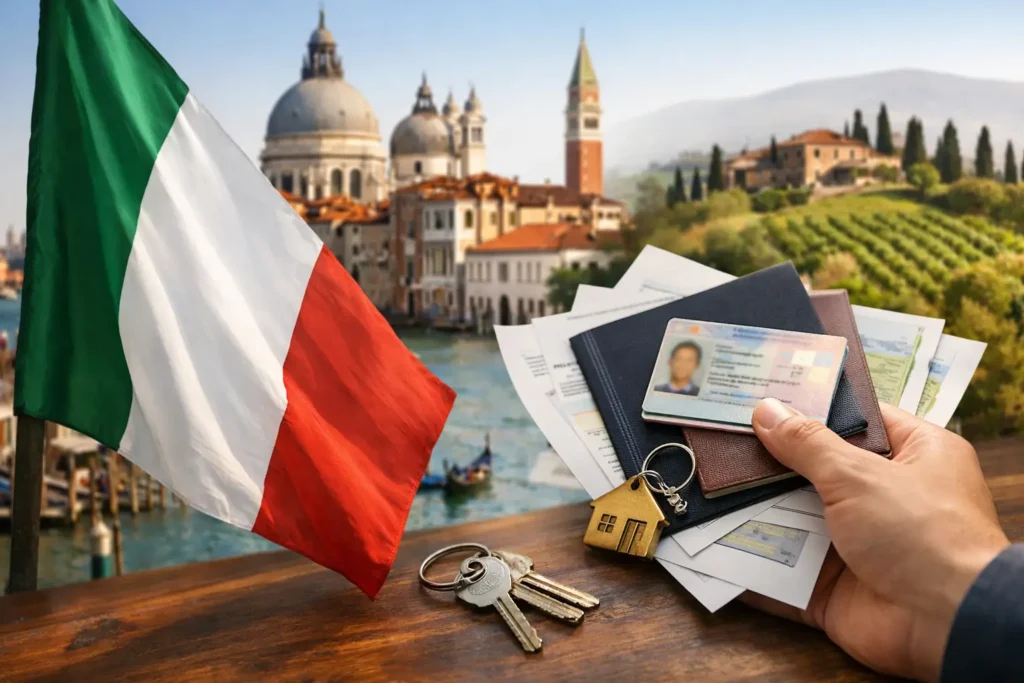
You can fall in love with Italy long before Italy recognises that you live here.
That gap catches many expats off guard.
You find a rental, learn where to buy decent produce, and manage your first conversation at the pharmacy — and then the paperwork begins.
If you’re trying to sort out residency in Italy for expats, the hardest part is usually not one single rule.
It’s the mix of timing, documents, local offices, and language barriers that make simple steps feel much bigger than they should.
The good news is that residency is entirely manageable when you understand what it is, what it isn’t, and where the process tends to slow down.
What Residency in Italy for Expats Actually Means
In everyday conversation, people use terms like visa, permit, registration, and residency as if they’re interchangeable.
They are not.
Residency in Italy refers specifically to being officially registered as living at a specific Italian town hall or “comune”.
This is called residenza anagrafica or iscrizione anagrafica, and it’s handled by Ufficio Anagrafe (population registry office) at your local town hall.
It is separate from:
- Having the right to enter Italy (a visa)
- A residence permit (permesso di soggiorno) for non-EU citizens
- Simply paying rent and living in a property
Depending on your nationality, you may need several layers of legal status before residency registration can be completed:
EU citizens
No visa required and no permesso di soggiorno needed.
But you must register your residency at the Comune if you plan to stay longer than 90 days.
Some municipalities also ask EU citizens to file attestazione di soggiorno (EU right of residence certificate) confirming the basis for their stay — employment, study, or sufficient financial means plus health insurance.
Non-EU citizens
The process is layered.
- First you need the correct long-stay visa (e.g. Type D) before entering Italy.
- Within 8 days of arrival, you must apply for permesso di soggiorno at a post office with Sportello Amico desk.
- Only then can you finalise local residency registration. The postal receipt from your “permesso di soggiorno” application is generally accepted as proof of status while the physical card is processed.
The common pitfall: many people assume that renting a home means they have residency. In Italy, these are connected, but they are separate legal steps that must happen in a specific order.
Full details on each route in our dedicated residency registration guide and our guide for EU citizens moving to Italy.
Why Residency Matters More Than People Expect
Some expats begin the process because they want to do things properly.
Others discover very quickly that daily life becomes significantly harder without it.
Residency unlocks:
- Healthcare: Registering with your local ASL to access a General Practitioner (medico di base) through the national health service — this requires confirmed residency. Full details in our tessera sanitaria guide.
- Banking: Traditional Italian banks typically require a residency certificate to open a full current account. Digital banks (N26, Revolut, Wise) can work as a bridge while residency is being processed.
- Vehicle registration: You cannot put Italian plates on a car or get a standard Italian insurance policy without a residency certificate. Foreign vehicles must be re-registered within 60 days of establishing residency.
- Utility rates: Resident rates for electricity and gas are significantly lower than non-resident rates.
- School enrollment: Children cannot be enrolled in the Italian state school system without the family’s registered residency.
- 7% flat tax eligibility: For foreign retirees, the 7% flat tax incentive requires established tax residency in a qualifying Italian municipality — which begins with iscrizione anagrafica.
- Citizenship clock: For those with long-term plans, the clock for eventual Italian citizenship starts from the date of residency registration — 4 years for EU citizens, 10 years for non-EU.
The Basic Process — Without the Sugarcoating
Residency registration is logical on paper and variable in practice.
The standard process looks like this:
1. Secure a registered address
A lease formally registered at the Agenzia delle Entrate (contratto registrato), a property deed, or a written host declaration.
An unregistered lease is not accepted.
Your landlord must also authorise residency registration at the property — some leases include clauses that prevent this, which creates complications.
2. Gather your identity documents
Passport or EU national ID, Italian tax code (codice fiscale), proof of address, and proof of the basis for your stay.
3. Submit your application at the Ufficio Anagrafe
In person.
Some municipalities accept applications by email or certified mail (PEC), with provisional registration within 2 working days, but in-person is the most reliable route.
Provisional registration is immediate when you apply in person.
4. Home verification visit
The town hall (Comune) has 45 days to verify that you actually live at the declared address.
This usually means someone from the Local Police (Polizia Municipale) visits, often without prior notice.
Make sure your name is clearly visible on the letterbox and that you’re reachable by phone during this window.
5. Final confirmation
Once the verification is complete, your residency certificate (certificato di residenza) becomes available from the Comune or online via CIE.
Until the home visit is completed, your administrative life can feel “on pause”.
This is normal — annoying, but normal.
The key is not missing the verification window.
The Documents That Matter Most
While every “comune” varies slightly, these categories come up consistently.
The full EU/non-EU document breakdown is in our essential documents for Italy relocation guide.
- Valid passport or EU national ID card (originals and copies)
- Codice fiscale — your Italian tax code, required for almost every administrative step. Full guide on what it is and how to get yours.
- Registered lease or property deed — must be formally registered at the Agenzia delle Entrate, not merely signed
- Proof of basis for stay — employment contract, proof of self-employment, study enrolment, or proof of sufficient financial means and health insurance (for economically inactive EU residents)
- Non-EU citizens only: permesso di soggiorno or the official postal receipt of your application
- Civil status documents where relevant — birth or marriage certificates, often needing an apostille and a professional Italian translation
Important note on document freshness: a document may be technically correct but rejected if the office requires it to have been issued within the last 3–6 months, or if the translation doesn’t meet the formal standard expected locally.
Always bring originals and clear copies of everything, and check requirements before your appointment rather than after.
Where Expats Get Stuck Most Often
If the process stalls, it’s almost always one of these:
The address trap
Many expats arrive in short-term holiday rentals or Airbnbs.
Most town halls will not allow residency registration at tourist accommodation.
You need a long-term, formally registered contract.
If you don’t yet have stable housing, some municipalities offer residenza fittizia (a virtual administrative address) for people genuinely without a fixed address, though not all offices provide this.
The timing cascade
Non-EU citizens need to juggle the permesso di soggiorno application (within 8 days of arrival) with residency registration and the 45-day verification window.
If one step slips, the whole chain stalls — which then delays utilities, banking, and healthcare registration.
The verification miss
Not being reachable during the 45-day home visit window is one of the most common reasons applications are paused or rejected.
Make sure you’re staying at the declared address, your name is on the letterbox and intercom, and you’re reachable by phone (better to have an Italian phone number).
Language and local customs
Bureaucracy feels heavier when you’re facing legal terminology in a language you’re still learning.
Beyond the language, each office has informal customs around how applications are presented that don’t appear in any national guideline.
Residency Is Local, Not Just National
This is the most important thing to understand: Italy has national laws, but your experience depends on your local town hall.
Two municipalities 20 minutes apart can have meaningfully different practical requirements, office hours, document preferences, and communication styles.
What worked smoothly for someone in Pescara may not be exactly what’s expected in a hill town in the Chieti province — even if the national rule is the same.
In Abruzzo specifically, smaller towns can be wonderfully welcoming while also having fewer English speakers and more relationship-based communication styles.
Knowing how a specific local office tends to operate — when to arrive, what format they prefer, who to follow up with — is the kind of local knowledge that turns a confusing process into a manageable one.
This is exactly the kind of support our residency registration assistance service is designed for.
How to Make the Process Smoother
- Start early — securing a registered lease and translating civil documents both take longer than most people expect. Don’t begin this process the week you move in.
- Use the folder method — keep every document in both printed and digital form. Bring more than you think you need; two offices asking for the same document type may want different formats.
- Know the sequence — codice fiscale first, then registered lease or property deed, then residency registration, then utilities and banking. Doing things out of order creates the circular dependencies that make the process feel impossible. Our full sequence is laid out in the first month in Abruzzo checklist.
- Don’t rely solely on expat forum advice — local rules vary and change, and what worked in someone else’s municipality last year may not apply to yours this year.
—
Settling Into Abruzzo and Want Help With Residency Registration?
There is no prize for doing Italian bureaucracy the hard way.
If your move is time-sensitive, your Italian is limited, or you simply want someone who knows the local office to walk through the process with you, local support is the most practical choice available.
At Wanderlust Abruzzo, we accompany English- and German-speaking expats through residency registration and every other step of settling into the region — personally, bilingually, and on the ground.
Get in touch today and let’s talk about your move to Abruzzo.
—
Frequently Asked Questions
How long does the residency registration process take?
Provisional registration is immediate if you apply in person at Ufficio Anagrafe, or within 2 working days for email/mail applications. After submission, the town hall (Comune) has 45 days to complete the home verification visit. Final confirmation and your certificato di residenza follow verification — typically a few weeks if the visit goes smoothly. In busier municipalities, the full process can occasionally take longer.
Can I register residency with an Airbnb or holiday rental address?
Usually no. Most town halls require a stable, formally registered long-term lease (contratto registrato all’Agenzia delle Entrate), a property deed, or a written host declaration from the property owner. Holiday rental contracts are generally not accepted. If you’re between permanent addresses, ask your local Comune whether they offer residenza fittizia (a virtual administrative address) for people without stable accommodation.
Can I buy or register a car before I have residency?
You can purchase a car, but you generally cannot register it with Italian plates or obtain a standard Italian insurance policy without a residency certificate. If you’re bringing a foreign vehicle, Italian re-registration must happen within 60 days of establishing residency. Our foreign car registration guide covers the full process.
Do I need to be present for the home verification visit?
Yes. The Local Police (Polizia Municipale) needs to verify that you’re actually living at the declared address. Visits may happen with or without prior notice within the 45-day window. If they visit and cannot reach you multiple times, your application may be paused or rejected. Make sure your name is clearly on the letterbox and intercom, you’re staying at the address, and you’re reachable by phone during this period (we strongly suggest having an Italian phone number already).
Is residency permanent once I have it?
As long as you continue to live in the same comune, your residency remains active. If you move to a different municipality, you must re-register at the new Comune Anagrafe within 20 days of the move. Your residency in the previous municipality is automatically cancelled when the new registration is confirmed.
Does registering residency start the clock on Italian citizenship?
Yes. For long-term residents, the legal clock for Italian citizenship applications begins from your date of iscrizione anagrafica. EU citizens can apply after 4 years of continuous registered residence; non-EU citizens after 10 years. This is one of the less obvious reasons to complete residency registration promptly rather than delaying it.


 English
 Deutsch