
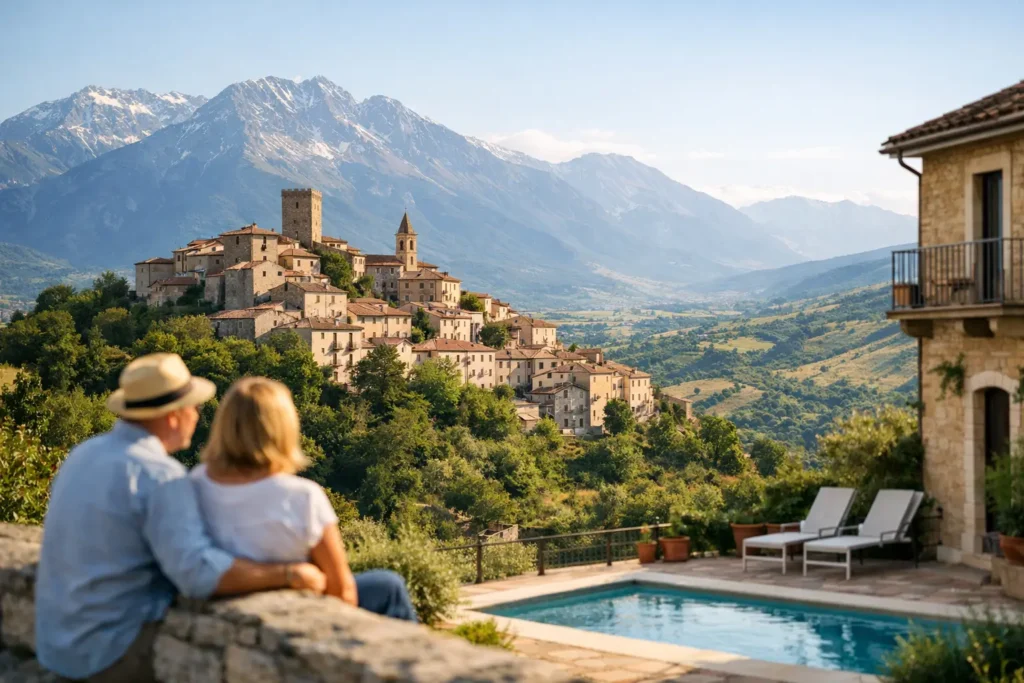
Some people arrive in Abruzzo convinced they want a medieval hill town with stone streets and mountain views.
Then they spend one rainy week without a car and start looking at the coast.
Others come dreaming of beach life, only to realise they want more space, lower prices, and the tight-knit community of the interior.
That’s why the real answer to where expats live in Abruzzo isn’t a single town.
It’s a handful of very different areas, each attracting a different kind of newcomer.
If you’re planning a move, the better question is this:
What kind of daily life do you want once the holiday feeling wears off?
The Three Types of Location Most Expats Choose
Most expats in Abruzzo settle in one of three broad environments:
- the coast
- the practical near-city areas
- or the traditional inland towns and villages
Each has clear advantages, and each comes with trade-offs that matter once you’re dealing with groceries, residency registration, and winter heating costs.
Before diving into specific towns, one thing worth flagging upfront: your location choice also affects your eligibility for Italy’s 7% flat tax for foreign retirees.
Following a 2026 law change, municipalities with fewer than 30,000 residents now qualify — which excludes Pescara (~120k), Montesilvano (~55k), and Vasto (~40k), but includes most other towns on this list.
If that incentive is part of your financial planning, it’s worth factoring into the location decision from the start.
For a detailed comparison table covering services, car dependency, rent and purchase prices, expat community size, and 7% flat tax eligibility across 17 Abruzzo towns, see our dedicated guide to the nicest towns in Abruzzo for expats.
Coastal Abruzzo: The Smoothest Transition
If you want the easiest possible start — more infrastructure, better transport, English spoken more often — the coast is usually the first place to look.
It’s also where the largest concentration of English-speaking expats is found.
Pescara
Abruzzo’s most connected city:
- Airport links to Germany, the UK, and beyond
- main train station
- full hospital infrastructure
- the largest English-speaking expat community in the region
- and a year-round urban lifestyle
The trade-offs: higher prices (city centre averaging €2,756/m² to buy as of May 2026) and Pescara’s population (~120k) means it doesn’t qualify for the 7% flat tax.
More detail in our Pescara settling-in guide and our Pescara housing guide.
Francavilla al Mare
Directly south of Pescara, with a noticeably calmer residential feel and easy sea access.
With a population of around 25,000, it now qualifies for the 7% flat tax following the 2026 threshold change.
A combination of coastal convenience and tax eligibility that’s genuinely hard to find.
Silvi and Pineto
Both have populations around 15,000 and qualify for the 7% flat tax.
Calmer coastal bases for people who want sea access with a slower rhythm.
Pineto is particularly known for its pinewoods and clean beaches.
Both go quieter off-season, which suits some people and frustrates others.
Ortona
A historic coastal town with a real working-port identity, a castle, and a year-round local atmosphere that resists the heavy seasonality affecting smaller beach towns.
Population around 23,000 — qualifies for the 7% flat tax.
More character than some coastal options, but less international expat infrastructure.
Vasto
In the south of Abruzzo, Vasto has a clifftop historic centre, one of the region’s largest English-speaking expat communities alongside Pescara, and access to the Trabocchi Coast and Punta Aderci nature reserve.
Population around 40,000 means it doesn’t qualify for the 7% flat tax — though nearby San Salvo (~19k) is worth considering as an alternative base.
The coastal trade-off: higher costs and density than inland, and the summer liveliness that attracts many people brings crowds and traffic that vanish by January.
Practical Near-City Areas: Often Overlooked, Often Smart
Areas like San Giovanni Teatino and Città Sant’Angelo frequently get dismissed by people searching for “charm” — and are often quietly chosen by people who’ve thought more carefully about what their first year in Abruzzo will actually involve.
Città Sant’Angelo
One of Italy’s officially recognised Borghi più belli (most beautiful villages), featured in Forbes as one of the top retirement destinations globally, and close to both the coast and Pescara Airport.
It offers a genuine historic hilltop centre alongside modern commercial infrastructure in the lower area.
Population around 15,000 — qualifies for the 7% flat tax.
A strong all-round choice for expats who want character without real isolation.
San Giovanni Teatino (Sambuceto)
Located between Pescara and Chieti, this is the practical, no-romance choice — and for many expats, especially in year one, that’s exactly what works.
Close to the airport, well-supplied with everyday services, strong housing value relative to Pescara.
Population around 15,000 — qualifies for the 7% flat tax.
It won’t give you stone streets and hilltop views, but it will give you reliable internet, easy parking, and proximity to every office you’ll need to visit repeatedly.
Spoltore
Another well-located town near Pescara often overlooked by newcomers.
Population around 18,000, qualifies for the 7% flat tax, good housing value, and practical daily life without full city intensity.
Inland Towns and Villages: Beautiful, Slower, and Worth Planning For
A lot of future expats picture a stone house surrounded by hills.
Abruzzo offers this in abundance.
But inland living works best when your expectations are grounded in real logistics, not holiday impressions.
More in our guide to the best Abruzzo villages for expats.
Sulmona
Often, the first recommendation for expats who want genuine inland character.
Elegant historic centre, mountain scenery, a train connection to both Pescara and Rome, and a year-round pulse.
Following the 2026 law change, Sulmona (~24k residents) now qualifies for the 7% flat tax.
Known as the birthplace of the Roman poet Ovid and famous for its sugar-coated almond sweets (confetti) tradition — a town with real cultural depth and a growing international expat community.
Guardiagrele
A gateway to the Maiella National Park with a strong local identity rooted in copper and wrought-iron craftsmanship, still practised in active artisan workshops.
Feels lived-in and substantial.
Population around 9,000 — qualifies for the 7% flat tax.
Best for expats who want genuine mountain-town immersion and are comfortable driving for services.
Penne
An elegant brick-built hilltop town with a genuine historic centre and an active English-speaking expat community relative to its size (~12k residents).
Qualifies for the 7% flat tax.
Good value, though services are more limited than in larger inland towns.
Loreto Aprutino
Known for exceptional olive oil, a small but dedicated expat community, and a genuinely quiet village pace.
Population around 7,000 — qualifies for the 7% flat tax.
Best for people who specifically want rural immersion and are fully comfortable with car-dependent daily life.
Chieti
A provincial city split between the elegant hilltop historic centre (Chieti Alta) and the flat commercial lower area (Chieti Scalo), with the train station.
Strong university presence, good everyday services, and significantly lower prices than Pescara.
Population around 51,000 — doesn’t qualify for the 7% flat tax, but offers genuine urban functionality at a fraction of Pescara’s cost.
Compared in detail in our Pescara vs Chieti guide.
Smaller hilltop villages
Santo Stefano di Sessanio, Pacentro, Castel del Monte, and others offer the most dramatic character and the lowest prices — but also the most self-sufficiency required.
Extraordinary to visit, demanding to live in full-time without real preparation.
More on these in our Abruzzo hidden gems guide.
For regional tourism and town information across the interior, the Official Abruzzo Tourism portal is a good complementary resource.
How to Choose Where to Live in Abruzzo
Start with your non-negotiables, not your dream aesthetic:
- Mobility: If you don’t want to drive daily, stay on the coast or in a well-connected urban area. Most inland towns require a car for everything.
- Language confidence: If your Italian is limited, coastal and near-city areas give you more English-language infrastructure as a bridge. Smaller inland towns are warmer and more community-oriented — but ask more of you linguistically.
- Work setup: Don’t assume every beautiful property has reliable internet. Always check actual connectivity at the specific address before committing.
- Seasonality: A town that’s vibrant in June can feel very quiet in November. Visit outside peak season before you decide — this is genuinely important advice that most relocation guides skip.
- Tax planning: If the 7% flat tax is relevant to your move, make sure your shortlisted towns fall under the 30,000-resident threshold. This rules out Pescara, Montesilvano, Vasto, and Chieti while leaving most other towns on this list eligible.
For most newcomers, renting first is the safest approach.
It gives you time to learn the rhythm of an area before committing to a purchase.
That said, the long-term rental market in Abruzzo has tightened significantly, with many landlords preferring short-term summer lets.
Our rent versus buy guide for Abruzzo covers the current market honestly.
What Expats Often Get Wrong About Location Choice
The biggest mistake is choosing with your eyes and not paying enough attention to logistics.
It’s easy to fall for a village on a sunny spring visit and miss what life there will require in January, during a bureaucratic appointment you can’t reach without a car, or when something breaks in the house.
It’s equally easy to dismiss practical towns too quickly because they feel less cinematic at first glance.
The towns that make daily life easiest in year one are not always the ones that photograph best — and year one is when you most need daily life to be manageable.
There is no single “best” expat area in Abruzzo.
The region offers genuinely different versions of a good life: near the sea with cafés and services close by, or with mountain views and a quiet local rhythm.
What matters is finding the place that supports the life you’re actually going to live — not the one that looks best in photos taken in May.
—
Not Sure Which Town Fits Your Life in Abruzzo?
This is exactly the kind of decision that benefits from honest, local, on-the-ground perspective.
Not just listings and travel photos.
At Wanderlust Abruzzo, we help English- and German-speaking expats compare areas honestly, find the right home, and settle in with bilingual support at every stage.
Personal, bilingual, and on the ground in Abruzzo.
Get in touch today and let’s talk about finding your place in Abruzzo.
—
Frequently Asked Questions
Where do most English-speaking expats live in Abruzzo?
The largest concentrations are in Pescara and the surrounding coastal towns, followed by Vasto in the south. Growing international communities also exist in Sulmona, Penne, Lanciano, and Loreto Aprutino. Online, the Abruzzo Expats Facebook group and the Life in Abruzzo community give you a realistic, town-specific picture from people actually living here.
Is it expensive to live on the Abruzzo coast?
More expensive than the inland areas, but significantly more affordable than the coastlines of Tuscany, Liguria, or Puglia. Pescara city centre averages around €2,756/m² to buy, with rental prices rising around 3.89% year-on-year as of early 2026. Smaller coastal towns like Francavilla, Silvi, and Pineto offer better value while remaining within easy reach of Pescara’s services. Full breakdown in our Abruzzo cost of living guide.
Can I live in an inland or mountain village without a car?
In the vast majority of cases, no. Public transport to smaller towns and villages is limited and often impractical for daily use. A car isn’t a luxury in inland Abruzzo — it’s infrastructure. If you’re committed to life without a car, stick to central Pescara or Chieti Scalo, where walking to services and public transport are genuinely viable.
Which area is best for remote workers?
Pescara and the commercial lower areas of Città Sant’Angelo offer the most reliable high-speed fibre internet and modern infrastructure. That said, fibre availability through OpenFiber has expanded significantly across the region — always check actual availability at a specific property address rather than relying on coverage maps. In rural areas, radio-frequency providers like Eolo or Starlink satellite internet are common. Our WiFi setup guide covers all options in detail.
Which towns in Abruzzo qualify for the 7% flat tax for retirees?
Following a 2026 law change raising the population threshold from 20,000 to 30,000 residents, the qualifying towns from this guide include Francavilla al Mare, Silvi, Pineto, Ortona, Città Sant’Angelo, San Giovanni Teatino, Spoltore, Sulmona, Guardiagrele, Penne, and Loreto Aprutino. Pescara, Montesilvano, Vasto, and Chieti do not qualify. Always verify current eligibility with a qualified Italian tax advisor. Full details in our 7% flat tax guide.

 English
 Deutsch