
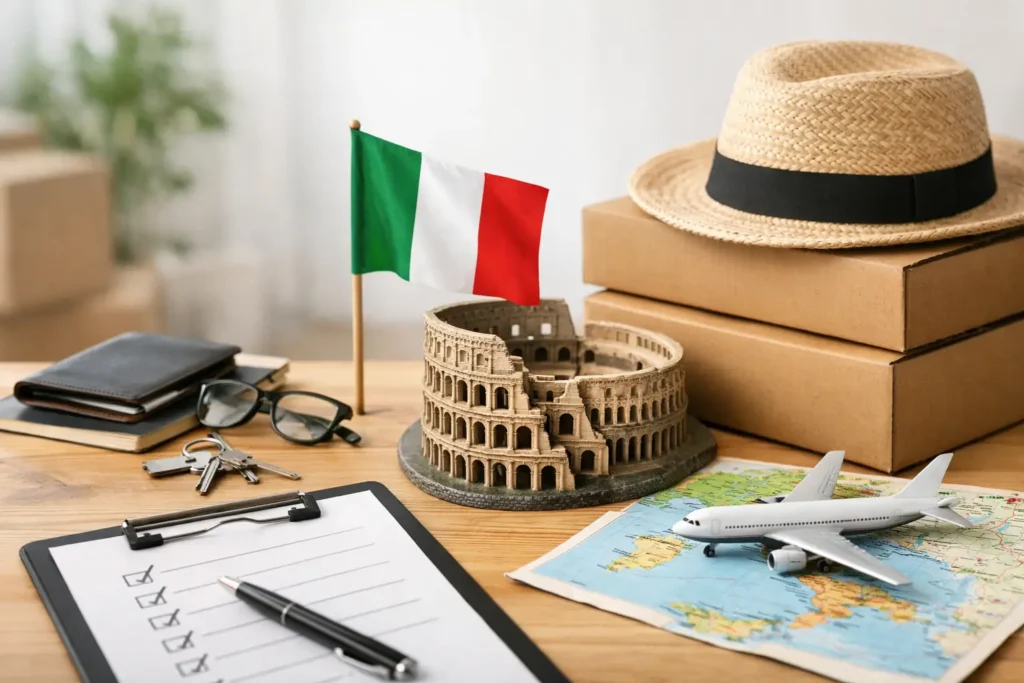
Moving to Abruzzo gets romanticized until you are staring at a lease you cannot fully read, trying to book an appointment at a Comune that doesn’t answer the phone, and realizing your international data plan won’t last the week.
That is exactly why an Abruzzo relocation checklist matters. Italy rewards the prepared and punishes the vague.
If you are moving for the “Dolce Vita”, the smartest approach is to think in stages.
Some tasks need attention months before your flight, while others only make sense once you are standing in a sun-drenched piazza in Chieti or Pescara.
Stage 1: First Steps (3–6 Months Out)
The first part of any move is about decision-making, not logistics.
Before you book movers, you must establish your legal and financial foundation.
- Define Your Legal Path: Are you an EU citizen, a Digital Nomad, or a retiree applying for Elective Residency? Your paperwork and timelines will vary wildly based on this choice.
- Build an “Abruzzo Budget”: While Abruzzo is affordable, the “Setup Month” is expensive. Factor in three months of rent as a deposit, agency fees, document translations, and initial utility deposits.
- The Document Audit: Gather paper and digital copies of your birth/marriage certificates and proof of income. If they need to be translated or legalized, do this before you leave your home country.
- Strategic Housing Research: Start researching where expats live in Abruzzo. Do you want the coastal services of Pescara or the quiet, rugged hills of Teramo?
Stage 2: Arrival & Setup (The First 14 Days)
Once you land, focus on the “Life Support” tasks that allow you to function calmly.
- The Master Key (Codice Fiscale): You cannot sign a lease or buy a permanent SIM card without your Codice Fiscale. Make this your first appointment at the Agenzia delle Entrate.
- Italian Connectivity: Get an Italian SIM card immediately. You will need a local number for everything from delivery drivers to furniture technicians.
- Short-Term “Breathing Room”: We recommend short-term housing for your first 2–4 weeks. It gives you time to view long-term rentals in person and avoid “The Idealista Trap” where photos don’t match the reality of the street.
- Opening a Bank Account: For long-term life, you’ll eventually need an Italian IBAN to set up direct debits for your electricity and gas bills.
Stage 3: Settling-In (Months 1–3)
This is where the administrative heavy lifting happens.
This stage is a sequence; if you do them out of order, the system will stall.
- Sign a Registered Lease: Ensure your landlord registers the contract with the Agenzia delle Entrate. Without a registered lease, you cannot apply for residency.
- Register for Residency (Residenza): Visit your local Comune. This is the “Master Pillar” that unlocks access to the national health system (SSN).
- Utility Coordination: Handle your Voltura or Subentro for electricity, gas, and water.
- The Waste Tax (TARI): Register for trash collection at the town hall. It’s a small step that prevents large fines a year later.
Don’t Ignore the 90-Day Residency Rule
In Italy, if you intend to stay longer than 90 days, you are legally required to register your residency.
Many expats wait too long, thinking they can “fly under the radar”.
The danger? Without residency, you will pay significantly higher “non-resident” rates on your electricity bills, and you will be unable to sign up for a local family doctor.
In Abruzzo, the vigile (local police) will physically visit your home to verify you actually live there.
Being prepared for this visit is a crucial part of the “Settling-In” phase.
Building Your Local Network: Moving Past the Paperwork
A checklist often focuses on forms, but the most successful relocations are the ones that prioritize human connection.
Abruzzo runs on relationships.
Knowing which forno has the best bread or which local mechanic is trustworthy isn’t just about “lifestyle” — it’s about survival.
Start by introducing yourself to your neighbors with a simple “Buongiorno”.
In small villages, word travels fast; being seen as a respectful, interested newcomer will open more doors than any official document ever could.
—
Why “National” Advice Often Fails in Abruzzo
In Italy, procedures are nationally defined but locally interpreted.
A clerk in a small village in the Majella mountains may request a specific document that a clerk in Pescara doesn’t care about.
This is where local guidance moves from a luxury to a necessity.
When you are trying to decode the process and the local dialect at the same time, simple tasks feel heavy.
Having a “Bilingual Bridge” ensures you are doing the right task at the right time.
At Wanderlust Abruzzo, we help English- and German-speaking expats navigate this exact roadmap.
We don’t just give you the list; we attend the appointments with you to ensure nothing gets lost in the “Language Trap”.
—
Frequently Asked Questions
What is the most common mistake on an Abruzzo relocation checklist?
Assuming you can find a long-term rental from abroad. Most Italian landlords want to meet you in person to build trust. Booking a viewing trip or hiring a local viewing partner is the only way to ensure the house is residency-compliant.
How much money should I have saved for my Arrival & Setup?
For a smooth transition, we recommend having at least €5,000–€7,000 accessible for the first two months. This covers your rental deposit (usually 2-3 months), agency fees, first month’s rent, and initial utility deposits.
Can I apply for residency before I have a house?
No. To register for residency in Italy, you must have a legal right to occupy a specific address, evidenced by a registered lease or a purchase deed.
Do I need a car in Abruzzo?
If you live in the heart of Pescara, you can get around by train. However, for the hills, smaller villages, or even reaching the major supermarkets and public offices, a car is essential for daily life.
How long does the “Settling-In” phase take?
From your arrival to being “fully settled” (with residency and a health card), expect a timeline of 3 to 6 months, depending on the efficiency of your local Comune.

 English
 Deutsch