
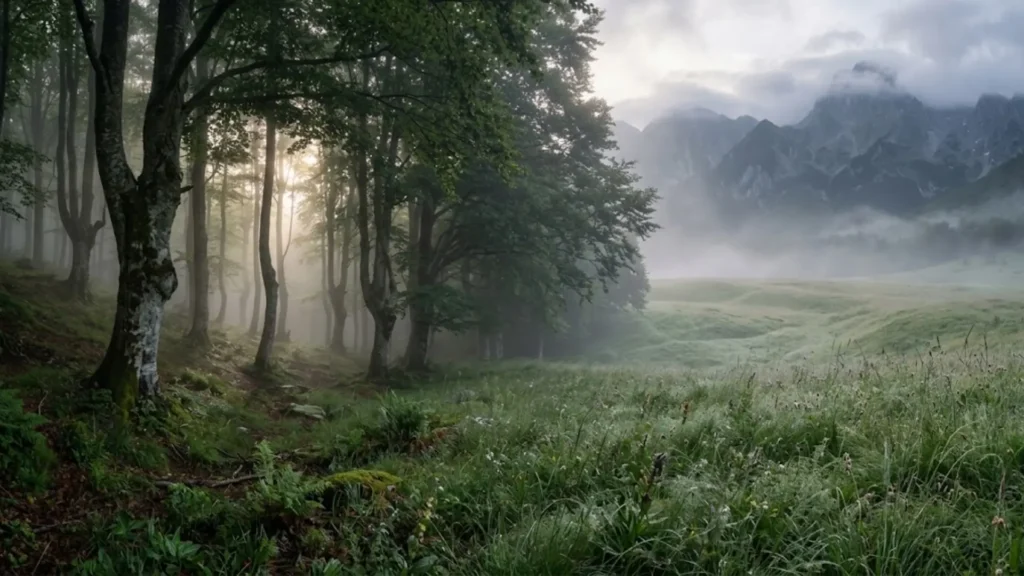
If you’ve searched for wolves or bears in Abruzzo, you’ve likely landed here for a reason: this region is home to one of Europe’s genuinely rarest and most remarkable wildlife conservation stories.
Abruzzo National Park isn’t just a scenic protected area.
It’s the reason the Marsican brown bear still exists at all, and it’s the most famous of the region’s three national parks.
What Is Abruzzo National Park?
Its official name is Parco Nazionale d’Abruzzo, Lazio e Molise (PNALM), reflecting that its protected territory now spans across all three neighbouring regions, though its historic and administrative heart remains firmly in Abruzzo.
Es ist Italy’s oldest national park, and one of the oldest in Europe.
How the park began
The park’s origins trace back to the late 19th century, when only a handful of Marsican brown bears and Apennine chamois survived in these mountains, hunted to the brink of extinction.
King Victor Emmanuel II first established a royal hunting reserve to halt the slaughter, though it was later closed due to maintenance costs.
The real turning point came on October 2, 1921, when a federation from Bologna leased land in the Camosciara area from the municipality of Opi, forming the park’s original core.
By November 25, 1921, the autonomous body of the Abruzzo National Park was formally established, with the park’s boundaries expanding steadily over the following century to its current size.
Today, the park covers roughly 50,000 hectares of core protected territory, with an additional 80,000-hectare buffer zone — making it not only Italy’s oldest national park, but also its richest in biodiversity.
Abruzzo’s Three National Parks
Parco Nazionale d’Abruzzo, Lazio e Molise (PNALM) is Abruzzo’s oldest and most internationally famous protected area, but it’s actually one of 3 national parks within the region.
A genuinely rare concentration that gives Abruzzo its reputation as one of Italy’s greenest regions.
- Parco Nazionale d’Abruzzo, Lazio e Molise (PNALM) — covered in this post, home to the Marsican brown bear and the region’s founding conservation story.
- Parco Nazionale del Gran Sasso e Monti della Laga — centred on the highest peak in the Apennines, including the striking high-altitude plateau of Campo Imperatore. We cover this park in detail in our dedicated Gran Sasso guide.
- Parco Nazionale della Majella — a wilder, less-visited park known for its dramatic gorges, extensive cave systems, and its own resident wolf population. Also covered in our dedicated Majella guide.
Together, these three parks — alongside several smaller regional reserves — mean roughly a third of Abruzzo’s total territory sits under some form of environmental protection.
That’s part of what gives the region its distinctive character: real, functioning wilderness within a short drive of coastal towns, historic hill villages, and everyday services.
Our post on what Abruzzo is known for covers this broader identity in more depth.
The Marsican Brown Bear: Europe’s Rarest Bear
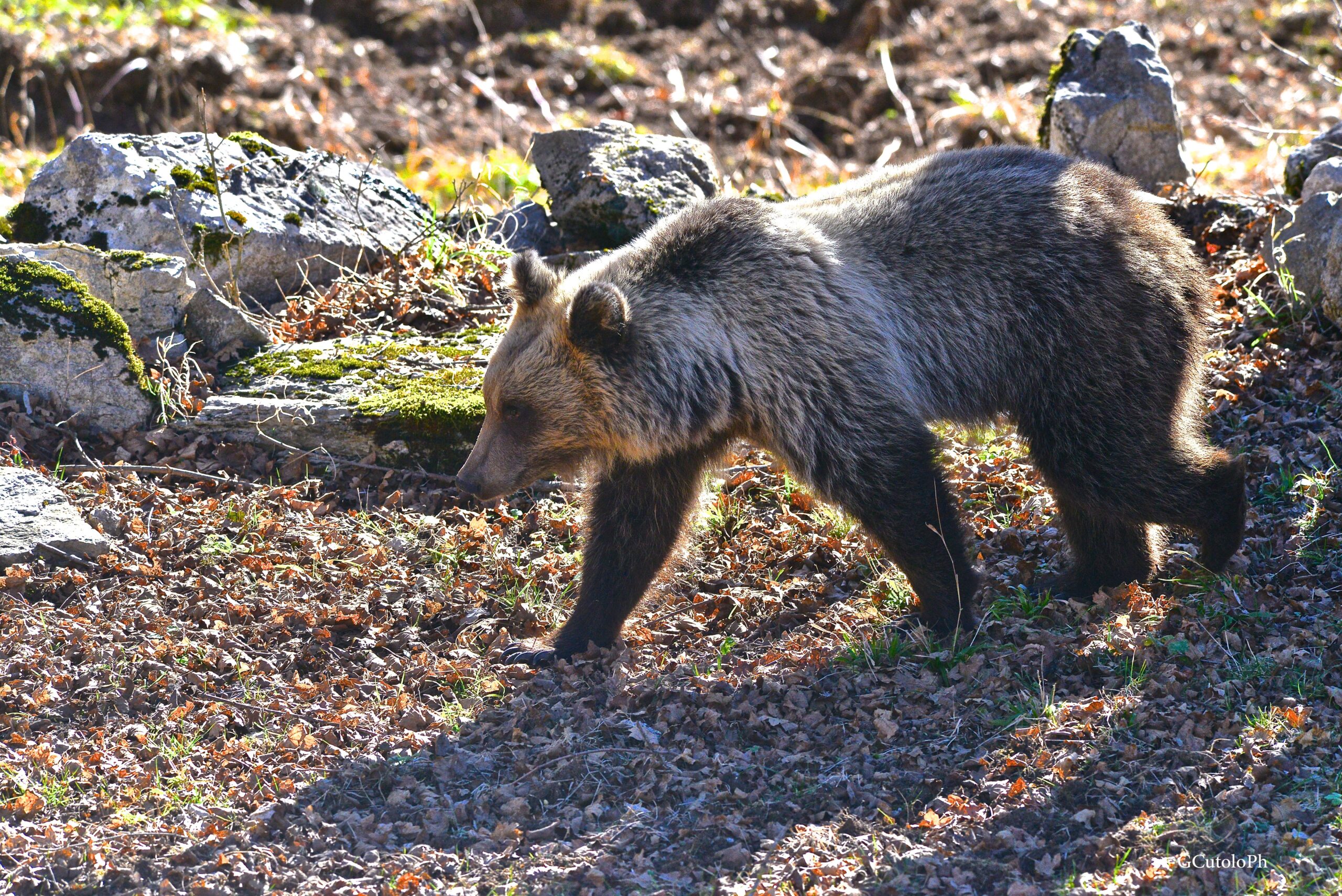
The park’s most famous resident — and the entire reason it was founded — is the Marsican brown bear (Ursus arctos marsicanus), a genetically distinct population isolated in these mountains for an estimated 3,000–4,000 years.
How many bears live in Abruzzo?
This is one of the most searched questions about the park, and the honest answer has genuinely improved in recent years.
A July 2026 population estimate reports 81 Marsican brown bears in the central Apennines (43 females, 38 males) — up meaningfully from around 50 individuals in 2014.
This makes the Marsican bear one of the very few large European carnivore populations showing genuine, measurable recovery, though it remains classified as Critically Endangered by the IUCN due to its extremely low genetic diversity and small overall numbers.
What makes this bear different from other brown bears
The Marsican brown bear is smaller than its Alpine and northern European cousins.
Males can weigh up to around 200kg, females up to roughly 140kg.
It has developed distinct behavioural traits from its long isolation, including notably solitary, quiet habits.
It primarily inhabits elevations between 800 and 1,700 metres, favouring beech forest, though it also forages in lower-altitude oak woods, orchards, and open grasslands.
Bears feed almost entirely on what the forest provides: fruits, berries, grasses, insects, honey, roots, and occasionally other animals.
Sightings require genuine patience.
The best chances tend to be spring (April–May, when bears emerge from hibernation actively foraging), and early morning or dusk during summer months.
The Apennine Wolf
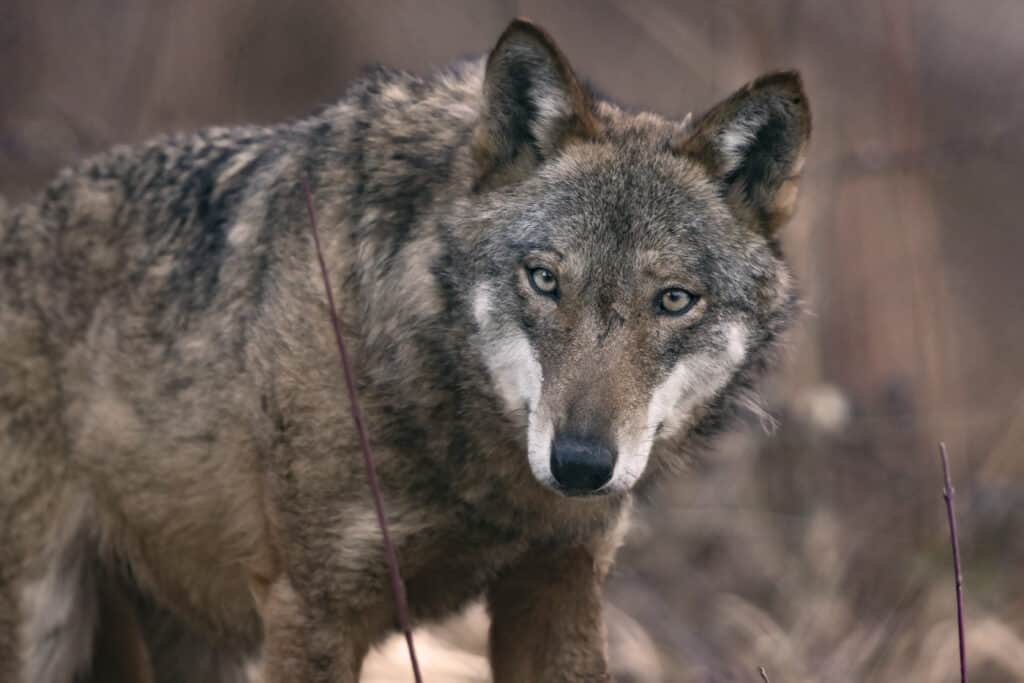
Alongside the bear, the park is home to the Apennine wolf (Canis lupus italicus) — a subspecies that came dangerously close to extinction by the early 1980s, surviving only in isolated pockets including the protected valleys of this park and the Sila mountains further south.
Sustained conservation work over the following decades has allowed the wolf population to recover significantly, and Apennine wolves have since expanded well beyond the park’s boundaries into much of peninsular Italy.
Unlike the bear, wolves are considerably more elusive and far less frequently sighted by visitors.
Their recovery is measured more through tracking, howling surveys, and camera trap data than casual observation.
What Else Lives in the Park?
Beyond its two most famous residents, the park supports an extraordinary range of wildlife for a relatively compact protected area:
- The endemic Apennine chamois (Rupicapra pyrenaica ornata), a mountain goat species found almost nowhere else on Earth
- Golden eagles, alongside black kites and peregrine falcons
- Red deer, roe deer, and wild boar
- Over 60 mammal species, roughly 300 bird species, and around 40 reptile species in total
Visiting Responsibly
The park’s most accessible base for visitors is the town of Pescasseroli, home to the park’s main visitor centre, where guided wildlife-watching programmes are organised.
Given the bear population’s extremely fragile status, responsible visiting matters more here than in most national parks.
This means:
- staying on marked trails
- keeping a genuine distance from any wildlife encountered
- never approaching or feeding animals
- and, where possible, joining a guide-led observation rather than attempting solo wildlife tracking
Organisations including Salviamo l’Orso (an Italian volunteer conservation association dedicated to the Marsican bear) offer awareness events and updates for anyone genuinely interested in supporting the population’s continued recovery.
A worthwhile resource whether you’re visiting for a week or considering the region as a longer-term home.
—
Considering a Longer Stay Near Abruzzo’s Wilderness?
Living close to genuine nature — mountains, protected parks, real seasons — is one of the most common reasons people choose Abruzzo over more crowded parts of Italy.
We help make that move happen practically.
Bei Wanderlust Abruzzo, we help English- and German-speaking expats relocate to, and settle into life in Abruzzo.
Persönlich, zweisprachig und direkt vor Ort.
Kontaktiere uns noch heute und lass uns über deinen Umzug nach Abruzzo sprechen.
—
Häufig gestellte Fragen (FAQs)
How many bears live in Abruzzo National Park?
A 2026 estimate places the Marsican brown bear population at 81 individuals across the central Apennines — up from around 50 in 2014. Despite this genuine recovery, the species remains Critically Endangered due to its very low genetic diversity and small overall population size.
How many wolves are there in Abruzzo?
Exact current population figures are harder to pin down precisely than the closely monitored bear population, since wolves range more widely and are tracked primarily through indirect methods like camera traps and howling surveys. What’s well documented is the trajectory: the Apennine wolf nearly went extinct by the early 1980s and has since recovered significantly, expanding from small protected pockets in Abruzzo and Calabria into much of peninsular Italy today.
Is Abruzzo National Park safe to visit given the wolves and bears?
Yes, with normal outdoor precautions. Both species are naturally elusive and avoid human contact; the greater practical risk to visitors is typical hiking terrain rather than wildlife encounters. Staying on marked trails, keeping food secured, and never approaching or feeding wild animals is standard, responsible practice — actual dangerous encounters are extremely rare.
What is the best time to see wildlife in Abruzzo National Park?
Spring (April–May) tends to offer the best bear-sighting opportunities, as bears emerge from hibernation and forage actively. During summer, early morning and dusk are the most productive windows. Wolves are considerably harder to spot regardless of season, given their naturally cautious behaviour around humans.
Is Abruzzo National Park the same as the whole Abruzzo region?
No. The park is one specific protected area within the wider Abruzzo region — officially named Parco Nazionale d’Abruzzo, Lazio e Molise since its territory now extends into those neighbouring regions too. Abruzzo, the region, also contains two additional national parks (Gran Sasso e Monti della Laga, and Maiella), together protecting roughly a third of the region’s total land area.


 English
 Deutsch