
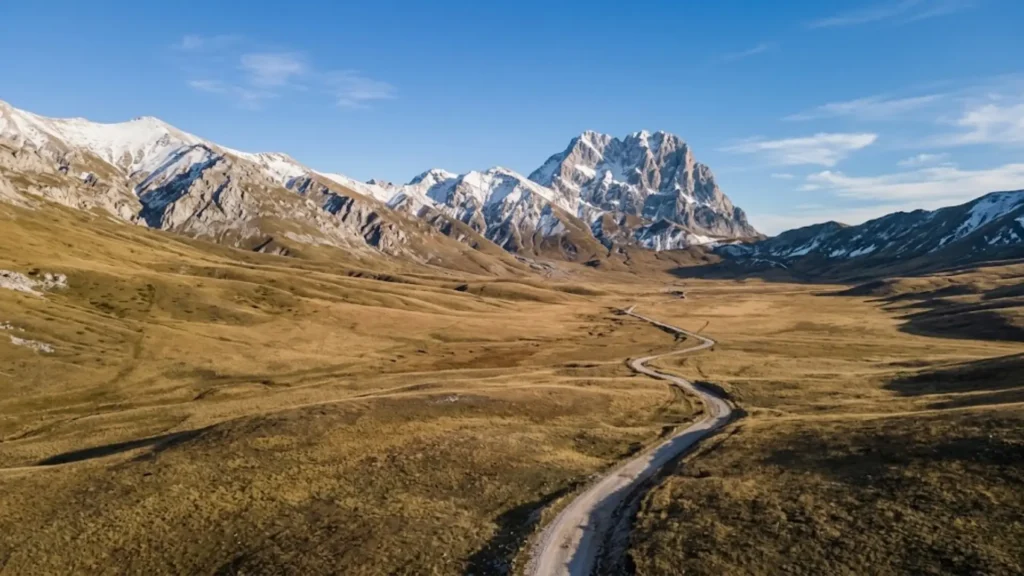
Wenn Abruzzo National Park is famous for its bears, Gran Sasso is famous for its scale.
This is where the Apennines reach their highest point, where you’ll find one of the strangest and most photographed landscapes in Italy, and where a slice of genuinely dramatic 20th-century history happened to unfold at nearly 2,000 metres above sea level.
What Is Gran Sasso e Monti della Laga National Park?
Established in 1991, the park covers approximately 140,000 hectares (some sources cite the core protected area at 1,413 km²), making it the third-largest national park in Italy, behind only Cilento, Vallo di Diano e Alburni, and Pollino.
It spans three regions — Abruzzo, Lazio, and Marche — though its geographic and cultural centre of gravity sits firmly in Abruzzo, particularly around the province of L’Aquila.
The park is genuinely two landscapes in one:
- The Gran Sasso massif forms the dramatic, rocky, high-altitude core — Italy’s most vertical mountain scenery outside the Alps.
- The Monti della Laga range to the north is entirely different in character: heavily forested, softer in profile, with rivers, waterfalls, and a noticeably wetter, greener feel than the stark Gran Sasso peaks.
Corno Grande: The Highest Peak in the Apennines
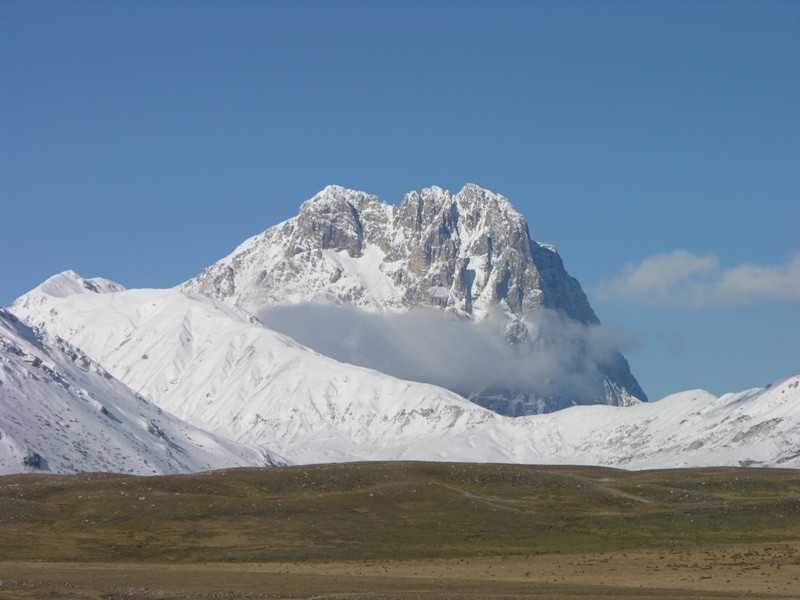
The park’s undisputed centrepiece is Der Corno Grande, standing at 2,912 metres — the highest point in the entire Apennine range, and one of the most recognisable mountain silhouettes in central Italy.
The peak has multiple named summits, with the western summit (Vetta Occidentale) marking the true highest point.
Beneath Corno Grande’s northern face lies the Calderone, widely considered Europe’s southernmost glacier.
Though, like glaciers across the continent, it has retreated significantly in recent decades and is now more accurately described as a glacial remnant.
Its continued existence at this latitude remains a genuine geographic curiosity.
Campo Imperatore: Italy’s “Little Tibet”
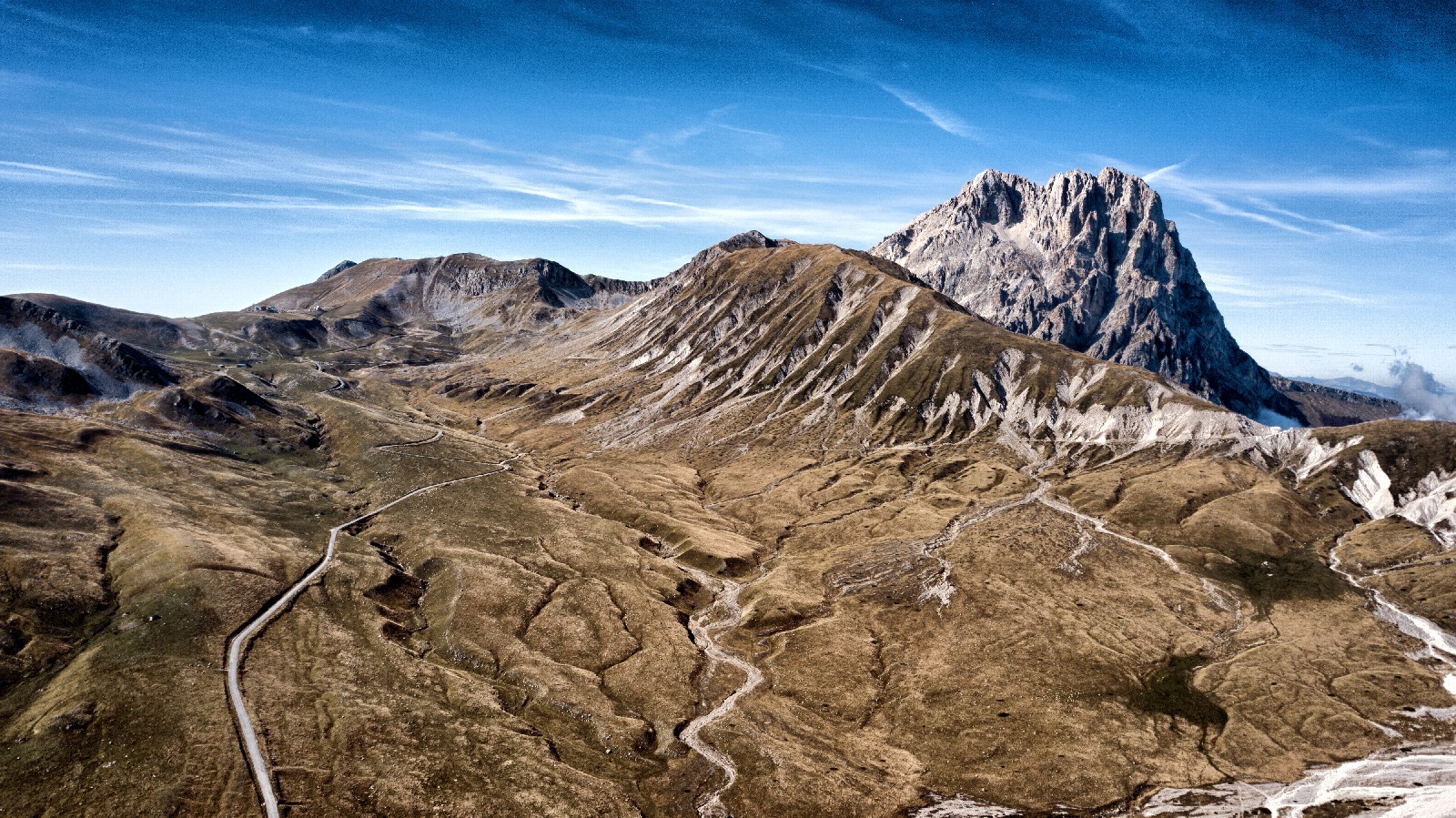
If one single place defines this park in photographs, it’s Campo Imperatore.
A vast, basin-shaped alpine plateau stretching roughly 27km long and 8km wide, sitting between 1,500 and 1,900 metres in elevation.
Its scale, emptiness, and stark rolling grassland have earned it the enduring nickname “Little Tibet” among Italians — a comparison that, once you see photographs of the place, makes immediate sense.
A surprising piece of history
Campo Imperatore isn’t just scenically dramatic.
It’s also the site of one of the more remarkable episodes in modern Italian history.
The historic Hotel Campo Imperatore (also known as Albergo di Campo Imperatore) served as Benito Mussolini’s prison from August 28 to September 12, 1943, following his removal from power.
He was famously extracted in a daring German glider-and-paratrooper rescue operation.
A story that still draws historically curious visitors to the site today, alongside the hikers and photographers who come for the landscape alone.
Wildlife and Landscape Diversity
The park’s dramatic range of altitudes and geology creates genuine ecological diversity within a relatively compact area.
At the highest elevations, where summits reach nearly 3,000 metres, the terrain preserves rare glacial relict environments and endemic alpine flora and fauna found almost nowhere else in Italy.
Lower down, the landscape shifts dramatically — almond trees, vineyards, and olive groves appear in the valleys well before you’ve left the park’s official boundaries.
The park is also home to the Tirino river, frequently cited as having some of the clearest water in Europe, and to Lake Campotosto on the northern side of the Monti della Laga range, an important seasonal stopover point for thousands of migratory birds.
Visiting Gran Sasso and Campo Imperatore
Most visitors start at Campo Imperatore itself, which is the starting point for the majority of the park’s well-marked hiking trails, including the main route up Corno Grande.
The plateau is accessible by road and, seasonally, by cable car from the nearby town of Assergi.
A few practical notes worth knowing before visiting:
- Best seasons: late spring and early autumn generally offer the most comfortable hiking conditions and the best wildflower or foliage displays
- Avoid August for serious climbing on Corno Grande specifically — the combination of crowds and elevated rockfall risk makes this a less ideal period for the more technical routes
- Mountain weather changes quickly at this altitude, even in summer — proper layers and a genuine respect for changing conditions matter here more than at lower-altitude Abruzzo destinations
- The winding access roads up to Campo Imperatore involve sharp curves and can see slow-moving traffic including large vehicles — a straightforward drive, but one that rewards a bit of patience rather than rushing
Part of Abruzzo’s Three National Parks
Gran Sasso e Monti della Laga is one of three national parks within the Abruzzo region.
Alongside the wildlife-focused Abruzzo National Park (PNALM), home to the Marsican brown bear, and the more rugged, less-visited Parco Nazionale della Majella, covered in our dedicated Majella guide.
Together, these three parks protect roughly a third of Abruzzo’s total territory.
A genuinely rare concentration of wilderness for a single Italian region, and part of what gives Abruzzo its reputation as one of the country’s greenest.
—
Considering Life Close to Mountains Like These?
Living within reach of genuine high-altitude wilderness — not a scenic backdrop, but a real, accessible mountain range — is one of the most distinctive things Abruzzo offers compared to almost anywhere else in Italy.
Bei Wanderlust Abruzzo, we help English- and German-speaking expats relocate to, and settle into life in Abruzzo.
Persönlich, zweisprachig und direkt vor Ort.
Kontaktiere uns noch heute und lass uns über deinen Umzug nach Abruzzo sprechen.
—
Häufig gestellte Fragen (FAQs)
What is the highest peak in the Apennines?
Corno Grande, at 2,912 metres, located within Gran Sasso e Monti della Laga National Park in Abruzzo. It’s the highest point in the entire Apennine mountain range, which runs the length of the Italian peninsula.
Why is Campo Imperatore called “Little Tibet”?
The nickname comes from the plateau’s stark, expansive, high-altitude grassland landscape — its scale, emptiness, and dramatic mountain backdrop bear a genuine visual resemblance to the Tibetan Plateau, which is why the comparison has stuck among Italians and increasingly appears in international travel content too.
Is it true Mussolini was imprisoned in Abruzzo?
Yes. Following his removal from power in July 1943, Benito Mussolini was held at the Hotel Campo Imperatore, on the Gran Sasso plateau, from late August until his dramatic rescue by German forces on September 12, 1943. The historic hotel building still stands on the plateau today.
Does Gran Sasso National Park have an actual glacier?
Yes — the Calderone glacier, located on the northern face of Corno Grande, is widely cited as Europe’s southernmost glacier. Like most glaciers globally, it has retreated substantially in recent decades, and today is more precisely described as a glacial remnant rather than an active glacier in the traditional sense.
How does Gran Sasso National Park compare to Abruzzo National Park?
They’re genuinely different experiences. Abruzzo National Park (PNALM) is centred on wildlife conservation — most famously the Marsican brown bear — within dense beech forest terrain. Gran Sasso is defined by dramatic high-altitude, largely treeless mountain landscape, including the Apennines’ highest peak and the striking Campo Imperatore plateau. Both sit within the same region, but they offer quite different visiting experiences.


 English
 Deutsch