
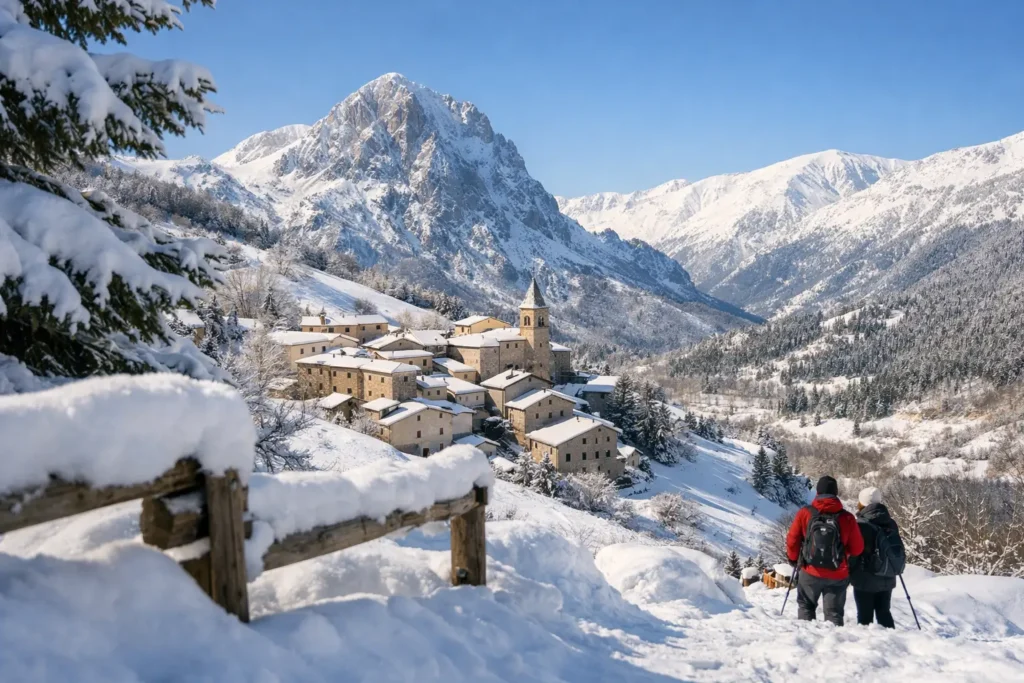
If you’re planning a move and asking yourself whether it snows in Abruzzo, you’ve already stumbled onto one of the most important and underappreciated questions in Abruzzo relocation research.
Because the answer isn’t just yes or no.
It’s: it depends on where you choose to live — and that distinction matters more than most people realise when they’re scrolling through beautiful property listings from a warm apartment somewhere far away.
Abruzzo is one of those rare regions where you can have beaches, rolling hills, medieval hilltop villages, and some of the highest peaks in peninsular Italy all within a relatively short drive of each other.
That geographic variety is a big part of its appeal.
But it also means winter looks completely different depending on your postcode.
Two towns that look equally charming in a summer photo can feel worlds apart in January.
So rather than a simple yes or no, let’s talk about what snow in Abruzzo actually looks like — in real life, for people who are going to be living here, not just visiting.
Abruzzo’s Two Distinct Climates
The coastal and maritime side
The stretch of coast along the Adriatic — around Pescara, Francavilla al Mare, Silvi, Pineto, Vasto — has what climate experts call a transitional Mediterranean climate.
Winters here are mild, damp, and occasionally windy.
According to Climates to Travel, coastal areas experience mild winters with average temperatures around 8°C (46°F).
Snow can happen, and during cold snaps from Eastern Europe, it sometimes does, but it tends to be brief and infrequent rather than a defining feature of the season.
If you’re moving from northern Germany, Austria, or the UK, coastal Abruzzo winters will likely feel very manageable.
Chilly, sometimes grey — but not harsh.
The mountain and interior side
Move inland, and the story changes quickly.
The Apennine interior has continental characteristics, and the region is exposed to cold winds from Eastern Europe, which can bring snowfalls in winter, after being loaded with moisture from the Adriatic.
In the highest areas — Gran Sasso, Maiella, the national park zones — snow is a normal, expected part of winter, not an occasional surprise.
According to Leben in Abruzzo, at altitudes between 55 and 1,000 metres above sea level in Abruzzo’s interior mountainous areas, you can expect around 38 days of settled snow per year.
At ski resort altitudes of 2,000 metres or more, that figure rises to up to 190 days — making the area excellent for skiing and cross-country skiing anywhere between December and the beginning of April.
That’s a meaningful number for anyone considering a property in the hills or mountains.
It doesn’t mean you’ll be snowed in for months, but it does mean winter deserves serious thought in your decision-making.
When Does It Snow in Abruzzo?
The core snow season runs from December through February, with the possibility of early snowfall in late November or late-season snow in March and April at higher elevations.
In the mountainous areas, December through February consistently brings cold, often snowy conditions.
What this looks like in practice
In coastal areas, you might see a light dusting once or twice across the whole winter, or none at all.
In hill towns at medium elevation, you can typically expect snow a handful of times each season, usually melting within a few days.
In mountain villages and higher terrain, snow arrives in earnest and stays.
It’s also worth noting that winters vary considerably from year to year.
Some are genuinely mild.
Others bring cold snaps that push snow much further down toward the coast than usual.
That unpredictability is part of the reality of living here, and it’s worth factoring in rather than assuming the quieter winters will be the norm.
Does It Snow Enough for Winter Sports?
Absolutely, in the right areas.
Abruzzo has a well-established ski infrastructure, with resorts including Roccaraso, Campo Felice, and Ovindoli drawing both locals and visitors from Rome and beyond each winter.
If you’re moving here and love skiing, you’re in a region that can genuinely support that lifestyle — something that’s not always possible in coastal southern Europe.
This is also part of what makes Abruzzo unusual compared to other regions.
Driving just 40 minutes from the Adriatic coast in January puts you in mountain conditions where temperatures can often drop below zero, and a fireplace becomes your best friend.
Sea to ski in under an hour is a real thing here, not a marketing slogan.
You can read more about what makes Abruzzo geographically distinctive in our post on what Abruzzo is famous for.
What Snow Means for Daily Life
If you live on the coast or at low elevation
Winter is generally manageable and rarely disruptive.
You might deal with a rainy week or a cold snap, but the kind of weather that requires serious preparation or changes your daily routine is uncommon.
If you live in a hill town at medium elevation
You’ll likely have a few snowy days each season.
Most towns handle this well — roads are cleared, routines continue.
But it’s worth checking road access to your specific property, especially if you’re on a narrow lane or on the edge of town.
Older homes in these areas can also feel colder than expected if they lack good insulation — something that surprises many newcomers more than the snow itself.
If you live in a mountain village or at high elevation
Snow is part of your life from December through to late winter, and planning around it is just part of how things work.
Italian snow ploughs are remarkably efficient — no matter how small the road, they are nearly always cleared, and unless you’re going skiing, you’re unlikely to need chains on your tyres (even if they are mandatory to carry them in the car with you from October to April).
That said, mountain living requires a certain practical mindset: keeping fuel stocked, knowing your road conditions, and being comfortable with the idea that some days are slower than others.
The question expats rarely think to ask isn’t “does it snow?” It’s “how does this specific house handle winter?” — and that distinction makes all the difference.
What to Think About Before Choosing a Winter Location
If mountain or hill living appeals to you, that’s not a problem — it’s a genuinely wonderful way to experience Abruzzo.
But it’s worth walking through a few practical questions before you commit.
Driving and access
Are you comfortable driving on steep, narrow, or winding roads in winter conditions?
Not every property is difficult to reach, but some are.
This is especially worth testing during a property viewing — ideally in autumn or winter, not just in summer when everything looks accessible and easy.
Proximity to services
How far are you from a supermarket, pharmacy, train station, or medical facility?
In summer, 20 minutes feels like nothing.
In winter, on a snowy road, it feels different.
Knowing where expats actually live in Abruzzo and why they’ve chosen those locations can give you a useful reality check.
The home itself
When you’re viewing properties, pay close attention to the heating system, window quality, insulation, and how the home was used by previous owners.
A beautiful stone farmhouse is a dream — and if it hasn’t been properly updated, January can feel very long inside it.
This is exactly the kind of detail that’s worth having someone experienced by your side during viewings, rather than discovering after you’ve moved in.
Should Snow Put You Off Moving to Abruzzo?
For the vast majority of people considering a move here, no, snow shouldn’t be a deterrent.
It should be a factor that helps you choose more wisely.
Many expats find that Abruzzo’s seasonality is one of its greatest qualities.
You get proper summers, genuine autumn colour, a real winter, and spring wildflowers.
That variety — in a region that still offers incredible value, authenticity, and a pace of life most of Europe has lost — is genuinely rare.
As Climates to Travel notes, the region’s dual climate — maritime on the coast, continental in the interior — means it offers genuinely diverse living conditions within a very compact geography.
The key is matching the place to the life you actually want to live, year-round.
- If ease, convenience, and mild winters are priorities, the coast and lower hill towns suit you well.
- If mountain scenery, real seasons, and a fireplace in January sound perfect, the interior areas may be exactly right.
What doesn’t work is choosing a place based only on how it looks in July, without imagining what February feels like when you need to drive to an appointment, your heating has an issue, and the nearest town is 20 minutes away on a winding road.
That’s not a reason to avoid Abruzzo — it’s a reason to choose your part of Abruzzo with care, ideally with someone who knows the region from the inside.
You can get a broader sense of the region’s geography and what different areas feel like in our guide to the best places to live in Abruzzo.
—
Thinking About Where to Live in Abruzzo This Winter?
Choosing the right location is one of the most important decisions you’ll make in your whole relocation process — and winter conditions are one of the things that’s genuinely hard to assess from a distance.
Photos don’t tell you how cold the house gets.
Listings don’t mention the road conditions in January.
And forums give you opinions, not expertise.
At Wanderlust Abruzzo, we help English- and German-speaking expats understand not just where to look, but what life really feels like in different parts of the region — across all seasons.
Whether you’re still deciding on your area or already have a property in mind, we’d love to help you think it through.
Get in touch today and let’s talk about your move to Abruzzo
—
Häufig gestellte Fragen (FAQs)
Does it snow a lot in Abruzzo, Italy?
It depends where you are. Coastal areas see occasional, light snowfall most winters. Hill towns at medium elevation typically get snow a handful of times per season. Mountain areas in the interior — particularly around Gran Sasso and the Maiella massif — get regular, sustained snow from December through February, with some years extending into March or even April at the highest elevations.
Which parts of Abruzzo get the most snow?
The most snow falls in the mountainous interior, particularly around the Gran Sasso massif, the Maiella area, and the national park zones. Ski resorts like Roccaraso and Campo Felice are specifically located in these areas because of the reliable snowfall. Coastal towns near the Adriatic see significantly less snow and milder winters overall.
Is winter in Abruzzo difficult for daily life?
In most areas, daily life continues normally through winter. Abruzzo’s mountain communities are well-adapted to seasonal weather, and roads are generally cleared efficiently after snowfall. The main things to plan for are the heating quality of your home (older properties can be cold if not well-insulated), road access to rural properties, and proximity to essential services if you live in a more remote location.
What are winter temperatures like in Abruzzo?
On the coast, January averages around 6–8°C (43–46°F). Inland at lower altitudes, temperatures are colder and can drop below freezing during cold snaps. In mountain areas like L’Aquila, which sits at around 700 metres above sea level, January averages are around 3.5°C (38°F), with temperatures sometimes dropping to -10°C or lower during particularly cold spells.
Should I visit Abruzzo in winter before deciding to move there?
Yes — genuinely, yes. Visiting in winter, or at least in late autumn, gives you a much more honest picture of a location than a summer visit does. You’ll see the town’s actual rhythm, understand the road conditions, feel how the property handles cold, and get a sense of what daily life looks like outside of tourist season. For many people, that visit either confirms the choice or usefully redirects it before any commitment is made.


 English
 Deutsch