
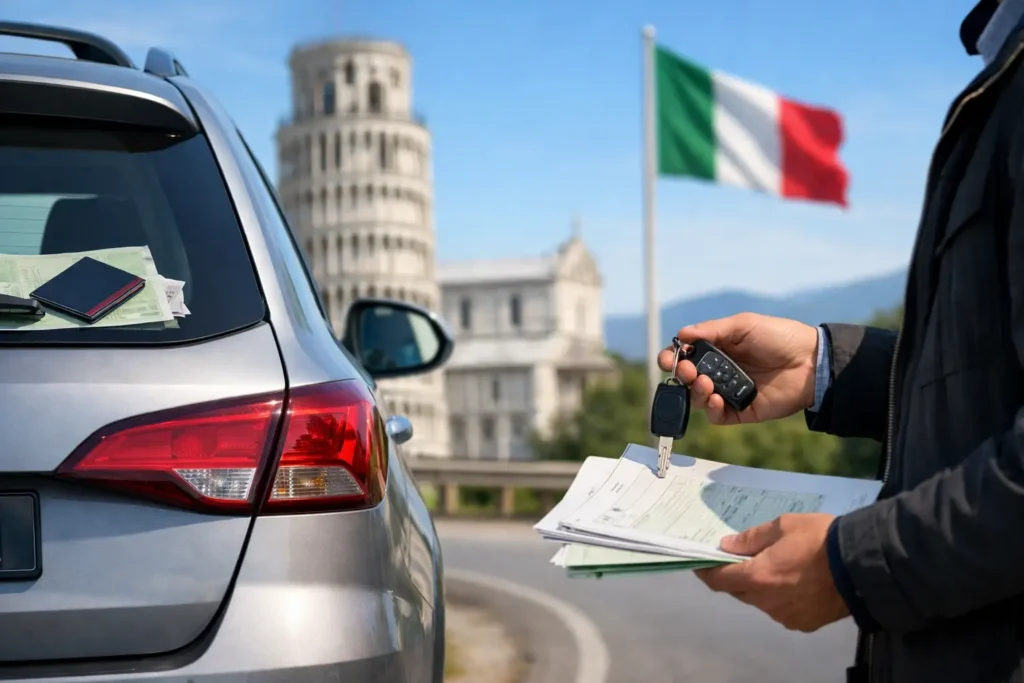
You can be fully settled into your new life in Italy and still feel stuck because of one thing sitting outside your house: your car. Foreign car registration Italy questions tend to show up right when you think the hardest part of the move is behind you.
Then the paperwork starts, the rules seem to shift depending on your situation, and a simple plan suddenly turns into a chain of appointments, translations, and missing documents.
That disconnect is what catches many expats off guard.
Driving your own car into Italy feels easy enough (not for some, though).
Keeping it there legally, and getting it properly registered if needed, is where things become complicated.
Registering your foreign car registration in Italy is not always straightforward
The first thing to know is that there is no single answer that fits everyone.
Whether you need to register your foreign car in Italy depends on:
- where the car is currently registered
- where you normally live
- how long you have been in Italy
- whether the vehicle comes from an EU country or from outside the EU
Das ist der Grund, warum sich der well-meaning advice from friends or Facebook groups often creates more confusion than clarity.
One person may have imported a German car after becoming a resident.
Another may still be using a foreign-plated vehicle under a different set of circumstances.
Their experience can be real and still not apply to you.
If you are moving to Italy permanently or becoming an Italian resident, assume that you need to check your position early rather than later.
Waiting until you have already completed the move can make the process feel much more urgent.
The question that matters first: are you becoming a resident?
For most expats, residency is the turning point.
Once you are officially resident in Italy, the rules around using a foreign-registered vehicle become more restrictive.
That is often the moment when a car that seemed convenient suddenly needs a proper Italian registration path.
This matters because many people plan their move in stages.
They arrive first, sort housing, work through residency registration, and only afterward realize the car issue has changed. If the vehicle is central to daily life – school runs, shopping, commuting, visiting smaller towns – that timing can create a lot of stress.
The practical takeaway is simple: treat your car as part of your relocation planning, not as an afterthought.
It belongs in the same category as housing, Papierkram für den Wohnsitz, utilities, und healthcare registration.
For most expats, residency is the legal trigger.
According to the Italian Highway Code (Codice della Strada), once you are officially a resident, the window to use a foreign-plated vehicle is narrow.
- The Rule: You have 3 months from the date you obtain your Residenza to register your car with Italian plates.
- The Risk: Roadside checks are frequent. Driving a foreign-plated car past this deadline can result in heavy fines, vehicle impoundment, or a forced export of the car.
What usually makes foreign car registration in Italy difficult
The hardest part is rarely one dramatic obstacle.
More often, it is the accumulation of small bureaucratic demands (and the waiting lines at the Motorizzazione Civile).
A document that was accepted in one office may be questioned in another.
A paper from your home country may need to match exactly what the Italian office expects.
If a technical detail on the vehicle paperwork is missing, the process can stall.
In many cases, you will need:
- a combination of ownership documents
- proof of identity
- residency-related paperwork
- vehicle records
Depending on the origin of the vehicle, there may also be technical compliance requirements or additional steps before registration can move forward.
Language adds another layer.
Even people who are comfortable ordering lunch or chatting with neighbors in Italian can feel completely out of their depth when dealing with vehicle bureaucracy.
Car registration language is specific, form-heavy, and easy to misunderstand.
Then there is the emotional side, which people often underestimate.
Bureaucracy is tiring when it affects convenience.
It feels much heavier when it affects mobility.
If your car is the thing that lets you function independently, delays can feel personal very quickly.
EU vehicles and non-EU vehicles are not the same story
This is one of the biggest sources of misunderstanding.
Bringing in a car from another EU country is generally a different process from bringing in a car from outside the EU.
The underlying paperwork, customs position, and technical checks may not be the same.
- For EU-origin vehicles, the path may feel more familiar on paper, but that does not mean it is simple. You will need the original registration certificate, a technical data sheet (often provided by the manufacturer), and proof of your Italian residency. You still need the right supporting documents, and missing or inconsistent records can cause delays.
- For non-EU vehicles (USA, UK, Canada), the process can become more document-heavy and more time-sensitive. You may need to deal with Customs (Dogana) and potential VAT (IVA) implications. People are often surprised by how much turns on the exact origin of the car and the status under which it entered Italy.
That is why copying someone else’s checklist from a different country route can backfire.
A British-plated car, a German-plated car, and a Swiss-plated car may each lead to a different practical experience, even if the owners all live in the same Italian town.
Timing matters more than people expect
A common mistake is assuming the process can wait until life feels calmer.
In reality, delays rarely make this easier.
Documents can expire, administrative windows can narrow, and what felt like a manageable task can become more stressful if your residency status has changed in the meantime.
There is also the issue of sequencing.
Sometimes, vehicle registration depends on paperwork linked to your move itself, such as your address or residency registration.
That means the car process cannot always start the day you arrive.
But it also should not be left floating indefinitely.
The most useful mindset is to think in phases:
- First, confirm whether registration is likely to be required in your case.
- Next, identify which of your personal relocation documents need to be in place first.
- Then gather the vehicle-specific paperwork before booking appointments or starting the formal process.
That approach saves a lot of wasted effort.
It also reduces the risk of being sent away because one foundational document is still missing.
Documents are where most people get stuck
When people say the process is confusing, they usually mean one of two things:
- Either they are not sure which documents are needed
- or they have documents, but are not sure whether those documents will be accepted in the format they have
Original paperwork matters.
Clear proof of ownership matters.
Consistent vehicle information matters.
If names, addresses, dates, or registration details do not line up neatly across documents, expect questions.
This can be especially frustrating for expats who have moved recently, changed address, or bought a car under a slightly different name format than the one now appearing on Italian residency records.
Small discrepancies that seem harmless in everyday life can suddenly matter.
Before starting anything formal, it is worth reviewing every car-related document you have as if you were a very skeptical clerk seeing your file for the first time:
- Does it clearly show who owns the vehicle?
- Does it match your identity documents?
- Is the registration history easy to follow?
If not, that is your warning sign to sort gaps early.
The Three Pillars of Italian Car Registration
To successfully navigate foreign car registration in Italy, you must clear three specific hurdles:
1. The Technical Check (Collaudo)
This is mostly required by non-EU vehicles.
Die Motorizzazione Civile must verify that your car meets Italian safety and environmental standards.
This is where older or modified vehicles often get stuck.
For EU-registered vehicles, you will need to fill out some Italian forms using your existing car data at the Motorizzazione Civile, but usually without needing a physical check.
2. The Public Registry (PRA)
Once cleared technically, the car must be entered into the PRA (Pubblico Registro Automobilistico).
This is where you receive your Documento Unico di Circolazione (the Vehicle registration certificate/card) — the holy grail of Italian car ownership.
3. The Car Tax (Bollo)
Unlike in many countries, the Italian car tax (Bollo) is mandatory and based on the power (kW) of your engine.
Failure to pay this annually can lead to problems with your registration down the line.
Should you register the car or change plans?
Sometimes the best answer is not to push forward with registration at all.
If your paperwork is incomplete, if the car’s value is low, or if the administrative burden is starting to outweigh the benefit, it may be worth stepping back and looking at the bigger picture.
That does not mean giving up. It means being realistic.
- In some cases, keeping and registering your current vehicle makes perfect sense.
- In others, people realize they are spending a lot of energy trying to preserve a solution that no longer fits their life in Italy.
This is one of those moments where practical advice matters more than optimistic advice.
The goal is not to force one outcome.
The goal is to help you get mobile and settled with the least friction possible.
If you are staring at a folder full of foreign vehicle documents and wondering where to even begin, you are not behind.
You are at a very normal part of the relocation process – the part where good guidance can turn a knot of stress into a clear next step.
—
Why local support can make this much easier
Foreign car registration Italy issues are not just about paperwork.
They are about context.
You need to know what stage you are at, which office or channel applies to your case, and what order makes sense for your move.
An diesem Punkt ist ein many expats feel relieved the moment they have someone bilingual and local guiding them.
Not because the process becomes magical, but because it becomes understandable.
Instead of guessing, you can work through the steps in a way that fits your actual situation.
That kind of support is especially valuable in places where a car is not optional.
In much of Abruzzo, daily life is simply easier with reliable transport.
If your move depends on being able to drive to appointments, shopping, schools, or train stations, getting clarity around your vehicle is part of settling in well.
For that reason, some people choose to handle the entire process themselves, while others prefer praktische Unterstützung beim Umzug that helps them prepare documents, understand appointment requirements, and avoid preventable mistakes.
Neither option is wrong.
It depends on your confidence with Italian administration, your time, and your stress threshold.
Managing the Move with a Local Partner
Bei Wanderlust Abruzzo, we don’t want you to face the Motorizzazione alone.
We assist with registering your foreign car when moving to Abruzzo by helping you prepare your document folder, coordinating with agencies (Agenzie Pratiche Auto), and ensuring your residency and car registration timelines are perfectly aligned.
We turn the administrative noise into a clear next step.
Ready to get mobile in Abruzzo? Book your free Relocation Strategy Call with us today.
—
Häufig gestellte Fragen (FAQs)
How much does it cost to register a foreign car in Italy?
Budget between €600 and €1,200. This includes administrative fees, the IPT (Provincial Transcription Tax), new plates, translations, and agency costs.
Can I drive on my foreign license while waiting for registration?
Yes, but check your status. Non-EU citizens (US/UK/Canada) can typically drive on their original license for one year after obtaining residency, but they often need an International Driving Permit (IDP) or a certified translation.
What is the car tax “Bollo” and how is it calculated?
Die Bollo is the annual car tax in Italy. It is calculated based on your car’s kW power and its Euro emissions class. You can pay it at any ACI office or many tobacco shops (Tabacchi).
Do I need to change my insurance immediately?
Yes. Once the car has Italian plates, you must have Italian motor insurance (RCA). Your foreign insurance will likely no longer be valid once the vehicle is registered in the Italian system, so you need to inform them once you have finalized all the car registration steps in Italy.
What happens if I miss the 3-month deadline?
You risk a fine starting at roughly €400, and the police can seize your vehicle documents, effectively grounding the car until the registration is corrected or the car is exported.



 English
 Deutsch