
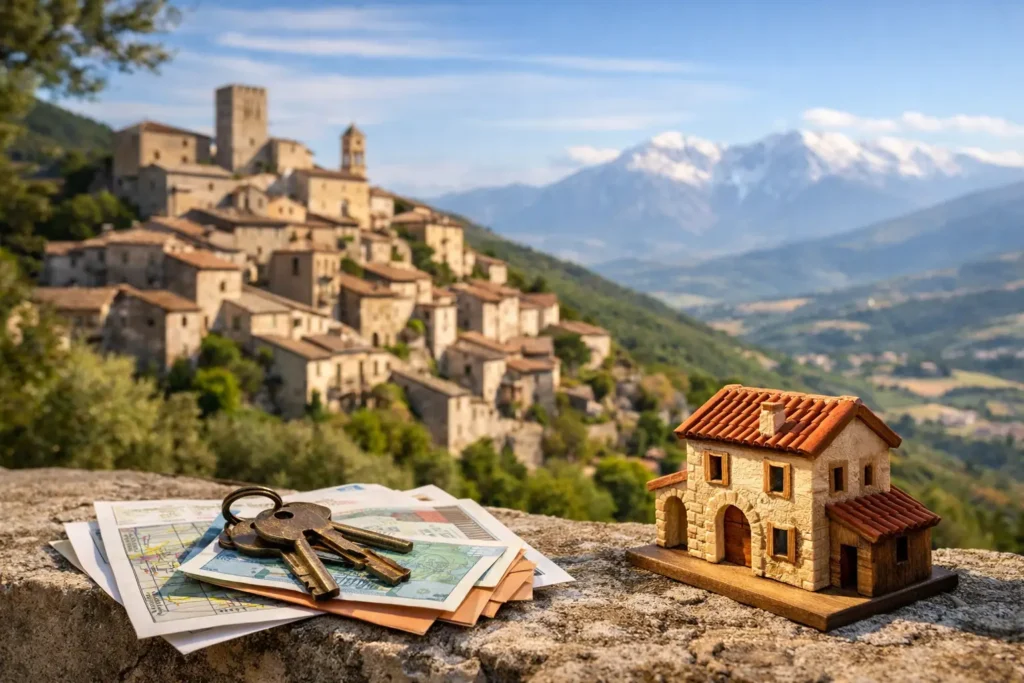
A stone house with mountain views for less than a small apartment in many parts of the UK, Germany, or the US sounds like a scam the first time you see it. So it makes sense that people ask, why are properties in Abruzzo so cheap?
The short answer is that many homes are inexpensive for real, local reasons – not because the whole region is flawed, but because price and demand work differently here.
If you’re dreaming about a move to Italy, this matters.
Cheap can mean opportunity.
But it can also mean renovation costs, location trade-offs, or paperwork that feels much heavier from abroad.
The real question is not just why prices are low.
It’s whether a low-priced property actually fits the life you want to build.
Why are properties in Abruzzo so cheap compared with other parts of Italy?
Abruzzo sits in a strange sweet spot.
It has beaches, mountains, national parks, beautiful hill towns, and a more grounded daily life than many better-known Italian regions.
But it does not have the same international profile as Tuscany, Lake Como, or parts of Puglia.
Lower visibility means lower outside demand, and lower demand usually means lower prices.
That gap in reputation is one of the biggest reasons buyers are surprised.
Abruzzo offers a lot in lifestyle terms, but it has not been marketed as aggressively to foreign buyers for decades in the same way as other regions.
Many people searching for an Italian home simply do not look here first.
Here’s a quick look at regional housing prices:
| Region | Avg. Price per m² (2026) | Market Positioning |
|---|---|---|
| Trentino | €3,718 | High-end luxury / Alpine |
| Tuscany | €2,550 | “Brand” name premium |
| Abruzzo | €1,385 | The Strategic Value Choice |
| Calabria | €960 | The Market “Floor” |
There is also a big difference between local value and international value.
A house may look charming to someone moving from London or Munich, but local buyers often judge it by everyday practicality – distance to work, heating costs, parking, whether the roof needs work, and how easy the town is to live in year-round.
That keeps prices more realistic.
Low demand in inland towns changes everything
The cheapest properties are usually not in the coastal hotspots or in the most convenient commuter areas.
They are often in:
- inland villages
- mountain towns
- or places with an aging population and fewer year-round jobs
These places can be beautiful, peaceful, and deeply appealing if you want space and quiet.
But they are not for everyone.
Many younger Italians have moved toward cities or abroad for work, leaving behind family homes that are inherited, little used, or difficult to maintain.
When several similar properties come onto the market in the same area, prices stay low.
This is one of the most important things to understand: cheap property in Abruzzo is often tied to demographic change.
In some towns, there are simply more homes than active local buyers.
That creates bargains, but it also means you need to think carefully about community, services, and whether the area feels alive in winter, not just in August.
Beautiful does not always mean convenient
A hilltop village can look perfect in photos and still be hard to live in full-time.
Steep streets, limited parking, patchy public transport, fewer shops, and longer drives to larger services all affect price.
None of these are deal-breakers if your priorities match the setting.
They do matter if you need easy access, reliable connections, or a quick setup after moving from abroad.
Many homes need more work than listings suggest
Another big reason properties are cheap is the condition.
Some are structurally sound but dated.
Others have been empty for years and need significant work before they are comfortable for modern living.
Old wiring, plumbing updates, damp issues, roof repairs, insulation, heating systems, and window replacement can change the picture fast.
An diesem Punkt ist ein online listings can be misleading.
A low asking price may reflect the fact that the home is not really move-in ready, even if the photos are flattering.
Buyers sometimes focus on the purchase price and underestimate what it takes to make the property practical year-round.
That does not mean you should avoid older homes.
Some are excellent opportunities.
It means the low price is often only one part of the real cost of creating your new life here.
Cheap purchase, expensive adjustment
A house bought for a very low price can still become expensive if you need to solve basic daily needs quickly.
Heating is a common example.
A property that feels romantic in summer may be cold and costly to run in winter if systems are outdated.
Internet access, utility activation, and access to tradespeople can also vary by location.
For international movers, this is often where stress starts.
The property itself may be affordable, but getting it functional from abroad or without fluent Italian can feel much less simple.
Sellers are often motivated to move on
In some cases, sellers are not trying to maximize price.
They may want a straightforward sale of an inherited home, a property they no longer use, or a house that has become a burden to maintain.
A fast, realistic sale can matter more than holding out for a premium.
This is especially true when a home has been empty for years.
Ongoing upkeep, taxes, and utility standing charges can wear people down.
That creates a market where asking prices may look surprisingly low compared with what overseas buyers expect.
But motivated sellers do not automatically mean easy transactions.
Every property has its own story, and those stories can affect timing, documents, and practical next steps.
From a distance, it helps to stay calm and curious rather than assuming every cheap listing is either a miracle or a disaster.
Abruzzo is affordable because daily life is more local
Part of the answer to why properties in Abruzzo are so cheap is that the region still functions around local rhythms rather than heavy international demand.
In many towns, life is not built around second-home buyers, luxury tourism, or constant short-term rental pressure.
That keeps the market closer to local purchasing power.
Für viele Expats this is exactly the appeal.
You are not only buying a home.
You are stepping into a slower, more grounded way of living.
- Seasons matter.
- Markets are local.
- Neighbors know each other.
The trade-off is that you may need to adapt more, especially if you’re used to highly international areas where services are designed around foreign buyers.
That trade-off can be a very good one if you know what you’re choosing.
Not all of Abruzzo is equally cheap
This is where broad statements stop being useful.
Property prices vary a lot depending on whether you’re looking:
- near the coast
- in a well-connected town
- in the countryside, or deep inland
A home near Pescara or in a popular seaside area will usually not be priced like a house in a remote mountain village.
Even within the same area, price can shift based on walkability, views, parking, condition, and whether you can live there comfortably right away.
Two homes with similar square footage may have totally different real-world value.
That is why it helps to think beyond the headline number.
- Cheap relative to what?
- Cheap for a holiday base?
- Cheap for a full-time move?
- Cheap because it needs cosmetic updates, or cheap because it comes with daily friction you have not spotted yet?
So, should low prices worry you?
Not necessarily.
Low prices in Abruzzo are often the result of low demand, older housing stock, location trade-offs, and local market conditions rather than some hidden regional problem.
In many cases, they reflect an honest market.
What should make you cautious is not the low price itself, but buying based on photos and assumptions.
A cheap property can be a wonderful start.
It can also become overwhelming if the area, condition, or setup needs do not match your plans.
The best purchases here usually come from clarity.
Know what kind of life you want. Know what support you will need.
And let the low price be one factor, not the whole story.
Abruzzo can be remarkably affordable, but the real value is not just in what you pay for a house.
It is in whether that house makes your new life feel easier, calmer, and more like home.
How to judge whether a cheap property is actually a good value
A good-value home is not always the cheapest one.
It is the one that supports the life you want with the fewest unpleasant surprises.
If you plan to live in Abruzzo full-time, pay close attention to year-round livability.
Ask yourself how far you are from supermarkets, healthcare, train links, and the places you will actually need.
Think about winter, not just summer.
Check how much work the home needs before it feels comfortable and functional.
—
Understanding the real value of properties with local support
If you’re moving to Abruzzo from abroad, practical setup matters more than many people expect.
A property with a slightly higher price but fewer complications can be the better choice by far.
This is especially true if you want a softer landing rather than a long project while also trying to handle residency, utilities, appointments, and everyday life in a new country.
That is also why local guidance matters.
Wanderlust Abruzzo supports people through exactly these kinds of decisions – not by selling a fantasy, but by helping them understand what life on the ground actually looks like.
We help you manage the logistics of your move to Abruzzo by finding and vetting properties, assessing the real cost of renovations, and assisting with managing your Anmeldung des Wohnsitzes, among other everyday services that will help you feel like a local without the stress of doing it all alone.
We provide the language support and local presence needed to secure your lifestyle.
Ready to see how your budget fits in Abruzzo? Book your free Strategy Call with us today.
—
Häufig gestellte Fragen (FAQs)
Are 1-Euro houses in Abruzzo a good deal?
1-Euro schemes still exist, but they come with mandatory renovation timelines and bonds. Most buyers find that a €30,000–€50,000 house in better condition is a more stable and ultimately cheaper investment.
Does the 7% tax break affect property prices?
Yes. Since the expansion of the 7% flat tax to towns of 30,000 people (like Sulmona), demand in these specific areas has increased, causing a slight upward pressure on prices compared to smaller, non-qualifying villages.
Is it safe to buy a very cheap house without seeing it?
Absolutely not. In Abruzzo, price is often linked to structural integrity oder legal succession issues (multiple heirs owning one house). We always recommend a technical viewing before making an offer.
Why is the province of Chieti the cheapest in Abruzzo?
The province of Chieti averaged €1,172/m². This is due to its large rural interior. However, coastal areas in Chieti (the Trabocchi Coast) remain highly desirable and priced closer to the regional average.
How much should I budget for utilities in a cheap house?
Older homes with poor insulation have high heating costs. Budget roughly €150–€250/month for a standard 85m² home, but expect this to double in winter if you are using traditional gas heating in a stone house.
 English
 Deutsch