
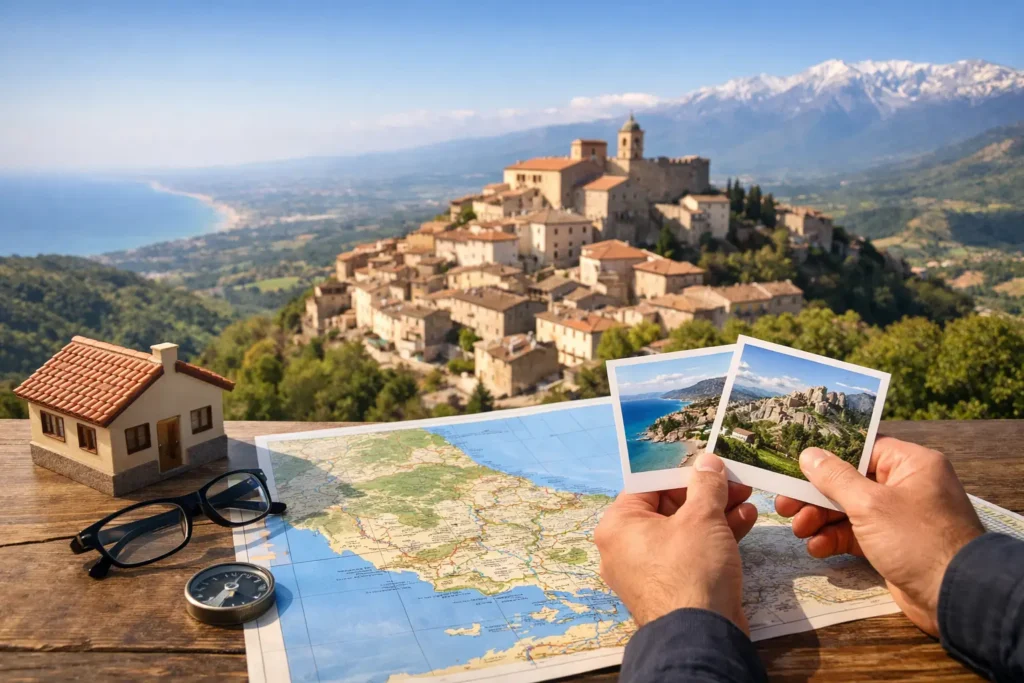
A beautiful house can still be the wrong place to live.
You may fall in love with a stone village, a sea view, or a low property price during a short visit, then discover that groceries, winter weather, parking, and everyday communication feel very different once you’re there full-time.
Learning how to choose an Abruzzo neighbourhood means looking beyond the listing and imagining an ordinary day in your new life — not the highlight-reel weekend that first sold you on the place.
Abruzzo offers an unusual range of lifestyles within one region: Adriatic beaches, working cities, vineyard-covered hills, mountain towns, and small villages where life follows a deeply local rhythm.
There is no single “best” area.
The right choice depends on what you need to feel comfortable, connected, and at home after the excitement of moving day has passed.
If you’re still comparing towns at the regional level, our comparison of Abruzzo towns for expats is the place to start.
This guide goes one level deeper — into the neighbourhood itself, once you’ve narrowed your town.
Start With the Life You Want to Live
Before comparing neighbourhoods, be honest about your non-negotiables:
- Do you want to walk to a café each morning)
- Do you prefer to live close to the beach?
- Do you want to have easy access to a train station?
- Or do you wish to wake up somewhere quiet with mountain views?
These priorities point toward very different parts of Abruzzo — and different parts of the same town.
For some newcomers, the ideal is a lively coastal town such as Pescara, Francavilla al Mare, Ortona, Silvi, or Pineto, where daily services, restaurants, and summer activity are close by.
For others, the appeal lies in a hill town or village near places such as Guardiagrele, Città Sant’Angelo, Penne, or Sulmona, with more space, dramatic views, and a stronger sense of traditional local life.
Neither option is automatically easier.
A central apartment may make errands simple but comes with traffic, noise, and limited parking.
A home in the countryside can offer peace and room to breathe, but you’ll likely rely more heavily on a car and need patience arranging services or meeting tradespeople.
Der Schlüssel liegt darin, choosing the trade-offs you can happily live with — not the ones that photograph best.
How to Choose an Abruzzo Neighbourhood for Daily Reality
A neighbourhood should work when you’re tired, busy, unwell, or simply not in the mood to drive 30 minutes for milk.
During viewings, look at the practical rhythm around the property, not only the property itself.
Ask where you’d buy groceries, pick up prescriptions, get a coffee, park your car, and receive deliveries.
Notice whether there are pavements, streetlights, and a place to take a daily walk.
If you don’t yet speak confident Italian, being near useful services can make the first months feel much less isolating.
It also helps to visit at different times of day:
- A peaceful street at noon may become busy in the evening.
- A sunny square may be wonderfully social — or it may be directly below your bedroom window.
In coastal locations, summer can bring a completely different level of traffic and noise.
In smaller inland towns, winter can feel quieter than visitors expect.
This is where local perspective matters.
Online maps show distances, but they cannot tell you which road feels stressful in heavy rain, where parking becomes difficult in August, or whether a village stays active all year.
These details are often what determine whether a place feels easy or exhausting.
Consider Coast, City, Hills, and Mountains
Coastal living: convenient, social, and seasonal
The Abruzzo coast is often attractive to people who want a more active daily life:
- Beach walks
- rail connections
- shops
- and restaurants
They can all be close at hand.
Pescara is the region’s most urban choice, with broad services and transport options.
Smaller coastal towns may feel more relaxed while still offering access to the sea and everyday essentials.
The trade-off is seasonality.
Popular beach areas can be lively and crowded in summer, while some parts become noticeably quieter outside the holiday months.
If you’re considering a home near the shore, visit or ask detailed questions about both July and January, not just the season in which you happen to be house-hunting.
Wie Your Overseas Home’s 2026 guide to living in Italy as an expat notes, one of the main “watch-outs” for coastal Italian regions generally is checking winter services in smaller places before committing — a detail many buyers skip until it’s too late.
Hill towns: character, views, and a slower pace
The hills between the coast and mountains are where many people find the Abruzzo they imagined:
- old centres
- olive groves
- vineyards
- and sweeping views
Towns in these areas can offer a strong community feeling and good access to both coast and city, depending on the exact location.
However, “near” can be misleading.
A home that’s ten kilometers from a larger town may involve winding roads and a longer drive than expected.
Check the route yourself, especially if you plan to commute, regularly use the airport, or prefer not to drive after dark.
Also consider the slope of the street, access to the house, and whether you’re comfortable with narrow roads.
Mountain and inland areas: beautiful, but plan for winter
Inland Abruzzo can be deeply rewarding for people who want nature, quiet, and a more traditional way of life.
It can also require more preparation: higher elevations bring colder winters, possible snow, and a greater need to think carefully about heating, road access, and the distance to everyday services.
That doesn’t mean mountain life is impractical.
It simply suits people who genuinely enjoy a quieter setting and are comfortable being more self-reliant.
If you’re moving from a city where everything is five minutes away, give yourself time to understand the adjustment.
Check Transport Before You Commit
Many people moving to Abruzzo plan to drive, and a car opens up much more of the region.
Dennoch don’t assume every location will feel equally manageable behind the wheel.
Historic centres may have restricted traffic zones, narrow streets, or limited resident parking.
Rural homes may sit on roads that are lovely in daylight but less appealing on a dark, wet evening.
If you prefer to use trains or buses, check the actual schedule rather than relying on the presence of a station or stop on a map.
Frequency matters.
A place can be technically connected but not convenient for everyday life.
Think ahead about visitors, too.
If family and friends are likely to visit from abroad, an easy route to Pescara Airport, a train station, or a major road can make a meaningful difference.
You don’t need to live in the centre of everything, but you should understand what your chosen distance looks like in real life.
Look Closely at the Home’s Surroundings
Neighbourhood choice and property choice are inseparable in Italy:
- A charming house may have a stunning terrace but poor vehicle access.
- An apartment in a historic centre may be close to everything but have steep stairs and no lift.
- A detached home may feel private, yet be surrounded by holiday properties that stand empty most of the year.
During a viewing, pay attention to:
- mobile signal
- internet availability
- water pressure
- damp smells
- sun exposure
- and the condition of nearby buildings
Ask what happens when it rains heavily, where rubbish is collected, and how deliveries reach the address.
These aren’t glamorous questions, but they can save you from real surprises later.
If working remotely is part of your plan, internet should be checked before you become emotionally attached to a house.
Coverage can vary street by street, particularly in rural areas and older historic centres.
Don’t rely only on an agent’s general reassurance that WiFi “should be fine”.
Unser WLAN-Leitfaden für Italien covers what to check and how.
Notice the Social Fit, Not Just the Scenery
Abruzzo can be welcoming, but belonging takes time, especially when you’re learning the language and local customs.
A neighbourhood with a bar, bakery, market, or regular community activity can make it easier to build familiar faces into your week.
This may matter more than having the most spectacular view from your window.
Wie Impatria’s 2026 guide to living in Abruzzo notes, local communities are genuine, but integration requires at least functional Italian — and the active English-speaking communities in towns like Sulmona, Lanciano, and Penne can serve as a genuine bridge in the early months for those choosing a neighbourhood in or near those areas.
Wenn du allerdings don’t expect every small town to offer an instant expat community.
Some newcomers prefer that; others want more international connection nearby.
There’s room for both, but it’s worth knowing which environment will support you best before you sign anything.
Try a simple test:
- Could you picture yourself here in November, not only in May?
- Could you manage a routine, meet people slowly, and enjoy a quiet weekend without feeling cut off?
Your answer will often tell you more than a property brochure can.
Give Yourself Permission to Decide Slowly
A relocation is not just a house purchase or rental agreement.
It’s a decision about your routines, confidence, and sense of belonging in a new country.
Wenn möglich, rent first, spend time in more than one area, and see places in ordinary weather.
A short-term base can give you breathing room to learn what you truly need before committing long-term.
When that’s not possible, get eyes on the ground.
Our Home Hunting Abruzzo Playbook walks through exactly this process — how to evaluate a neighbourhood, what questions to ask during a viewing, and how to avoid the common mistakes that only become obvious after signing.
Wanderlust Abruzzo can also help directly with neighbourhood insight, property viewings, agent communication, and the practical questions that are easy to miss when you’re searching from another country.
The goal is not to choose the most picturesque pin on a map.
It’s to choose a place where your new life has room to become familiar, manageable, and genuinely yours.
The right Abruzzo neighbourhood may not be the one that impresses you fastest.
It’s often the one that lets everyday life feel a little easier with each passing week.
—
Not Sure Which Neighbourhood in Abruzzo Is Right for You?
Choosing between two similar-looking streets, or two towns twenty minutes apart, is exactly the kind of decision that benefits from someone who knows the area from the inside.
Bei Wanderlust Abruzzo, we help English- and German-speaking expats compare neighbourhoods honestly and find the home that actually fits their daily life — not just the one that photographs well.
Persönlich, zweisprachig und direkt vor Ort in Abruzzo.
Get in touch today and let’s talk about finding your neighbourhood in Abruzzo
—
Häufig gestellte Fragen (FAQs)
How do I know if a neighbourhood in Abruzzo is right for me?
Visit at different times of day and, if possible, in a different season than your first viewing. Check walking distance to groceries, pharmacy, and parking. Test mobile signal and internet at the specific property. Ask about winter services if you’re considering a coastal or seasonal area, and ask about summer traffic if you’re considering somewhere quiet in the off-season. The right neighbourhood is the one that still feels manageable on an ordinary Tuesday, not just during a pleasant weekend visit.
Should I choose a coastal or inland neighbourhood in Abruzzo?
It depends on your priorities. Coastal areas offer more year-round services, flatter terrain, and easier transport, but can be crowded and expensive in summer and quieter than expected in winter. Inland and hill areas offer more character, lower prices, and often qualify for Italy’s 7% flat tax for retirees, but usually require a car and more self-reliance for everyday errands. Neither is objectively better — the right choice depends on how much daily convenience matters to you versus how much quiet and space you want.
What should I check about internet and connectivity before choosing a neighbourhood?
Coverage in Abruzzo can vary significantly street by street, especially in rural areas and older historic centres. Never rely on a general assurance that WiFi “should be fine” — ask for the specific provider and connection type available at the exact address (fibre, FWA, or satellite), and if possible, test the connection during your viewing. This matters enormously if remote work is part of your plan.
How important is it to visit a neighbourhood in winter before deciding?
Very important, particularly for coastal and smaller inland towns. Many areas that feel vibrant in summer become noticeably quiet from October through April, with fewer open businesses and less social activity. Conversely, some inland areas that feel peaceful in spring can feel isolating once snow or heavy rain sets in. If you can only visit once, ask locals or a trusted contact what the area is genuinely like outside peak season.
Can I choose a neighbourhood in Abruzzo without visiting in person?
It’s possible but riskier. If you can’t travel before deciding, arrange for a trusted local contact to visit the neighbourhood and the specific property on your behalf, ideally via a live video walkthrough that includes the surrounding streets, not just the interior. Our property viewing support service is designed specifically for this situation, and our Home Hunting Abruzzo Playbook provides a structured framework for evaluating a neighbourhood remotely.



 English
 Deutsch