
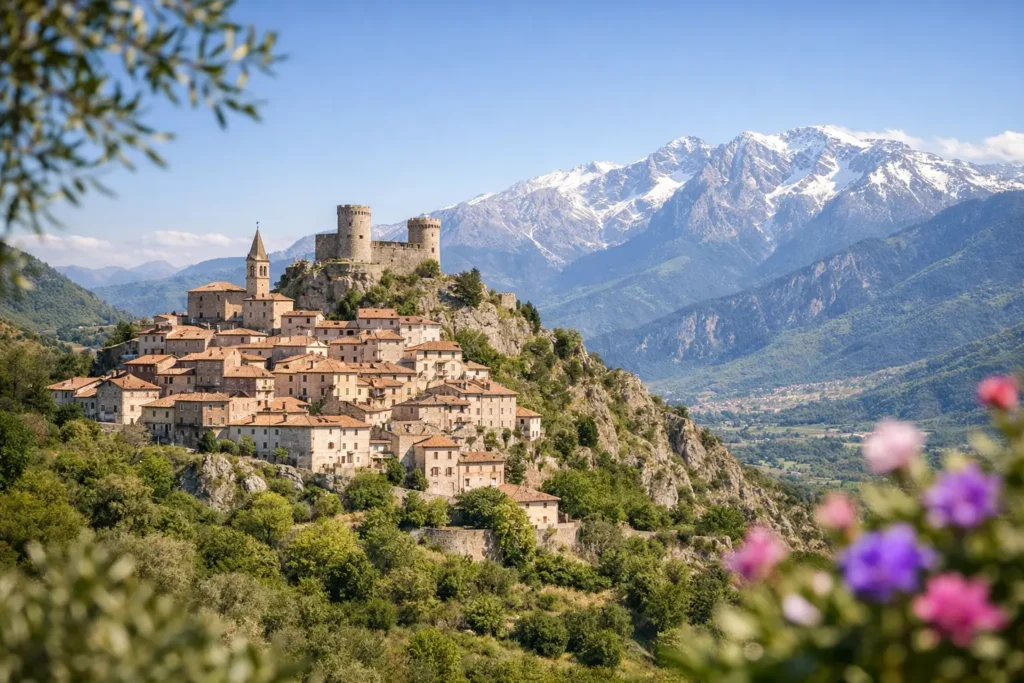
You can fall in love with Abruzzo very quickly, then get stuck on one deceptively simple question: what is the nicest town in Abruzzo for expats?
People usually ask it after seeing photos of stone hill towns, a beach promenade, or a mountain view — and imagining their future there.
Die ehrliche Antwort lautet: the nicest town is the one that fits your daily life, not just your travel mood.
That matters even more if you’re thinking about relocating.
A town can be gorgeous and still feel wrong if it’s too quiet in winter, too hard to reach without a car, or too far from the services you’ll actually need.
So rather than naming one place and pretending it works for everyone, this guide looks at the kind of life you want to build in Abruzzo, with honest comparisons across coastal towns, inland hilltop towns, and the larger provincial cities.
—
Comparison Table: Abruzzo Towns for Expats
| Town | Leistungen | Car needed? | Rent/Buy range | Expat community | 7% flat tax? | Winter livability |
|---|---|---|---|---|---|---|
| Pescara | Excellent | Optional in centre | €600–900/mo rent; €1,500–2,756/m² | Large | ❌ No (~120k pop.) | Excellent |
| Francavilla al Mare | Good | Recommended | €550–750/mo rent; €1,200–1,800/m² | Medium | ✅ Yes (~25k pop.) | Good |
| Ortona | Good | Recommended | €450–650/mo rent; €900–1,400/m² | Small | ✅ Yes (~23k pop.) | Good |
| Vasto | Good | Recommended | €500–750/mo rent; €1,000–1,600/m² | Large | ❌ No (~40k pop.) | Good |
| Silvi / Pineto | Moderat | Yes | €450–650/mo rent; €900–1,300/m² | Small | ✅ Yes (~15k pop.) | Quieter |
| Montesilvano | Good | Optional | €550–800/mo rent; €1,100–1,700/m² | Small | ❌ No (~55k pop.) | Good |
| Sulmona | Good | Yes | €400–600/mo rent; €800–1,200/m² | Active | ✅ Yes* (~24k pop.) | Good |
| Chieti | Very good | Yes (hilltop) | €400–600/mo rent; €800–1,200/m² | Small | ❌ No (~51k pop.) | Good |
| Teramo | Very good | Yes | €400–600/mo rent; €800–1,200/m² | Small | ❌ No (~55k pop.) | Good |
| L’Aquila | Good (growing) | Yes | €350–550/mo rent; €700–1,100/m² | Academic | ❌ No (~70k pop.) | Cold/snowy |
| Lanciano | Moderat | Yes | €350–500/mo rent; €700–1,100/m² | Active | ❌ No (~35k pop.) | Good |
| Città Sant’Angelo | Moderat | Yes | €450–650/mo rent; €900–1,400/m² | Medium | ✅ Yes (~15k pop.) | Good |
| Guardiagrele | Basic | Essential | €350–500/mo rent; €700–1,000/m² | Small | ✅ Yes (~9k pop.) | Quieter/cold |
| Penne | Basic | Essential | €300–450/mo rent; €600–900/m² | Active | ✅ Yes (~12k pop.) | Quieter |
| Loreto Aprutino | Limited | Essential | €300–450/mo rent; €600–900/m² | Very small | ✅ Yes (~7k pop.) | Very quiet |
| Atri | Basic | Essential | €300–450/mo rent; €600–900/m² | Very small | ✅ Yes (~10k pop.) | Quieter |
| Spoltore | Good (near Pescara) | Yes | €450–650/mo rent; €900–1,400/m² | Small | ✅ Yes (~18k pop.) | Good |
✅ Yes = newly eligible following the 7 April 2026 law change raising the threshold from 20,000 to 30,000 residents (L. 34/2026, art. 26). Always verify current eligibility with a qualified tax advisor before making financial decisions.*
⚠️ Always verify 7% flat tax eligibility with a qualified Italian tax advisor. Rules and population counts can change. The 7% incentive runs for 10 years and is not renewable.
—
The 7% Flat Tax Update That Changes Some of These Choices
Before diving into each town, this is worth flagging clearly because it affects the comparison significantly.
On 7 April 2026, Italy formally raised the population ceiling for the 7% flat tax for foreign retirees from 20,000 to 30,000 residents — confirmed by Feather’s June 2026 analysis of the law change (L. 34/2026, art. 26).
This is a meaningful shift.
Städte wie Sulmona (24,000), Ortona (23,000), and Francavilla al Mare (25,000) — previously excluded under the 20,000-resident cap — now qualify.
If you’ve seen older guidance listing these towns as ineligible, it may predate this change.
Confirm the current status with a qualified Italian tax advisor.
—
The Nicest Coastal Towns in Abruzzo for Expats
Pescara
Pescara is Abruzzo’s most connected and practical city for expats.
The airport (links to Germany, UK, and beyond), train station, full hospital infrastructure, and year-round services make it the easiest landing point for newcomers who aren’t yet confident in Italian.
It has a real beach, a lively promenade, restaurants open year-round, and the largest English-speaking expat community in Abruzzo.
Die Kompromisse are price (the highest in the region at €1,500–2,756/m² to buy) and the 7% flat tax ineligibility.
It also has the feel of a real urban environment — not the quiet village in Italy many expats imagine.
But for those who want to settle in quickly, function independently early, and access everything without stress, Pescara often wins.
Our guide to settling into Pescara und Pescara vs Chieti comparison go into more detail for this specific decision.
Francavilla al Mare
Francavilla sits immediately south of Pescara and shares many of its conveniences while feeling noticeably calmer.
With a population of around 25,000, it now qualifies for the 7% flat tax following the April 2026 law change — a combination of coastal accessibility and tax eligibility that’s genuinely rare.
The seafront is excellent, the town stays fairly active year-round, and the drive to Pescara for anything bigger is minimal.
For expats who want coastal life with a quieter tone and the flat-tax benefit, Francavilla is increasingly one of the most practical choices in the region.
Montesilvano
Directly north of Pescara, Montesilvano offers good housing value, beach access, and proximity to Pescara’s services without quite the price premium.
It’s more residential and less touristy than Pescara’s centre, which suits people who want practical city living.
However, in summer it gets quite busy (and a bit noisy).
At approximately 55,000 residents, it doesn’t qualify for the 7% flat tax.
Ortona
Ortona has a character that distinguishes it from the more obviously expat-facing coastal towns.
It has a real working-port identity, a historic castle (Castello Aragonese), a genuinely interesting centre, and a year-round local atmosphere that resists the seasonality that affects some smaller coastal towns.
At around 23,000 residents, it now qualifies for the 7% flat tax.
Ortona is a good choice for expats who want a coastal base that feels grounded in real Italian life rather than oriented around summer tourism.
Vasto
Vasto is a strong contender for the south of Abruzzo — clifftop setting, beautiful old centre, one of Abruzzo’s largest English-speaking expat communities alongside Pescara, and excellent access to the Trabocchi Coast and the Punta Aderci nature reserve.
At approximately 40,000 residents, it no longer qualifies for the 7% flat tax under the current 30,000-resident threshold.
If that incentive is important, San Salvo nearby (~19,000 residents) may be worth considering as an alternative base.
Silvi und Pineto
Both suit people who want a calmer coastal lifestyle with 7% flat tax eligibility.
Silvi combines a working lower town (Silvi Marina) with a historic upper village (Silvi Alta).
Pineto is known for its pinewoods, clean beaches, and family-friendly atmosphere.
Both are around 15,000 residents and genuinely qualify.
Der Kompromiss hierbei ist, dass services are more limited than in Pescara or Vasto, and both feel noticeably quieter outside the summer season.
—
The Nicest Inland and Hilltop Towns in Abruzzo for Expats
Sulmona
Sulmona is consistently rated one of Italy’s most livable small cities — and after the April 2026 law change, it now qualifies for the 7% flat tax at approximately 24,000 residents.
It has a genuinely beautiful historic centre, a strong train connection to both Pescara and Rome, a cultural calendar that runs through winter, and a growing international expat community.
It’s what many people picture when they imagine authentic Italian hill-town living, but with more infrastructure than a purely rural location.
The birthplace of the Roman poet Ovid, Sulmona is also famous for its centuries-old confetti (sugar-coated almond candy) tradition — a craft still practised in historic workshops in the centre.
If you want one all-around recommendation for expats who want inland character with real livability, Sulmona is probably the strongest single answer.
Its mountain setting means cooler winters than the coast — L’Aquila province can get genuine snowfall from December through February — which is beautiful if you’re prepared for it and uncomfortable if you’re not.
Chieti
Chieti is a city of two parts: Chieti Alta (the hilltop historic centre with elegant streets, an archaeological museum, and a cathedral) and Chieti Scalo (the flat lower commercial area with the train station, large supermarkets, and practical services).
Together, they offer real urban functionality alongside genuine historic character.
At approximately 51,000 residents, Chieti doesn’t qualify for the 7% flat tax — but it offers excellent value compared to Pescara, a university with an active student energy, and enough services to support everyday life comfortably.
For expats who want an authentic Italian provincial city experience without Pescara’s prices or crowds, Chieti is underrated.
Teramo
Teramo is Abruzzo’s northern provincial capital — solid, unpretentious, and genuinely well-functioning year-round.
Known for its distinctive regional cuisine and proximity to the Gran Sasso National Park, it suits families who want urban services combined with fast access to mountains and coast.
At approximately 55,000 residents, it doesn’t qualify for the 7% flat tax.
But for those not prioritising that incentive, Teramo offers excellent value, high-speed fibre internet, a university presence, and relatively affordable housing compared to Pescara.
L’Aquila
L’Aquila deserves a separate, honest treatment because it carries significant history — and significant potential.
On the earthquake risk: L’Aquila was struck by a devastating Mw 6.3 earthquake in April 2009, which killed 309 people and caused widespread destruction of its historic centre.
This is not ancient history — parts of the city were still in reconstruction as recently as 2023, and the region sits in one of Italy’s highest seismic risk zones (Zone 1).
This doesn’t mean L’Aquila is an unsafe or undesirable place to live — but it does mean that seismic risk is a real factor to research when considering any property purchase in L’Aquila province, particularly older buildings.
Newer and post-earthquake reconstructed buildings follow much stricter seismic standards.
On the positives: L’Aquila is Italy’s Capital of Culture for 2026, which has brought genuine state investment in infrastructure, cultural programming, and visibility.
It’s a university city with a growing, younger, more international energy.
Property prices are the lowest in Abruzzo — €700–1,100/m² — which makes it one of the most affordable entry points in the region for buyers.
High-speed fibre internet is available.
And its mountain setting (over 700 metres elevation) means proper seasons, clean air, and extraordinary natural access.
At approximately 70,000 residents, it doesn’t qualify for the 7% flat tax.
Lanciano
Lanciano is often overlooked by expats, which means it offers good value and an active English-speaking community without the competition.
It has a well-preserved medieval centre, an interesting mix of commerce and cultural life, and a weekly market that gives it real local energy.
The basilica sanctuary of San Francesco d’Assisi a Lanciano contains what the Catholic Church recognises as Italy’s oldest recorded Eucharistic Miracle, making it a site of genuine pilgrimage significance.
At approximately 35,000 residents, Lanciano sits just above the 30,000-resident threshold and does not currently qualify for the 7% flat tax.
Worth watching if the threshold is ever adjusted further.
Città Sant’Angelo
One of Abruzzo’s Most Beautiful Villages (Borghi più belli), Città Sant’Angelo delivers medieval hilltop character with genuine practical accessibility — just 20 minutes from Pescara Airport, close to the coast, and with services more robust than many comparable hill towns.
At around 15,000 residents, it qualifies for the 7% flat tax.
It’s one of the best answers for expats who want visual charm and village identity without the genuine isolation that some smaller inland towns create.
The trade-off is that it feels less cinematically remote than Santo Stefano di Sessanio or Pacentro — which is actually the point.
Guardiagrele
Guardiagrele has a strong local identity rooted in centuries of copper and wrought-iron craftsmanship, still visible in active artisan workshops in the centre.
It sits at the foot of the Maiella massif, offering dramatic mountain views and fast access to serious hiking.
At approximately 9,000 residents, it qualifies for the 7% flat tax.
On earthquake risk: The Maiella area sits in a moderate-to-high seismic zone (Zone 2).
This is lower risk than L’Aquila province, but worth researching for any specific property, particularly older construction.
Always commission a structural survey (perizia strutturale) for older buildings before purchase.
Guardiagrele suits expats who want deep immersion in authentic Abruzzo culture and are comfortable driving for services.
It does not suit those who want convenience, walkable amenities, or a gentle initial transition.
Penne
Penne is a town with genuine elegance and a strong English-speaking expat community relative to its size (~12,000 residents).
Brick-built, tidy, and with a lived-in rather than touristy atmosphere, it offers a quality of local life that surprises many visitors.
It qualifies for the 7% flat tax and is one of the more affordable towns on this list.
The honest caveat: Penne needs investment in some areas, and the town is smaller than it once was.
What it offers in character and community, it trades in service depth and everyday convenience.
Loreto Aprutino
Loreto Aprutino is primarily for those expats who want deep rural quiet and an authentic village pace.
Known for its exceptional olive oil — some of the best in Abruzzo — and with a small but dedicated expat community, it’s beautiful and genuinely immersive.
At approximately 7,000 residents, it qualifies for the 7% flat tax.
It requires a car for virtually everything and accepts solitude as part of the deal.
Atri
Atri offers culture, architecture, and the famous Calanchi badlands just outside town — an almost lunar eroded landscape that surprises most visitors.
At approximately 10,000 residents, it qualifies for the 7% flat tax.
It’s not the easiest place for everyday convenience, but the combination of historic character and accessible coastline (not far from Montesilvano and Pescara) makes it a genuine option for people who prioritise character over convenience.
Spoltore
Spoltore is a practical choice often overlooked precisely because it sits so close to Pescara.
It’s a well-functioning town of about 18,000 residents that qualifies for the 7% flat tax, offers good housing value compared to Pescara, and provides straightforward access to all of Pescara’s services.
It doesn’t offer the romantic town-centre feel of Città Sant’Angelo or Sulmona — but it’s an honest, well-located base that makes daily life easier than many more visually appealing options.
—
Beauty Is Not the Same as Ease
An diesem Punkt ist ein many relocation decisions go off course.
People visit in spring or summer, eat well, wander through a medieval centre, and assume daily life will feel the same in November — when they need internet installed, a plumber called, and someone at the local office to understand their paperwork.
The nicest town in Abruzzo for a vacation and the nicest town for actually living are not always the same place.
That doesn’t mean you should choose convenience over beauty.
It means you should understand the trade-off and choose deliberately.
For many expats, the sweet spot is a town with charm and personality that still keeps them within reasonable reach of larger service hubs.
That way, you get the Abruzzo lifestyle people dream about without turning every small task into a project.
How to Choose the Nicest Town for Your Lifestyle
Start with your non-negotiables, not your fantasy:
- Do you want to walk to a café and the grocery store?
- Do you need to be near a train line?
- Are you comfortable driving mountain roads in winter?
- Do you want a lively summer town, even if it gets quieter off-season, or do you need steady year-round energy?
Think about how you will spend a normal Tuesday, not just a perfect Sunday.
If you’re working remotely, test how a town feels during business hours.
If you’re retired, consider access to healthcare, social life, and whether the town still feels comfortable in colder months.
Housing should also shape the decision.
Some towns are full of beautiful properties that look ideal online but come with realities that aren’t obvious at first glance — long waits for Versorgungsbetriebe, neighbourhoods that feel very different in winter, or structural issues in older buildings that require significant budget.
So, What Is the Nicest Town in Abruzzo for Expats?
If you want one name: Sulmona is the strongest all-around answer for most expats — beautiful, culturally rich, newly eligible for the 7% flat tax, well-connected by train, and with a genuine international community.
But it’s not automatically the best choice for everyone:
- For some, the nicest town will be Città Sant’Angelo because it balances charm and access.
- For others, it will be Francavilla al Mare for its coastal calm and tax eligibility.
- Vasto for its expat community and southern character.
- Oder L’Aquila, for its extraordinary cultural moment and lowest prices in the region.
The right answer lives where your priorities meet the reality on the ground.
The best town is not the one that impresses you for an afternoon.
It’s the one that lets you exhale and think: yes, I can build a life here.
—
Not Sure Which Town Is Right for You?
This is exactly the kind of decision that benefits from someone who knows these towns from the inside — not just from listings and travel blogs.
Bei Wanderlust Abruzzo, we help English- and German-speaking expats compare areas honestly and find the right home with bilingual support at every stage.
Get in touch today and let’s talk about finding your town in Abruzzo
—
Häufig gestellte Fragen (FAQs)
What is the nicest town in Abruzzo for expats?
There’s no single answer — it depends on lifestyle, budget, and priorities. For all-around livability, Sulmona stands out (beautiful, well-connected, active expat community, newly eligible for the 7% flat tax). If you want coastal access and practical services, Pescara and Francavilla al Mare are strong choices. For the lowest prices and highest cultural investment, L’Aquila. If you seek authentic village character with tax eligibility, Città Sant’Angelo, Guardiagrele, or Penne.
Which Abruzzo towns qualify for the 7% flat tax for retirees in 2026?
Following a law change on 7 April 2026 (L. 34/2026), the population threshold was raised from 20,000 to 30,000 residents. This makes Sulmona (~24k), Ortona (~23k), and Francavilla al Mare (~25k) newly eligible. Towns that were already eligible and remain so include Città Sant’Angelo, Guardiagrele, Penne, Loreto Aprutino, Atri, Spoltore, Silvi, and Pineto. Towns above 30,000 — including Pescara, Chieti, Teramo, L’Aquila, Vasto, Montesilvano, and Lanciano — do not qualify. Always verify with a qualified tax advisor.
Is it safe to buy property in L’Aquila given the earthquake history?
L’Aquila sits in one of Italy’s highest seismic risk zones (Zone 1) and was severely damaged by the 2009 earthquake. This doesn’t make it an unacceptable place to live, but seismic risk is a real factor to research for any specific property purchase in L’Aquila province. Always commission a structural survey for older buildings, and check whether a property has been seismically upgraded post-2009. Newer and post-earthquake reconstructed buildings follow strict modern standards.
Should I choose a coastal town or an inland town in Abruzzo?
Coastal towns (Pescara, Francavilla, Ortona, Vasto, Silvi, Pineto) generally offer better services, easier year-round living, flatter terrain, and more immediate infrastructure for newcomers. Inland and hilltop towns (Sulmona, Chieti, Guardiagrele, Città Sant’Angelo, Penne, Teramo, L’Aquila) offer more authentic character, lower prices, and in many cases, 7% flat tax eligibility. The right choice depends on how much daily friction you’re willing to accept in exchange for a certain atmosphere — and how important the tax incentive is to your planning.
Do I need a car in Abruzzo regardless of which town I choose?
In virtually every town except central Pescara and parts of Chieti Scalo, a car is essential for everyday life — not just for exploring the region, but for routine errands, administrative appointments, and accessing larger services. Public transport in Abruzzo is limited outside of the main train corridors and coastal strip. Always factor car ownership into your overall cost of living calculation.

 English
 Deutsch