
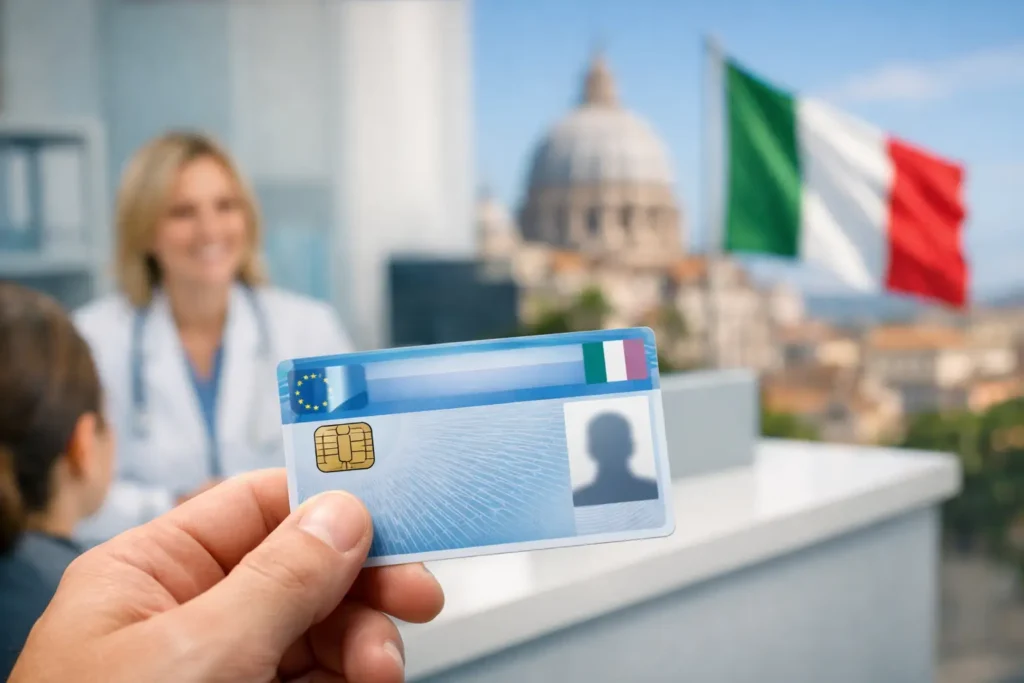
You usually realise you need the Italian Health Card (tessera sanitaria) right after you thought the hardest part was over.
You found a place to live, started sorting residency, maybe even figured out the grocery store — and then someone asks for your health card number.
Wenn du dich fragst, how to get your tessera sanitaria in Italy, the good news is the process is genuinely manageable once you know which office handles what, which documents matter, and what you can actually do online versus what still needs a physical visit.
For many expats, this is one of those deceptively simple Italian admin tasks.
It sounds like one card, one form, one appointment.
In practice, it depends on your nationality, your legal basis for being in Italy, and whether your registration is mandatory or voluntary.
That’s where confusion starts — so let’s walk through it properly.
What the Tessera Sanitaria Actually Is
The tessera sanitaria is Italy’s national health card, issued by das Finanzamt (Agenzia delle Entrate) once you’re registered with the Servizio Sanitario Nazionale (SSN), Italy’s public healthcare system.
The card also doubles as your codice fiscale card — your tax code is printed on the back — and its reverse side functions as the European Health Insurance Card (EHIC/TEAM), giving you emergency healthcare coverage across EU countries plus Norway, Iceland, Liechtenstein, and Switzerland.
The card itself isn’t the first thing you apply for in isolation — it’s the result of successfully registering with the SSN through your local health authority or ASL (Azienda Sanitaria Locale).
First, you establish your right to enrol, then you register, then the card is issued and mailed to you.
Who Can Get the Tessera Sanitaria?
Eligibility depends on your nationality and legal status.
As confirmed by the official Agenzia delle Entrate guide for foreign citizens, the rules break down as follows:
EU/EEA/Swiss citizens
If you’re staying in Italy for more than 90 days, you can and should register with the SSN once you’ve secured official residency.
Registration is free if you’re working, self-employed, studying, or have acquired permanent resident status.
EU citizens not yet registered can use the EHIC for temporary or emergency coverage, but it’s not a substitute for proper SSN registration once you’re living here permanently.
Nicht-EU-Bürger
Your access is tied directly to your residence permit (permesso di soggiorno).
Registration falls into two categories:
- Mandatory registration (free): applies if your permit is for work (employed or self-employed), family reasons, asylum, fostering, or adoption
- Voluntary registration (paid): applies to students (currently €700/year), elective residency visa holders (€2,000/year), au pairs, religious staff, and others staying more than 90 days who don’t qualify for mandatory registration
If you’re on a voluntary basis, you must pay the annual contribution via an F24 form (modello F24 semplificato) at a bank, post office, or online through your Italian banking portal — and bring the stamped receipt with you to the ASL.
⚠️ Voluntary contribution rates are set on a calendar-year basis (January–December), are non-prorated, and are subject to legislative change. Always verify current figures with your ASL before paying.
Can I Register for the Italian Health Card Online?
This is where many guides are vague or misleading, so let’s be precise.
What you CANNOT do online (currently)
The initial SSN registration and general practitioner ((medico di base) oder medico di medicina generale MMG) selection must be done in person at your ASL’s “Scelta e Revoca” desk.
This is because doctor selection requires choosing from a physical list of available GPs in your postal code area, and the registration process requires staff to verify your original documents (when you’re not an Italian citizen).
Some regions allow online appointment booking for this visit, but the visit itself is mandatory.
What you CAN do online
Once you have your health card and a SPID (Sistema Pubblico di Identità Digitale), CIE (Carta d’Identità Elettronica), or activated CNS (the chip-enabled version of your tessera sanitaria itself), you can access a range of services through the Sistema Tessera Sanitaria portal and the Agenzia delle Entrate website:
- Request a duplicate or replacement card — if your card is lost, stolen, or damaged, you can request a replacement online via the Sistema TS portal, the Agenzia delle Entrate website, or via certified email (PEC)
- Correct data errors — if your card shows wrong personal data, you can fix it online via SPID/CIE through the “Rettifica dati” function on the Sistema TS portal
- Access your Electronic Health Record (EHR) (Fascicolo Sanitario Elettronico or FSE) — your digital health record, containing prescriptions, test results, specialist consultations, and hospital reports
- View and download your healthcare spending summary — for tax return purposes (dichiarazione dei redditi), available on the Sistema TS portal
- Book an ASL appointment — in regions that support online booking, you can schedule your “Scelta e Revoca” visit online rather than queuing in person
- Pay the voluntary F24 contribution — can be done online via your Italian bank’s F24 portal or the Agenzia delle Entrate’s website if you have a Fisconline account
CIE vs SPID: which to use for online services
To access any of the online services listed above, you need a recognised digital identity credential.
In Italy, there are currently two main options: SPID und CIE (Carta d’Identità Elettronica, the electronic identity card).
Our recommendation: use CIE.
Here’s why.
What is the difference between CIE and SPID in Italy?
SPID is issued by private providers and has become increasingly expensive to maintain — Poste Italiane, which manages around 30 million digital identities, introduced a €6 annual fee from January 2026.
While some other providers (Namirial, TIM, Sielte, Intesi Group, EtnaID) still offer SPID free of charge if activated via CIE or CNS, as Il Sole 24 Ore confirms, the direction of travel is clear.
The CIE is free, government-issued, and as The Local’s April 2026 analysis confirms, the Italian government officially confirmed in July 2025 that SPID will be gradually phased out and replaced by the CIE over the next two to three years.
It’s already accepted on over 80% of public service portals, and the number is growing.
The CIE is what we personally use to get into all the public service portals, so that is what we suggest you do, too.
How to use CIE for online services
- Download the CieID app (available on iOS und Android) — this is the official app for CIE authentication
- You’ll need a smartphone with NFC technology to read the chip inside the card
- For desktop logins: enter your card’s 9-character serial number on screen, then scan the physical card with your phone to complete authentication
- You’ll need both halves of your PIN — 4 digits given to you on a receipt when you collect the card at the Ufficio Anagrafe, and 4 digits mailed to you with the physical card itself
If you’ve lost one half of the PIN, you can request a new one at your local Ufficio Anagrafe.
Getting a CIE requires an appointment at your local residency registration office ((Ufficio Anagrafe)) — you cannot apply online.
It’s issued to anyone with registered residency in Italy.
Once you have it and both PIN halves, it works as a complete, free, and future-proof alternative to SPID for all online public administration services, including the Sistema Tessera Sanitaria portal.
How to Get Your Tessera Sanitaria: Step by Step
Step 1: Gather your documents
Before going anywhere, make sure you have:
- Valid passport or EU national ID card (+ photocopies)
- Your Italian tax code (codice fiscale) certificate (+ photocopy)
- Proof of residential address — a residency certificate (certificato di residenza) or, in some municipalities, a signed self-declaration
- Your stay permit (permesso di soggiorno), or the official postal receipt if still being processed (non-EU citizens only)
- For mandatory registration: employment contract, recent payslips, or equivalent proof of your qualifying basis for staying
- For voluntary registration: your stamped F24 payment receipt showing the annual contribution has been paid
Bring originals and photocopies of everything.
Even where digital systems exist, a printed copy consistently saves time at the desk.
Step 2: (Optional but recommended) Book an online appointment
Check your regional ASL website to see if online appointment booking is available.
In Abruzzo ASL Pescara, ASL Chieti, ASL Teramo, und ASL L’Aquila all have their own portals.
Search for your specific ASL’s appointment online booking (prenotazione online) oder Scelta e Revoca booking section.
Where available, booking ahead avoids potentially long in-person queues.
Step 3: Go to the ASL’s Scelta e Revoca desk
Locate the ASL office covering your specific address and find the Scelta e Revoca desk.
Staff will review your documents, confirm your eligibility category, and present you with a list of General Practitioners or GPs (medico di base or Medico di Medicina Generale MMG) accepting new patients in your postal code area.
If you have children under 14, you’ll also choose a pediatrician (pediatra di libera scelta).
Research your GP options in advance if you can: check Google reviews, ask local expats for recommendations, particularly if you want an English- or German-speaking doctor.
Your medico di base becomes your gateway to almost all non-emergency care: specialist referrals, prescriptions, diagnostic tests.
Step 4: Receive your temporary certificate
Once registration is processed, you’ll receive a temporary paper certificate on the spot.
This is your official proof of healthcare coverage immediately — keep it safe and accessible.
You can use it for doctor appointments, prescriptions, and pharmacy visits right away.
Step 5: Wait for the physical card
The plastic health card (tessera sanitaria) ist mailed to your registered address in the Agenzia delle Entrate’s database (Anagrafe Tributaria).
Make sure your codice fiscale registration reflects your current Italian address before starting the process.
Delivery typically takes 2–4 weeks, though it can take up to 6–8 weeks in some regions.
Once received, you’ll need to activate the chip (TS-CNS) using instructions that come with the card — typically done at a pharmacy or following the instructions on the Agenzia delle Entrate website — to use it for online public administration services.
What the Card Covers
Once registered and assigned a general practitioner ((medico di base)), you’re entitled to the same healthcare rights as Italian citizens:
- GP visits — free
- Specialist consultations (with GP referral) — co-payment (ticket) of approximately €20–50
- Diagnostic tests (blood tests, X-rays, ultrasounds) — co-payment of approximately €10–100
- Hospital care and emergency treatment — free or minimal co-payment
- Prescription medications — typically €2–15
- Dental care — not covered under standard SSN (emergency dental only)
Co-payment exemptions exist for low-income households, people with recognised chronic illnesses, and certain other categories.
Ask your ASL about eligibility when you register.
Common Situations That Slow Things Down
The biggest delays usually come from:
- address mismatches between the town hall (Comune (Rathaus)) residency records and the Agenzia delle Entrate database
- incomplete documentation
- and confusion between the codice fiscale registration and the separate SSN healthcare registration
Having the first doesn’t automatically trigger the second.
Another frequent issue: non-EU citizens who arrive expecting to register immediately, not realising they need either the stay permit (permesso di soggiorno) card or the official postal receipt of their application.
The receipt is generally accepted in place of the physical permit.
But not every office handles this the same way, which is why arriving with both (if your permit is in process) is the safest approach.
What If You Need Healthcare Before the Card Arrives?
Your temporary paper certificate covers you fully in the meantime.
If you haven’t yet completed registration and need non-emergency care, private practitioners are available, though you’ll pay out of pocket.
Emergency rooms (pronto soccorso) treat genuine emergencies regardless of registration status.
Getting It Right Without Getting Stuck in Admin Circles
Think in stages rather than one task:
- establish eligibility
- → gather documents
- → (optional) book online
- → register at ASL
- → choose doctor
- → receive paper certificate
- → wait for card
- → activate chip online
When everything gets lumped together as simply getting the tessera sanitaria, it’s easy to lose track of exactly where a delay is sitting.
For expats settling into Abruzzo specifically, this is one of those moments where local, bilingual support makes a real difference.
A language barrier or one missing document can turn a straightforward appointment into a confusing half-day.
Du kannst auch mehr darüber lesen, the broader picture of healthcare access and costs for foreigners in Italy for additional context on eligibility categories.
—
Settling Into Abruzzo and Need Help With Your Tessera Sanitaria Registration?
Healthcare registration is straightforward in theory and genuinely confusing in a second language.
We help make sure it goes smoothly the first time.
Bei Wanderlust Abruzzo, we assist English- and German-speaking expats with the health card registration and every other step of settling in — residency, utilities, banking, and beyond.
Persönlich, zweisprachig und direkt vor Ort.
Get in touch today and let’s talk about how we can help you settle in Abruzzo
—
Häufig gestellte Fragen (FAQs)
Can I apply for the tessera sanitaria online?
The initial SSN registration and (medico di base) selection must be done in person at your local ASL’s “Scelta e Revoca” desk — this cannot currently be completed fully online for new expats. However, you can book your ASL appointment online in many regions, and once you have your card, online services via SPID, CIE, or CNS include requesting duplicates, correcting data, accessing your digital health record (FSE), and managing your healthcare spending records for tax purposes.
How do I replace a lost or stolen tessera sanitaria?
You can request a replacement online via the Sistema Tessera Sanitaria portal (with SPID, CIE, or CNS credentials), via the Agenzia delle Entrate website, via certified email (PEC) to the Agenzia delle Entrate, or in person at any Agenzia delle Entrate office or your local ASL. If the card was stolen, it’s also recommended to file a police report.
How long does it take to receive the physical card?
Typically 2–4 weeks by post to your registered address, though it can take up to 6–8 weeks in some regions. Your temporary paper certificate issued at registration serves as full proof of coverage in the meantime.
Is the tessera sanitaria free for everyone?
No. EU citizens and non-EU citizens with qualifying permits (work, family, asylum) register for free under mandatory registration. Others — including students and elective residency visa holders — must pay an annual flat-rate voluntary contribution via F24 before registering: currently €700/year for students and €2,000/year for other voluntary categories (rates subject to change).
What is CIE and do I need it for online services related to the tessera sanitaria?
The CIE (Carta d’Identità Elettronica) is Italy’s electronic identity card, issued free of charge at your local (Ufficio Anagrafe) with registered residency. It’s the recommended credential for accessing online public services — including the Sistema Tessera Sanitaria portal. It replaces the need for SPID, which is being gradually phased out by the Italian government and now costs €6/year with Poste Italiane (the largest provider). To use CIE online, download the CieID app (Apple oder Android) and have an NFC-enabled smartphone. You don’t need CIE to get your tessera sanitaria — the initial registration is done in person at the ASL — but it becomes essential for managing your card, healthcare records, and other online public services going forward.


 English
 Deutsch