
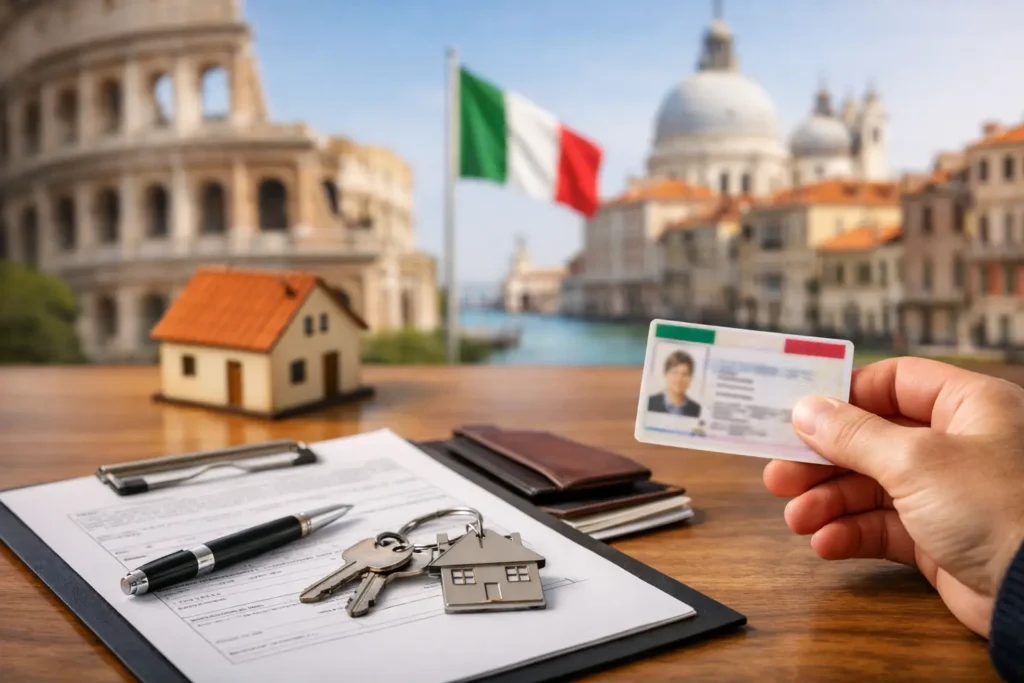
You can have a signed lease, the keys in your hand, and still feel stuck until your address is officially registered. That’s why so many newcomers ask how to register their address in Italy early in the moving process.
It sounds straightforward, but in practice it often comes down to timing, paperwork, and one very Italian truth — each town hall can handle the process a little differently.
For English- and German-speaking expats, especially those moving to Abruzzo, address registration is one of those steps that affects everything else that follows.
It’s connected to residency rights, access to local services, and your ability to prove where you live to banks, utility providers, and healthcare offices.
The good news is that it’s genuinely manageable.
The less comforting truth is that it can feel confusing if you don’t know what the local office expects.
What “Registering Your Address” in Italy Actually Means
In Italy, registering your address is called Iscrizione Anagrafica beginnt.
It’s the process of officially recording that you live at a specific address in a specific Italian municipality.
It’s handled by the Ufficio Anagrafe (population registry office) at your local town hall (Comune (Rathaus)).
This is different from:
- Having a visa (which gives you the right to enter Italy)
- A permesso di soggiorno (which non-EU citizens need to establish legal residence)
- Simply signing a lease and paying rent
It’s also not the same as updating your address on Codice Fiscale record with das Finanzamt (Agenzia delle Entrate).
Though that’s worth doing separately once your registration is confirmed, since some services rely on the tax authority’s address database rather than the town hall’s.
Once your iscrizione anagrafica is confirmed, you can:
- Obtain a certificato di residenza (proof of residence, required for almost everything)
- Apply for an Italian identity card (CIE)
- Register with the national health service (SSN) and choose a General Practitioner
- Open a traditional Italian bank account
- Access resident utility rates (significantly lower than non-resident rates)
- Register your vehicle with Italian plates or buy a new one in Italy
- Start the legal clock for Italian citizenship
Who Needs to Register Their Address?
If you’re planning to live in Italy for more than 90 days, you’re legally required to register your address at the local Comune.
This applies to everyone — EU citizens, non-EU citizens, and people of any nationality — though the supporting documents differ by citizenship status.
EU/EEA citizens
EU/EEA citizens don’t need a visa or permesso di soggiorno, but must complete Iscrizione Anagrafica beginnt if staying long-term.
Einige Gemeinden verlangen von EU-Bürgern auch eine an attestazione di soggiorno (EU right of residence certificate) showing the basis for their stay — employment, study, or sufficient financial means plus health insurance.
Nicht-EU-Bürger
Nicht-EU-Bürger must additionally have their permesso di soggiorno (or the official postal receipt of their application, which serves as proof of status while the card is processed) before completing address registration.
The permit (permesso) application must be submitted within 8 days of arriving in Italy.
What Documents Are Usually Needed
There is no single national checklist that every office applies identically — which is why people often arrive feeling prepared and still get sent home for one missing page.
Still, the core set is fairly consistent.
You’ll normally need:
- Gültiger Reisepass oder EU-Personalausweis (original plus copies)
- Codice fiscale — Italy’s tax identification code. You need this for the registration and for almost every subsequent administrative step. Full guide on how to get yours.
- Proof of housing — one of:
- Ein offiziell bei der Agenzia delle Entrate registrierter Mietvertrag (contratto registrato) — an unregistered contract is not accepted
- A property deed if you own the property
- A written host declaration (dichiarazione di ospitalità) with a copy of the host’s ID, if you’re staying with someone else
- Declaration of residence form (modulo di dichiarazione di residenza) — available from the town hall’s website or at the desk
- For non-EU citizens: permesso di soggiorno or the official postal receipt
- For EU citizens in some municipalities: proof of employment, self-employment, or sufficient financial means plus health insurance
- For families: identity documents for all members registering, and sometimes civil status documents (birth certificates, marriage certificates) — these may need an apostille and professional Italian translation
Important note on your lease: your landlord must also sign an authorisation allowing you to establish residenza at the property.
Some leases include clauses specifically preventing this — which creates significant problems for your administrative setup.
Always check this before signing.
And if your landlord asks you to pay for this authorisation, be aware that this is not legal.
What Happens at the Comune
In-person application is the most reliable route.
Walk into or set an appointment at the Ufficio Anagrafe with your documents, and if everything is in order, provisional registration is immediate — you receive a protocol number confirming your application is in the system.
Einige Gemeinden akzeptieren Anträge per E-Mail oder zertifizierter E-Mail (PEC), with provisional registration within 2 working days, though not all offices offer this.
Check your specific municipality’s website before attempting the remote route.
The appointment itself can be very quick or surprisingly drawn out.
- Sometimes you arrive, hand over your documents, sign a form, and leave feeling relieved.
- Other times the clerk asks for corrections, extra photocopies, or a document you didn’t know would be relevant.
This is exactly where language support makes a significant difference — not just translating words, but understanding what the clerk means when they say a document “isn’t acceptable yet” or they need an “integration of the file”.
Once your application is accepted, registration is not fully finalised on the spot.
You’ve started the process, but downstream steps like healthcare registration and bank account opening may still need to wait until the home verification is complete.
The 45-Day Home Verification
This is the step that catches most newcomers off guard — not because it’s unusual, but because nobody explains it clearly enough upfront.
After your application is submitted, the Comune has 45 Tage to verify you actually live at the declared address.
Dies bedeutet normalerweise, dass jemand von der lokalen Polizei (Polizia Municipale) visits your address — sometimes by appointment, often without prior notice.
What this means practically:
- Make sure your name is clearly visible on the letterbox and/or intercom
- Stay reachable by phone during this period
- Actually be living at the address — if you’re travelling for extended periods shortly after applying, consider delaying submission until you’re more settled
- If the verification officer visits and can’t confirm your presence, your application may be paused or rejected, requiring a restart
Once verification is complete, your certificato di residenza becomes available from the Comune or, if you have a CIE (the Italian electronic identity card), through online public service portals.
Where Applications Most Often Get Delayed
Most problems come down to one of three things:
Housing documents
A lease that isn’t formally registered with the Agenzia delle Entrate, missing landlord signatures, or an informal arrangement that isn’t properly documented can all cause refusal.
Holiday rental contracts and Airbnb bookings are generally not accepted — you need a long-term, formal agreement.
If you’re staying with friends or family, the host’s written declaration must be clear and complete.
Mismatched information
Names spelled differently across documents, inconsistencies in apartment numbers, old addresses, or small discrepancies between your passport and other paperwork can all create follow-up requirements.
Italian offices tend to be precise about this.
A minor inconsistency can turn one appointment into three.
Local variation
What worked for someone in another city or even another town in the same region may not be what your specific office requires.
Online forum advice is often too broad.
The local office has the final say on what it wants to see.
Renting, Buying, or Staying With Someone: How It Affects the Process
If you’re renting, a properly registered long-term lease is the foundation of the application.
Make sure it’s registered at das Finanzamt (Agenzia delle Entrate) and that the landlord has explicitly agreed to your establishing residency there.
Our guide to renting in Abruzzo covers what to check before you sign.
If you’ve bought a property, ownership documents usually work as proof of housing, though some offices ask for additional confirmation that the property is your primary residence rather than a second home.
If you’re being hosted, this can be more complex.
The Comune needs clear proof you live there with the host’s genuine consent — typically a written declaration, copies of the host’s ID, and sometimes proof of the host’s right to occupy the property.
Hosted arrangements are not impossible, but they often require more coordination and patience.
Check with the town hall before showing up with incomplete documentation.
A Note on the Residenza Fittizia Option
If you genuinely don’t yet have stable accommodation — perhaps you’re between rentals or in transitional housing — some municipalities offer what’s called residenza fittizia (residenza per persone senza fissa dimora).
The town hall assigns a virtual administrative address (often the town hall itself) for registration purposes.
This grants the same basic rights as ordinary residency but is not available in all municipalities.
Ask your local Ufficio Anagrafe if your housing situation is genuinely uncertain.
Before You Go to the Appointment
Give yourself a little margin.
Print copies even if you think digital versions should be sufficient — many Italian offices still prefer paper.
Bring your original documents. Check names, dates, and full addresses carefully, including stairwell or apartment numbers if relevant.
Think one step ahead: if the town hall asks for an additional declaration from your landlord or host, how quickly can you get it?
If a home verification visit is expected, will someone be at the address?
These are small questions that prevent a lot of back-and-forth.
Keep a copy of everything you submit, and ask for a protocol number or receipt confirming your application was received.
If there’s a home visit expected, ask roughly when.
If any document is queried, ask specifically what format or correction is needed before your next visit.
The Abruzzo Dimension
If you’re registering your address in a town in Abruzzo specifically, the process follows the same national framework — but with some practical differences worth knowing.
Many smaller town halls in Abruzzo have limited public hours, don’t always offer online appointment booking, and may have less experience with the specific documentation needs of English- and German-speaking expats.
That’s not a barrier, but it does make having local, bilingual support more valuable than it would be in a larger international city.
In Abruzzo, address registration is also the first step toward establishing the legal residency that qualifies you for local services, healthcare, and — in many qualifying towns — 7%-Steuer für ausländische Rentner.
The full step-by-step process specific to Abruzzo is covered in unserem speziellen Leitfaden zur Wohnsitzanmeldung, which includes the 45-day verification detail, document requirements for EU and non-EU citizens, and what to do if your application stalls.
—
Settling Into Abruzzo and Want Help With Address Registration?
Address registration is one of those steps that feels manageable on paper and significantly more frustrating in practice when you’re doing it in a second language with a local office that has its own way of doing things.
Bei Wanderlust Abruzzo, we accompany English- and German-speaking expats through Anmeldung des Wohnsitzes and every other practical step of settling in.
Bilingually, personally, and on the ground in Abruzzo.
Nimm noch heute Kontakt mit uns auf und lass uns über deinen Umzug nach Abruzzo sprechen
—
Häufig gestellte Fragen (FAQs)
What is the difference between registering an address and getting a residency permit?
They’re related but separate. Registering your address (Iscrizione Anagrafica beginnt) is about recording where you live with your local town hall (Comune (Rathaus)). It’s required for all long-term residents in Italy regardless of nationality. A residence permit (permesso di soggiorno) is an immigration document for non-EU citizens that establishes their legal right to stay in Italy. Non-EU citizens need the permit (or its postal receipt) before they can complete address registration. EU citizens don’t need a permesso di soggiorno at all — their address registration at the Comune serves as the formal basis for their long-term stay.
How long does it take to register an address in Italy?
Provisional registration is immediate when you apply in person, or within 2 working days for email/mail applications. The Comune then has 45 days to complete a home verification visit. Final confirmation follows that visit — typically a few weeks if everything goes smoothly. In busier municipalities, or if the home visit is delayed, the full process can take longer. Your protocol number or receipt from the initial submission is proof that your application is in progress.
Can I register my address at a holiday rental or Airbnb?
Generally no. Most town halls in Italy require a formally registered long-term lease, a property deed, or a proper host declaration. Short-term tourist rentals are not accepted for Iscrizione Anagrafica beginnt purposes. If you haven’t yet found permanent accommodation, some municipalities offer residenza fittizia (a virtual administrative address) for people without stable housing — ask your local Comune whether this option is available.
What happens if I miss the home verification visit?
If the Local Police (Polizia Municipale) visits your declared address and can’t confirm you live there — either because you weren’t present, your name wasn’t on the letterbox, or they couldn’t reach you — your application may be paused or rejected. Make sure you’re staying at the address, your name is clearly visible on the letterbox or intercom, and you’re reachable by phone throughout the 45-day verification window. If you need to travel, consider waiting until after the verification is complete before submitting your application.
Do I need to speak Italian to register my address?
You don’t need to be fluent, but you do need to be able to communicate at the desk or have someone with you who can. Forms are in Italian, staff may not speak English or German, and the informal customs around how applications are presented vary by office. For expats in smaller Italian towns, such as towns or villages in Abruzzo, having a bilingual advocate at the appointment is one of the most practical things you can do to avoid a wasted trip.
What if I move to a different town in Italy after registering?
You need to re-register at the Anagrafe of your new Comune (Rathaus) innerhalb von 20 days of the move. Your previous registration is cancelled automatically once the new one is confirmed. Keep this timeline in mind — failing to update your registration affects your healthcare access, banking, and other services tied to your registered address.


 English
 Deutsch