
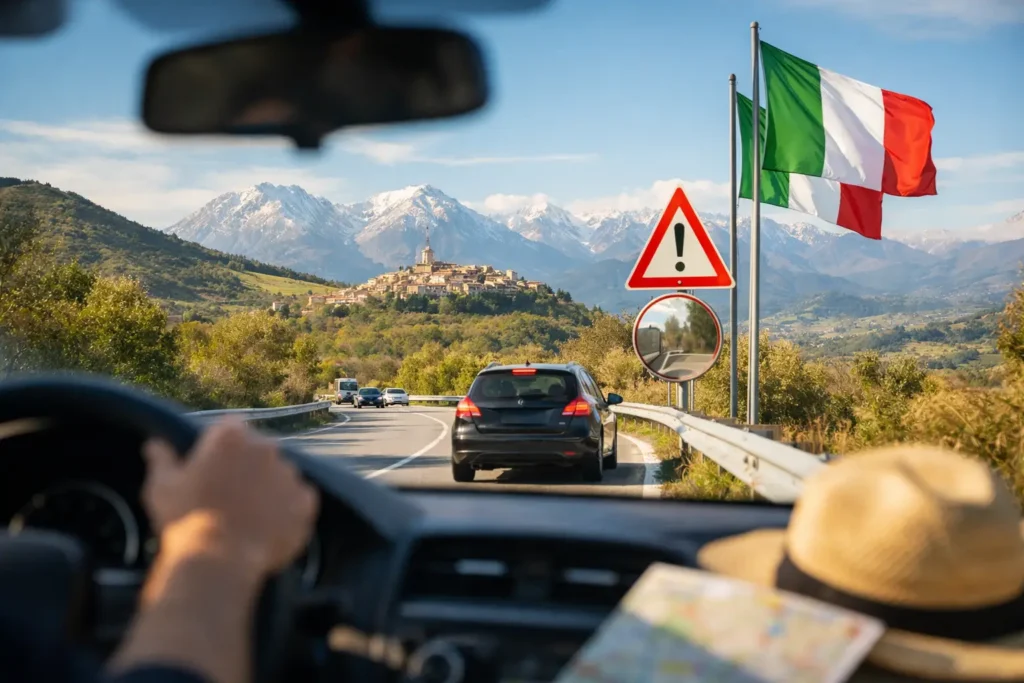
The first time you drive from a quiet Abruzzo village into a busy town centre, the challenge is rarely the road itself.
It’s the small decisions:
- whether that blue parking line needs a ticket
- whether your navigation has sent you toward a restricted zone
- or why the car behind you is flashing its lights
Italian driving rules are manageable once you understand the logic behind them.
But the deeper adjustment is realising that, for many Italian drivers, the rules function more as suggestions than firm boundaries.
For many newcomers, driving is what makes daily life possible.
It opens up beaches, mountain villages, supermarkets, appointments, and visits with new friends.
A little preparation — and a genuine shift in mindset — helps you enjoy that freedom without collecting unexpected fines, or worse.
The Mindset Shift That Matters More Than Any Rule
Before covering the specific rules, it’s worth being honest about something most driving guides skip.
The culture behind Italian driving is genuinely different from what most northern European, American, British, Canadian, or Australian drivers are used to.
And southern and central Italy, including much of Abruzzo, tends to be more assertive than the north.
Italy’s road safety performance sits marginally below the European average — in 2024 the country recorded 173,364 injury-related road accidents, with 3,030 people losing their lives.
Road accidents have been rising since 2020, and nearly every Italian region (with the exception of the islands) appears on the national list of highest accident counts.
This isn’t meant to alarm you — it’s meant to set the right expectation.
The formal rules on paper are essentially the same as elsewhere in Europe.
What’s different is how consistently they’re actually followed.
The single most important thing to internalise: you need to change your driving mindset completely from what you’re used to at home.
Assume other drivers may not indicate, may not stop fully at give-way signs, may follow closely, and — critically — may not stop at pedestrian crossings even when they clearly should.
Our best tips are:
- Drive defensively
- Avoid confrontation
- And never assume the other driver will do the “correct” thing simply because it’s the rule
If you’re walking, not driving
This deserves its own clear warning: cars in Italy very often do not stop at pedestrian crossings, even where the law requires it.
If you’re walking, never step into a crossing assuming a car will stop:
- Make eye contact with the driver if possible
- Wait until the car has genuinely slowed or stopped
- And treat every crossing as if the right of way is only theoretical
This single habit — waiting to be certain rather than assuming — prevents the vast majority of pedestrian incidents involving newcomers.
Italian Driving Rules Start Before You Turn the Key
Keep the documents required for you and your vehicle with you whenever you drive.
This commonly includes:
- your driving licence
- vehicle registration document
- and proof of insurance
If you’re using a foreign licence, the rules that apply to you can depend on where it was issued, how long you’ve been resident in Italy, and your individual circumstances.
Don’t assume that a driver’s licence accepted for a holiday is automatically suitable after a longer-term move.
- EU licences with a fixed expiry are simply renewed as Italian licences when they expire
- EU licences with unlimited validity must be actively converted after establishing residency
- Non-EU licences (US, UK, Australian, etc.) are typically valid for 12 months after registering residency, after which conversion or an Italian driving test is required
Check your position early, rather than discovering a problem when you need to rent a car, complete vehicle registration, or deal with an unexpected roadside check.
If you bring a foreign-plated car to Italy, there are deadlines and specific requirements connected to residency and use of the vehicle.
This is one of those areas where getting clear, current guidance at the beginning can save a great deal of back-and-forth later.
Learn the Signs That Cause the Most Trouble
Italian road signs use familiar European symbols, but a few signs deserve special attention because they’re frequent sources of confusion for expats.
ZTL: Do not follow your GPS blindly
ZTL stands for Zona a Traffico Limitato, or limited traffic zone.
These areas are common in historic centres, where access is restricted at certain times or reserved for authorised vehicles, residents, deliveries, or public services.
A sign at the entrance will usually say ZTL and may show the active hours.
The difficulty is that camera enforcement is common.
There may be no barrier, no police officer, and no obvious warning beyond the sign.
If you pass the camera without authorisation, a fine can arrive weeks or months later, especially if you were in a rental car or still using a foreign registration.
Many old town centres in Abruzzo have narrow streets that simply weren’t designed for through traffic.
Before driving into central Pescara, Chieti, Teramo, Ortona, or a hill town you’ve never visited, check where you can park outside the centre and walk the final few minutes.
Navigation apps are useful, but they don’t always account for temporary restrictions, market days, or access rules.
Parking colours are not decoration
Parking lines matter in Italy.
Blue lines usually indicate paid parking — look for a nearby machine, instructions on a sign, or an approved parking app.
You may need to display a printed ticket inside the windscreen, depending on the system in use.
White lines often indicate free parking, but always check the signs nearby.
Some parking spaces are limited by time, reserved for residents, or subject to local conditions.
Yellow lines are generally reserved for specific users, such as disabled permit holders, taxis, or service vehicles.
Don’t park there unless the sign clearly confirms you’re allowed to.
In smaller towns, the challenge may be less about payment and more about space.
Avoid blocking gates, driveways, corners, or narrow streets, even if other cars appear to be doing the same.
A local habit is not always a legal parking spot.
Restricted lanes and roundabouts
Bus lanes, bicycle lanes, pedestrian areas, and lanes marked for particular traffic are taken seriously.
Watch for signs as you approach larger intersections, particularly in towns and cities where lane choices may be made well before the junction.
Roundabouts are everywhere in Italy, including on roads that once had ordinary intersections.
Traffic already circulating in the roundabout generally has priority, but slow down, look carefully, and follow signs at each individual junction.
Use your turn signal when leaving the roundabout — it sounds simple, yet it makes your intention much clearer to drivers entering behind you.
It might seem that these rules are obvious, but you will notice that Italian drivers rarely signal when they turn, or even respect the corresponding priority.
Be well aware of that.
Speed Limits Change More Often Than You Expect
The posted sign is always the limit to follow.
As a general guide, limits are often 50 km/h in built-up areas, 90 km/h on many secondary roads, 110 km/h on major divided roads, and 130 km/h on highways in normal conditions.
Lower limits can apply in rain, roadworks, tunnels, near schools, and on roads with specific local restrictions.
The important habit is not memorising the highest possible limit — it’s noticing every change.
Italian roads can move quickly from a broad, open stretch to a village entrance, a sharp bend, or a school zone.
The genuinely reassuring part: speed cameras and radar in Italy are almost always signposted in advance.
You don’t need expensive radar-detection equipment — the government requires visible warning signage before fixed and mobile enforcement points, and locals (and most navigation apps) are usually well aware of where they’re commonly placed.
Pay attention to the signs and you’ll rarely be caught by surprise.
On the toll highway (autostrada), collect a ticket when you enter if the lane requires it, and pay when you exit.
Choose lanes carefully — signs show whether a lane accepts:
- cards
- cash
- electronic toll devices (Telepass)
- or a combination
Don’t stop suddenly at the last moment to change lanes.
If you choose the wrong one, stay calm and use the assistance button if necessary.
Drive Defensively, Not Timidly
Italian driving can look more assertive than what many Americans, Canadians, British, or northern European drivers are used to.
And this is particularly true in Abruzzo and much of southern and central Italy compared to the more orderly driving culture often found further north:
- Cars may follow more closely
- Scooters may appear beside you at a light
- And drivers may use a brief horn or flash of headlights to communicate that they’re approaching or intend to pass
That doesn’t mean you need to drive aggressively — quite the opposite.
Avoid confrontation entirely.
If someone tailgates, flashes their lights impatiently, or overtakes in a way that feels aggressive, the correct response is to stay calm, let them pass when it’s safe, and not engage.
Confrontations on Italian roads rarely end well and are simply not worth it.
The best overall approach is calm, predictable driving.
Keep to the right except when overtaking, signal early, leave room for scooters and bicycles, and avoid abrupt braking or wandering between lanes.
On mountain roads, especially in rural Abruzzo, expect blind corners, uneven surfaces, farm vehicles, and locals who know every bend by heart.
Consider a dashcam
One practical step many expats — including ourselves — have adopted is installing a dashcam (front-facing recording camera).
Dashcam footage provides clear, objective proof of fault in the event of an incident, and an increasing number of European insurers offer premium discounts of 5–15% for drivers who use one.
We’ve never had an accident in Italy, but unfortunately, they’re common enough that this small piece of extra peace of mind is genuinely worth it.
Both for potential insurance disputes and simply knowing you have an accurate record if something happens.
Insurance: Why It Costs More Than You Might Expect
Car insurance in Italy is mandatory — driving without valid third-party liability coverage (RCA, Responsabilità Civile Autoveicoli) carries fines from €866 to €3,464, and your vehicle can be confiscated.
Basic RCA covers only third-party damage — anything to your own vehicle (theft, vandalism, fire, weather damage) requires separate comprehensive coverage, which can add significantly to the total cost, particularly in urban areas. Weigh carefully whether comprehensive cover makes sense for your specific vehicle and situation.
Besides that, it’s also expensive, by European standards.
There are a few genuine reasons for this, and it’s worth understanding them rather than simply being surprised by the quote.
The Italian market historically handles a higher ratio of bodily injury claims per traffic accident compared to its northern European neighbours, which pushes baseline costs upward across the entire market.
Road conditions in many areas — particularly older, narrower roads and less consistently maintained rural stretches common in inland Abruzzo — also contribute to higher claim frequency.
And, frankly, the driving culture described throughout this post plays a role too: more assertive, less rule-consistent driving translates into more claims, which insurers price accordingly.
Italien verwendet a bonus-malus system with 18 classes: new policyholders typically start in class 14, moving up one class (cheaper) for each accident-free year, and down for at-fault accidents.
Your municipality of residence, the type of vehicle, and your accident history all factor into your premium.
New residents without an Italian driving history often start at a less favourable rate — this is normal and improves over time with a clean record.
Alcohol, Phones, and Everyday Safety
Italy has strict rules around driving after drinking.
The safest choice is straightforward: if you’re driving, don’t drink alcohol.
Limits can be lower for certain categories of driver, including newer drivers, and the consequences of getting it wrong aren’t worth guessing about after a long lunch or evening aperitivo.
Using a phone while driving is heavily restricted.
Now, expect to see many drivers doing it anyway.
Set your route before leaving, use a proper hands-free system if needed, and pull over safely if you need to answer a call or change directions.
Holding a phone at a traffic light is not a good workaround.
Seat belts are expected for everyone in the vehicle, and children must use the appropriate child restraint.
In winter, some areas require winter tyres or snow chains during specified periods — especially relevant if you plan to drive toward the mountains, where conditions can change quickly even when the coast is mild and sunny.
The general rule is to carry snow chains (or tire chains) in the car from October to April, no matter where you live.
If you’re ever involved in an accident, stop immediately, activate hazard lights, put on your high-visibility vest before exiting the vehicle, and place your warning triangle at least 50 metres behind the stationary car.
For emergencies, dial 112 — the single European emergency number covering police, ambulance, and fire services.
Fill in a CAI form (Constatazione Amichevole di Incidente) — Italy’s version of the European Accident Statement, accepted by all Italian insurers — and notify your own insurer promptly, typically within a few days.
Make Your First Weeks Easier
Give yourself permission to practise before tackling a complicated trip.
Start with familiar routes at quieter times of day:
- your local grocery store
- a beach parking area
- or a drive between your home and the nearest larger town
Learn where you can park, which roads become busy, and where the fuel stations are.
It also helps to keep a few practical items in the car:
- a reflective safety vest
- warning triangle
- phone charger
- water
- and a paper note with your address or destination written clearly
These are small comforts, but they matter when you’re tired, lost, or trying to explain your location in Italian.
If arranging Italian vehicle paperwork, understanding local parking rules, or making calls about an appointment feels like one more thing on an already overwhelming relocation list, local support can make the process feel far less lonely.
Wanderlust Abruzzo helps newcomers handle the practical steps of settling in, so they can spend less time second-guessing forms and directions.
Driving in Italy becomes easier through repetition, patience, and a genuinely adjusted mindset.
Soon, the blue lines, roundabout exits, toll lanes, and steep village streets stop feeling like tests.
They become part of the ordinary freedom of living here:
- taking the scenic road home
- stopping for coffee in a town you hadn’t planned to visit
- and knowing you can find your way — calmly, defensively, and without unnecessary drama
—
Settling Into Abruzzo and Need Help With Car Registration or Practical Setup?
From vehicle registration and driving licence conversion to the rest of your first-month setup, we help you get the practical foundations right.
Bei Wanderlust Abruzzobegleiten wir deutsch- und englischsprachige Expats durch alle praktischen Phasen der Auswanderung nach Abruzzo.
Persönlich, zweisprachig und direkt vor Ort.
Nimm noch heute Kontakt mit uns auf und lass uns über deinen Umzug nach Abruzzo sprechen
—
Häufig gestellte Fragen (FAQs)
Do cars stop at pedestrian crossings in Italy?
Not reliably, especially outside major cities and in southern and central regions. While the law requires drivers to stop for pedestrians at marked crossings, this rule is inconsistently followed. Never step into a crossing assuming a car will stop — wait until the vehicle has genuinely slowed or stopped, and make eye contact with the driver if possible before crossing.
Do I need expensive radar detection equipment to avoid speeding fines in Italy?
No. Italian law requires speed cameras and radar enforcement points to be clearly signposted in advance, both fixed and mobile installations. Paying attention to road signage is sufficient to avoid most unexpected fines — no special equipment is needed or, in most cases, legally permitted.
Why is car insurance so expensive in Italy?
Several factors combine: a historically higher ratio of bodily injury claims per accident compared to northern Europe, road conditions that vary significantly by region, a more assertive general driving culture that increases claim frequency, and the bonus-malus rating system, which starts new drivers at a less favourable rate regardless of their driving history elsewhere. Comprehensive coverage beyond the mandatory third-party liability (RCA) adds further cost, particularly in urban areas with higher theft and vandalism risk.
Is it worth installing a dashcam in Italy?
Many expats find it genuinely worthwhile. Dashcam footage provides clear, objective evidence in the event of a dispute or accident, and a growing number of insurers offer premium discounts of 5–15% for drivers who use one. Given the frequency of minor incidents and the assertive driving culture in much of Italy, it’s a relatively low-cost way to add real peace of mind.
Can I drive in Abruzzo with a foreign driving licence?
It depends on your citizenship and how long you’ve been resident. EU licences remain valid and are simply renewed as Italian licences upon expiry (or converted, if the licence has unlimited validity). Non-EU licences are typically valid for up to 12 months after you register Italian residency, after which you must convert your licence or pass an Italian driving test. Always confirm your specific situation, as rules can vary based on bilateral agreements between Italy and your home country.

 English
 Deutsch