
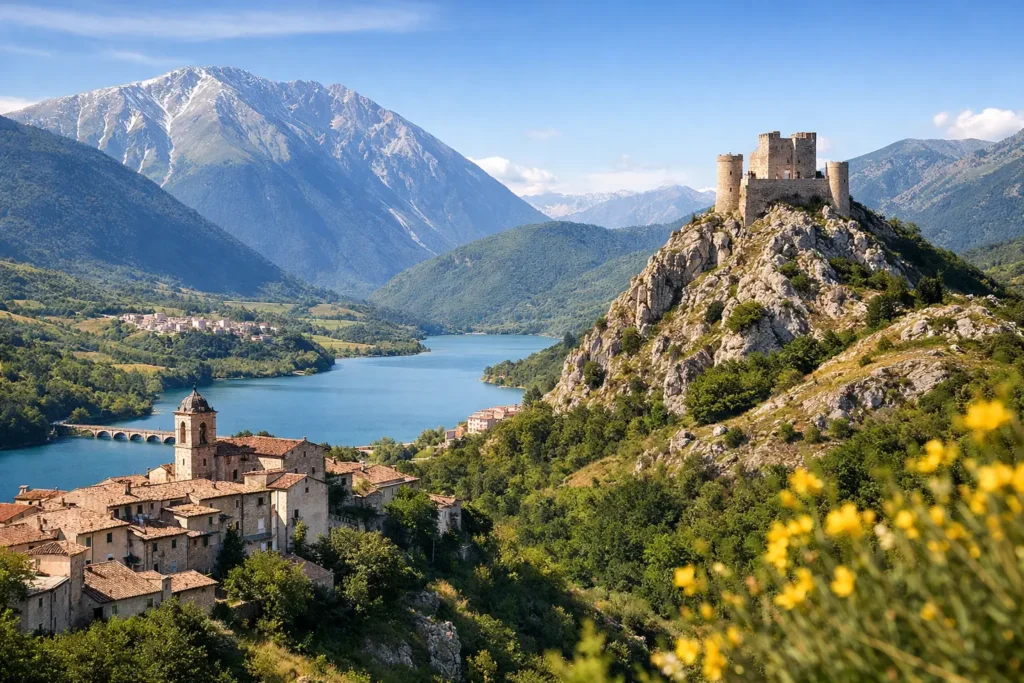
The first time you hear someone ask what the hidden gems in Abruzzo are, they usually mean places to visit on a long weekend.
But if you’re considering a move, the better question is this: which places still feel good after the novelty wears off?
That’s where Abruzzo really shines.
Beyond the better-known beach towns und postcard villages, there are places that offer something more useful to future expats — a strong sense of local life, manageable pace, beautiful surroundings, and enough character that daily errands don’t feel like a compromise.
Some hidden gems are perfect for a day trip.
Others are worth looking at with a more practical eye if you’re trying to picture your life here.
What Are the Better-Known Hidden Gems in Abruzzo for Future Expats?
Not every beautiful place is easy to live in, and not every practical place is memorable.
The sweet spot is where everyday life and local charm overlap.
In Abruzzo, those places tend to be small to mid-sized towns with real communities, walkable centres, and access to either the coast, the mountains, or both.
Wenn du house hunting from abroad, it helps to look beyond the names that show up first in generic travel guides.
Some of the most livable spots are quieter, less marketed, and far more revealing of what life in Abruzzo actually feels like.
Città Sant’Angelo
Città Sant’Angelo often surprises people.
It has the hilltop beauty many buyers want, with old stone streets, views that stretch toward the Adriatic, and a historic centre that still feels lived in rather than staged for tourists.
At the same time, it sits close enough to the coast and major roads to make daily life easier.
That balance matters.
A gorgeous medieval village can feel romantic for a week and exhausting in winter if every errand takes planning.
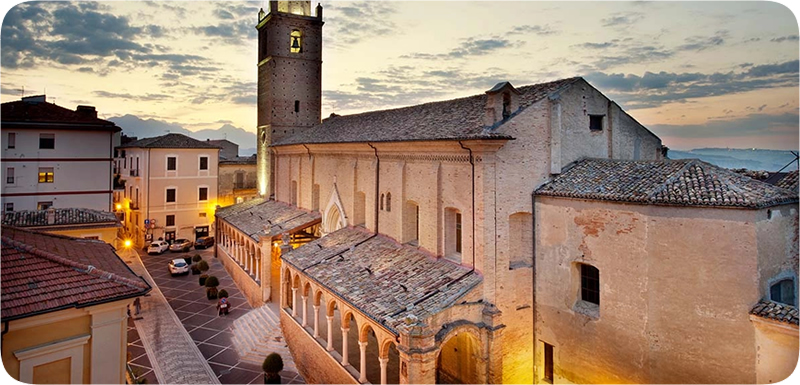
Città Sant’Angelo offers charm without complete isolation, which is one reason it stands out for people who want atmosphere but also need practical access to services.
It might not be considered a hidden gem anymore, but we strongly suggest you have a walk by its streets, whether just for a quick trip, or to consider it as your new home.
Guardiagrele
Guardiagrele has a stronger mountain feel and a more traditional rhythm.
It’s known locally for craftsmanship — particularly copper and wrought-iron work, still practised in active artisan workshops — and food, but what many newcomers notice first is the setting, close to the Maiella, with a dramatic backdrop that changes with the weather and season.

This town makes sense for people drawn to a quieter lifestyle and more authentic small-town energy.
The trade-off is that it feels less coastal and less internationally visible than some other areas.
For some expats, that’s the appeal.
For others, especially if they want a larger foreign community nearby, it may feel a little too tucked away.
Coastal Hidden Gems: The Trabocchi Coast and Beyond
San Vito Chietino and the Via Verde
If your image of Italy includes morning walks by the sea, San Vito Chietino deserves a serious look.
The Costa dei Trabocchi gets attention for good reason, but San Vito still manages to feel more personal than flashy.
It has sea views, access to the Via Verde cycling path, and a slower atmosphere than some beach areas farther north.
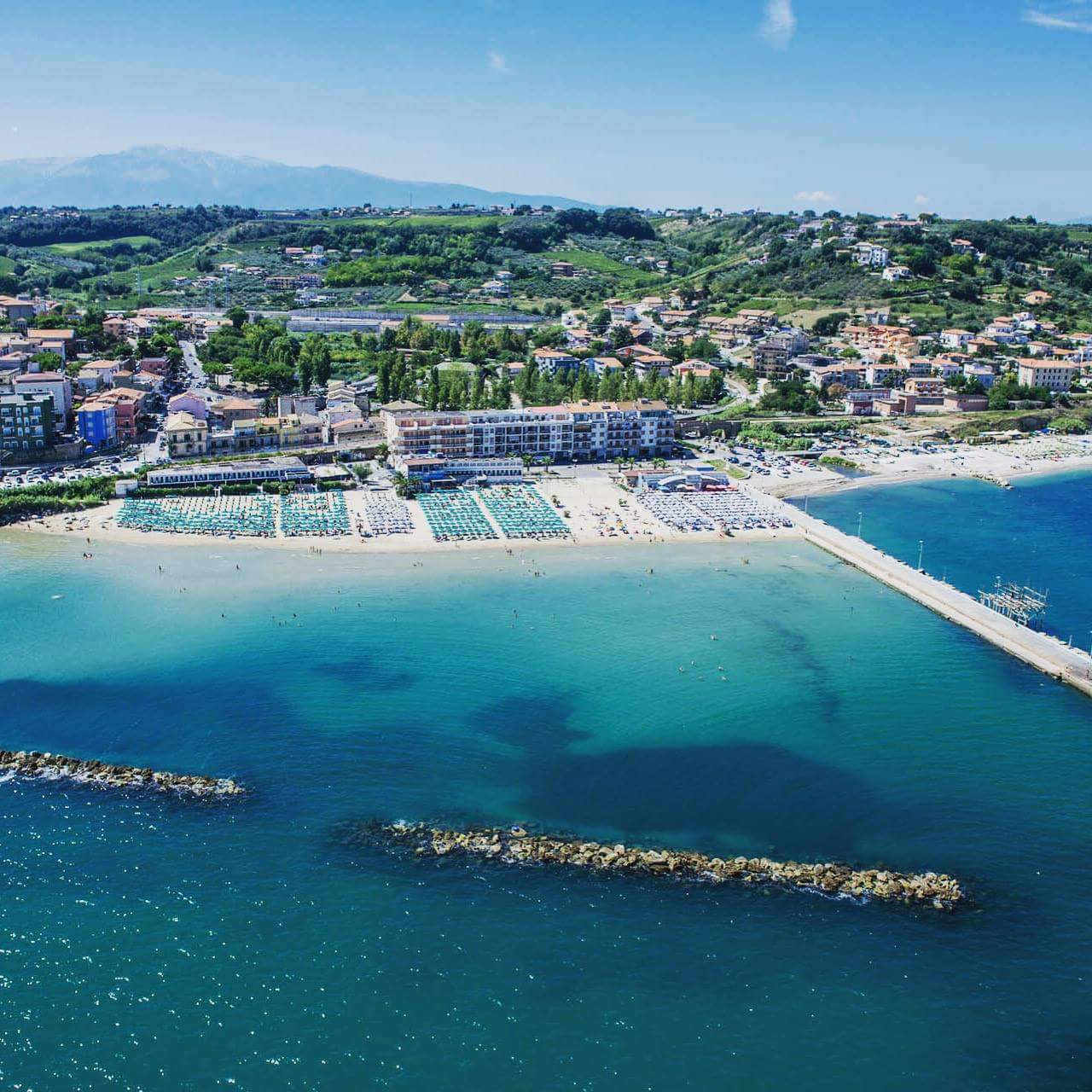
The “Via Verde” itself is worth knowing in its own right: a converted former railway line that now runs as a dedicated cycling and walking path along the Trabocchi Coast, currently stretching from around Ortona down toward the Spiaggia di Punta Aderci nature reserve near Vasto.
It’s flat, scenic, mostly traffic-free, and genuinely one of the best ways to experience this stretch of coastline — whether you’re cycling the whole route or just taking a slow seaside walk for an afternoon.

The catch with San Vito and the wider Trabocchi area is seasonality.
Coastal life can feel wonderfully open in spring and summer, then much quieter in the off-season.
Some people love that shift.
Others want more year-round activity nearby.
If you’re thinking about moving rather than just visiting, it helps to test both versions.
Mountain and Lake Hidden Gems
Scanno and the heart-shaped Lago di Scanno
Scanno is one of those places that’s almost too photogenic to feel real, and it absolutely deserves attention beyond the postcard.
The town itself is listed among Italy’s most beautiful villages (Borghi più belli), with a historic centre known for goldsmith workshops and a tradition of bobbin lace-making, and a strong, still-visible local culture.
Just outside town sits Lago di Scanno, the largest natural lake in Abruzzo, formed thousands of years ago by a landslide from Mount Genzana that blocked the Tasso River.

From a specific viewpoint reached via the Sentiero del Cuore (Heart Trail) — a roughly hour-long, family-friendly walk — the lake reveals its famous heart shape, making it one of the most romantic natural landmarks in central Italy.
A short distance away, near the village of Villalago, is the smaller, equally striking Lago di San Domenico, an artificial lake created in 1929, crossed by a charming stone bridge that leads to the Eremo di San Domenico, a small hermitage built into the rock where, according to local tradition, the Benedictine monk Domenico di Sora retreated around the year 1000.

Local legend holds that he tamed a wolf here — a nice echo of Abruzzo’s real, present-day population of wild wolves in the surrounding national park.
This area is firmly mountain Abruzzo: beautiful, quiet, and a genuine draw for hikers and slow-travel lovers, but it asks for real commitment in terms of driving and self-sufficiency if you’re considering it as a place to live rather than visit.
Caramanico Terme
Caramanico Terme sits inside the Maiella National Park and is considered something of the park’s unofficial capital — a small medieval town (just under 2,000 residents) built around its thermal springs, known since the 16th century for their sulphur-rich, anti-inflammatory mineral waters.
The historic spa, “La Salute”, opened in 1901, but was closed in 2021 because of the bankruptcy of the last management company, unfortunately.
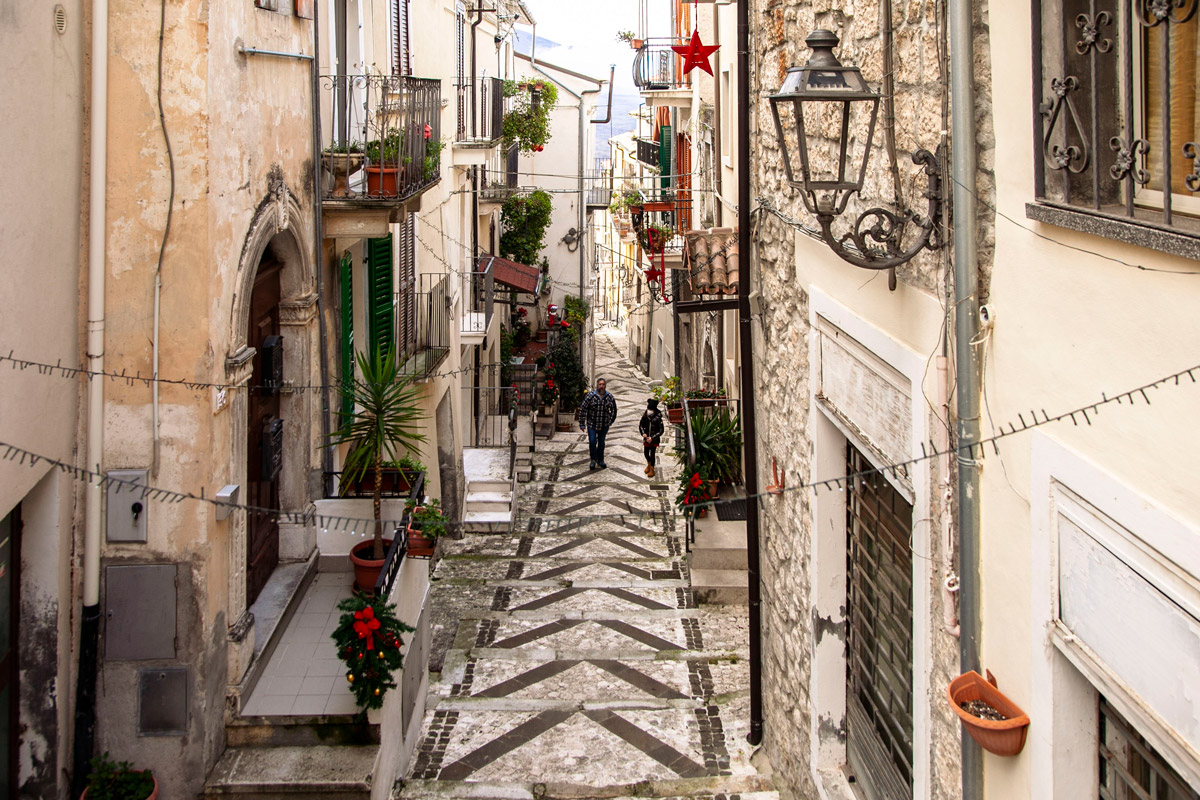
However, the town remains a genuine destination because it is one of the best access points for serious hiking in the Valle dell’Orfento nature reserve.
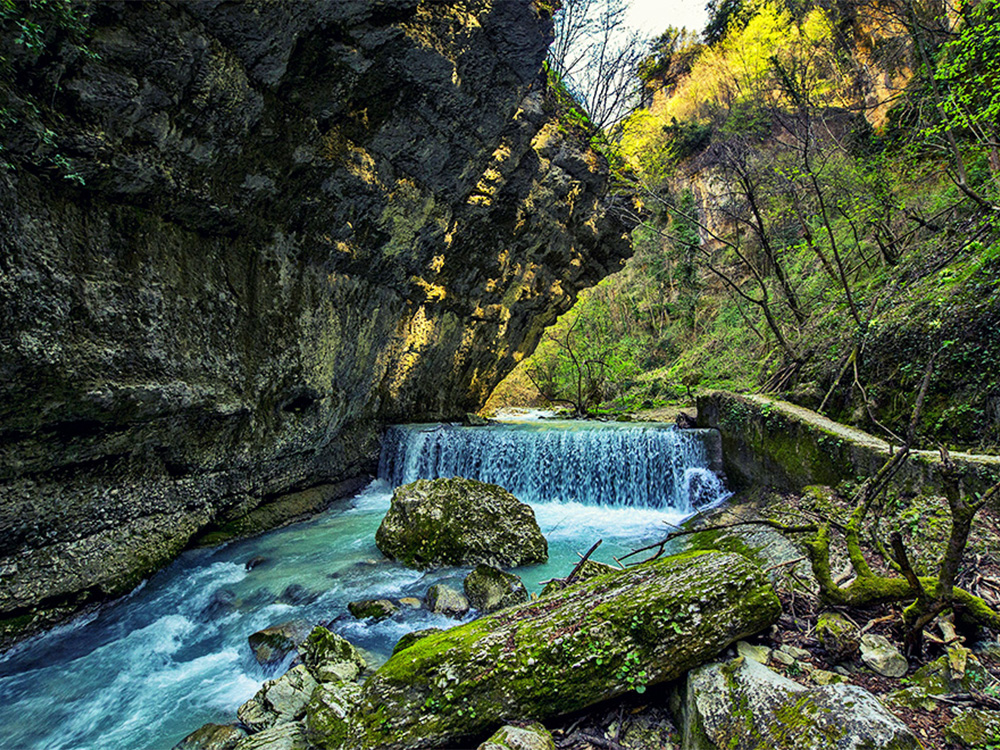
Beyond the springs and trails, Caramanico has built a strong reputation for its Christmas markets in December — a relatively recent addition to the town’s calendar, but one that’s become genuinely popular for its quality and atmosphere.
Combined with traditional festivals throughout the year — the Feast of Saint Anthony the Abbot in January, the Bonfire of St. Martin in November — Caramanico offers a rare combination: real outdoor adventure and a calendar of authentic local events that goes well beyond a typical small-town tourist offering.
Azzinano
This one is genuinely unusual and worth knowing purely for its character.
Azzinano is a tiny hamlet that has covered its walls in a series of charming, hand-painted murals depicting traditional children’s games once played in the village — a small, low-key but heartfelt act of cultural preservation.

There’s little practical reason to live here specifically, but it’s a wonderful example of how even Abruzzo’s smallest, least-known corners often have something unexpectedly creative going on.
Worth a visit if you’re exploring the region, and a good reminder that the most interesting finds here aren’t always the famous ones.
Pacentro
Pacentro sits beneath the Maiella massif, its medieval castle visible from a striking distance, and has the kind of setting that makes visitors stop and stare.
Unlike towns on the northern and eastern sides of the Maiella, Pacentro faces the more remote, mountainous Abruzzo interior, which gives it a genuinely more isolated feel — though its proximity to Sulmona, a stable and well-populated town, helps keep it from feeling neglected.

For expats deeply motivated by landscape and authenticity, it can feel very special.
It’s not the place to choose if you want coastal convenience or quick access to everything — it’s a better fit for people comfortable planning ahead, driving regularly, and embracing a more rural pace without needing constant stimulation.
Santo Stefano di Sessanio and Rocca Calascio
These two are increasingly well-known rather than truly hidden these days, but they’re worth including precisely because they represent the most dramatic end of what Abruzzo’s mountain villages offer.
Santo Stefano di Sessanio, with a population of just over 100, was famously restored beginning in 1999 after nearly disappearing entirely, and is known today for its Sextantio Albergo Diffuso and its prized local lentils, celebrated each September at der Sagra delle Lenticchie.
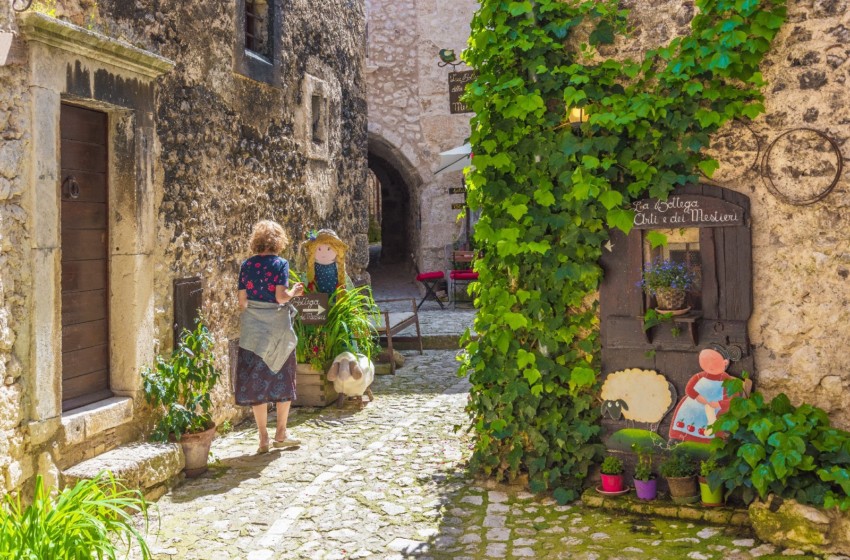
Nearby, Rocca Calascio — the highest castle in Italy at 1,460 metres — is no longer remotely a secret (it featured in films including Der Tag des Falken and regularly appears on lists of the world’s most beautiful castles), but it remains an essential part of understanding why people fall in love with this corner of Abruzzo.

Both places are extraordinary to visit and genuinely demanding to live in full-time, given their tiny populations and limited services — better suited to a very intentional, rural lifestyle than to everyday convenience.
The Hidden Gem Question Depends on How You Want to Live
This is the part many travel articles skip.
The answer to what the hidden gems in Abruzzo are depends on whether you’re coming for five days or five years.
If you want sea access and easier day-to-day logistics, places near Pescara, Francavilla al Mare, Ortona, Vasto, Montesilvano or the quieter edges of coastal towns may serve you better than a remote inland village.
If you’re craving space, mountain views, and a deeper immersion in local life, inland towns can be incredibly rewarding.
But they often ask more of you too — more driving, more language confidence, and more patience while settling in.
There is no single best answer, only a better match for your lifestyle.
Some people need walkability, train access, and a nearby airport.
Others want a garden, silence, and room to breathe.
A hidden gem is only a gem if it fits the life you actually want.
How to Spot a Real Hidden Gem Before You Move
The most useful approach is not to chase the prettiest town.
It’s to notice how a place functions.
- Spend time there on an ordinary day.
- See what’s open.
- Check how long it takes to buy groceries, park, or reach a train station.
- Walk the streets in the late afternoon, not just at lunch when everything looks lively.
- Notice whether the town feels inhabited or simply preserved.
If possible, visit in more than one season.
Abruzzo changes a lot across the year, especially between coastal and inland areas.
A breezy summer favourite can feel too quiet in January.
A mountain town that seems sleepy in spring can feel magical and deeply livable by autumn.
Genau an diesem Punkt ist auch lokale Beratung helps.
People moving from abroad often lose time focusing on places that look right on paper but don’t suit their actual needs.
A supportive local perspective can narrow that gap quickly.
At Wanderlust Abruzzo, this is often where conversations become more grounded — not just where to go, but where daily life is likely to feel easier, calmer, and more sustainable.
A Few More Places That Deserve Attention
If you like having options, keep an eye on smaller spots such as Silvi Alta for historic character above the coast, Pineto for a more relaxed seaside feel, and Loreto Aprutino oder Penne for village life with real personality and excellent olive oil.
None of these are secret in the strict sense, but they’re often undervalued by newcomers who only search the biggest names first.
That’s the pattern with Abruzzo.
The best places are not always the loudest ones.
They’re the towns that reveal themselves slowly, then keep making sense once real life begins.
If you’re asking what the hidden gems in Abruzzo are, you’re already looking in the right direction.
Just make sure you’re not only choosing a place that photographs well.
Choose one that feels like exhaling when you get home.
—
Exploring Abruzzo’s Hidden Gems and Wondering Where You Could Actually Live?
Visiting these places is one thing.
Understanding which ones could genuinely work as your home — practically, not just romantically — is a different question, and exactly the kind of thing we help people figure out.
Bei Wanderlust Abruzzo, we help English- and German-speaking expats explore the region with both heart and head — finding the places that move you and the places that will actually work for daily life.
Get in touch today and let’s talk about finding your place in Abruzzo
—
Häufig gestellte Fragen (FAQs)
What are the best hidden gems to visit in Abruzzo?
Standouts include the heart-shaped Lago di Scanno and nearby Lago di San Domenico, the Via Verde cycling path along the Trabocchi Coast, Caramanico Terme for hiking and the Christmas Market, the tiny mural village of Azzinano, and dramatic mountain villages like Pacentro and Santo Stefano di Sessanio. Each offers a genuinely different experience, from gentle coastal walks to serious mountain hiking and quiet medieval charm.
Is Lago di Scanno really shaped like a heart?
From most viewpoints, no, but from one specific spot along the Sentiero del Cuore (Heart Trail), a roughly hour-long walk from the lakeside, the outline genuinely does resemble a heart. It’s one of the most photographed natural landmarks in central Italy and a popular, accessible hike suitable for most fitness levels.
What is the Via Verde cycling path in Abruzzo?
The Via Verde is a converted former railway line that now serves as a dedicated cycling and walking path along the Costa dei Trabocchi, currently running from around Ortona down toward the Punta Aderci nature reserve near Vasto. It’s flat, scenic, largely traffic-free, and one of the best ways to experience this stretch of Adriatic coastline at a slower pace.
Are Santo Stefano di Sessanio and Rocca Calascio still hidden gems?
Not really anymore — both have become genuinely well-known, appearing regularly on lists of Italy’s most beautiful villages and castles. They’re included here because they remain essential to understanding Abruzzo’s mountain character, even if they’re no longer secrets. Both are extraordinary to visit but demanding to live in full-time, given their very small populations.
Which Abruzzo hidden gems are practical for actually living, not just visiting?
Città Sant’Angelo and Guardiagrele offer the best balance of charm and daily practicality among the towns covered here, both combining genuine local character with reasonable access to services and larger towns. San Vito Chietino and similar coastal spots near the Via Verde work well for people who want sea access with a calmer pace than the busiest beach towns. The more remote mountain villages — Pacentro, Santo Stefano di Sessanio, Scanno — are better suited to people specifically seeking rural immersion over convenience.


 English
 Deutsch