
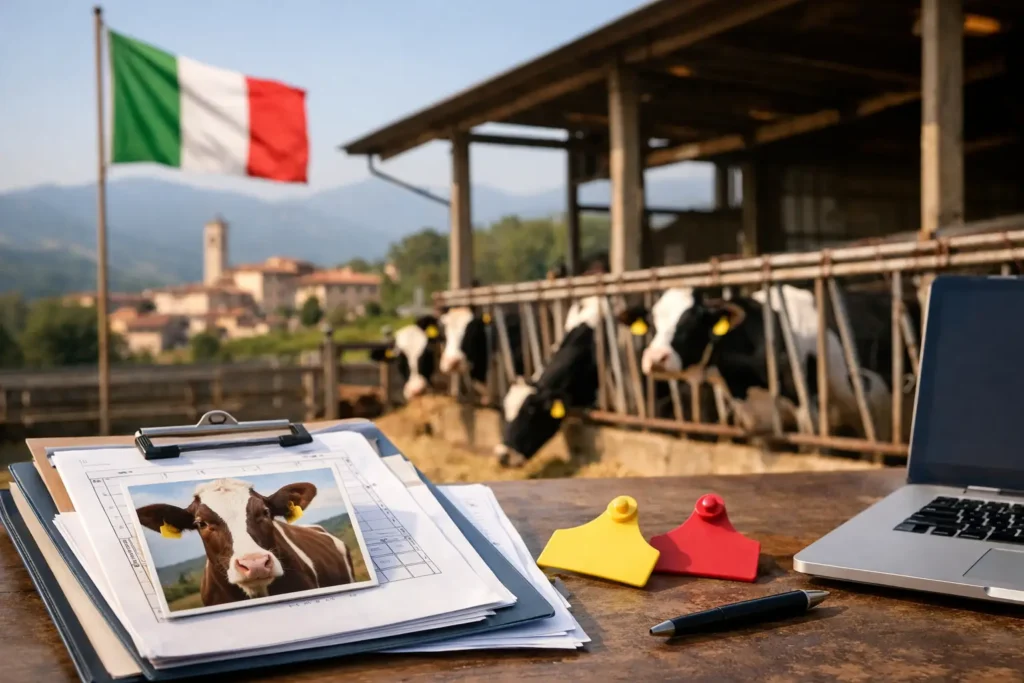
You can get surprisingly far into an Italy move before a very specific term suddenly appears in a conversation with a seller, a vet, or a neighbor: “Do you have the Codice Stalla?”
If you are buying rural property in Abruzzo, keeping animals, or trying to understand agricultural paperwork, this is one of those small but vital pieces of Italian bureaucracy that can catch newcomers off guard.
While the word stalla literally translates to “stable” or “barn”, in the eyes of the Italian state, it represents a complex system of animal traceability and public health.
What is the Codice Stalla Italy Really Used For?
In practical terms, the Codice Stalla identifies a “holding” — the physical location where livestock or registered animals are housed.
It is the agricultural equivalent of a tax code for your land’s animal activity.
Italy maintains a strict Anagrafe Zootecnica (Livestock Registry).
This system is designed for:
- Disease Prevention: Rapidly identifying the source of an outbreak (like Blue Tongue or Swine Fever).
- Food Safety: Ensuring that any animal products (cheese, meat, eggs) can be traced back to a specific farm.
- Animal Movement Control: Legally documenting when an animal is bought, sold, or moved from one province to another.
Who Usually Needs a Codice Stalla?
A common mistake expats make is assuming that “hobby animals” don’t count.
In Italy, the species of the animal often dictates the need for the code, regardless of whether you are selling products or just keeping a few pets.
- Mandatory for: Sheep, goats, pigs, cattle, buffalo, and equines (horses, donkeys, mules). Even if you only have one donkey to keep your grass trimmed, you legally need a Codice Stalla.
- Conditional for: Poultry (chickens, ducks) and bees. Rules vary based on the number of animals and whether they are for “self-consumption” (autoconsumo) or commercial sale.
- Exempt: Standard household pets like dogs and cats (which use the Anagrafe Canina microchip system instead).
Does the Code Belong to the Person or the Property?
This is where the paperwork history of your Abruzzo farmhouse matters.
This Codice Stalla is tied to the holding (the land/structure), but it must be registered to a responsible person (Detentore or Proprietario).
When you buy a property that already has sheep pens or stables, the code doesn’t automatically transfer to you.
You generally have two options:
- Transfer: If the previous owner had an active code, you can apply to the ASL to take over the responsibility for that location.
- New Registration: If the property was never registered or the old code was closed, you must apply for a fresh registration.
The Role of the ASL (Azienda Sanitaria Locale)
In Italy, the competent authority for the Codice Stalla is the Veterinary Public Health Service of the ASL.
This can be a language hurdle for many expats.
Dealing with the ASL involves technical terminology regarding “Sanitary Status”, “Movement Passports”, and “Registry Logs”.
You aren’t just talking to a vet; you are interacting with a branch of the public health system.
Why This Matters Before Buying Property
If your dream of Abruzzo involves a few rescue goats or a horse, the Codice Stalla is a vital part of your due diligence.
Before you sign a contract, ask the seller or your Geometra:
- “Is there currently an active Codice Stalla for this property?”
- “Are the existing animal structures (barns, stables) legally registered on the floor plan (Planimetria)?”
- “Is the land classified for agricultural use (Terreno Agricolo)?”
If a building is listed as a “storage shed” but you intend to use it as a stable, you may face hurdles in getting the ASL to approve a Codice Stalla for that location until the building’s use class is corrected.
Moving Beyond the Dictionary Definition
Don’t let the literal translation trip you up.
A “Stalla” isn’t always a fancy barn; it can be a simple fenced paddock with a shelter.
What matters to the Italian bureaucracy is the registration, not the aesthetics.
Trying to “wing it” without a code is risky.
If you need a vet for a sick horse or sheep, the first thing they will ask for is your code.
Without it, they may be legally limited in how they can treat the animal or record the visit.
—
How Wanderlust Abruzzo Helps
Starting a rural life in Abruzzo is rewarding, but the agricultural paperwork is a “Language Trap” of its own.
At Wanderlust Abruzzo, we help expats navigate these rural-specific tasks:
- ASL Liaison: We can contact the local veterinary office to check the status of a property’s code.
- Appointment Support: Accompanying you to the ASL to ensure your registration is handled correctly.
- Document Translation: Explaining the technical requirements for keeping animals in your specific Comune.
—
Frequently Asked Questions
Can I get a Codice Stalla if I am not a farmer?
Yes. You can register as a “non-professional holder” (detentore non professionale) if you are keeping animals for hobby or self-consumption purposes. You do not need a VAT number (Partita IVA) for this, but you still must follow health and welfare regulations.
How much does a Codice Stalla cost?
The administrative fee is usually quite low (often around €30–€50 for regional stamps), but you may have costs associated with making your structures compliant with ASL health standards (water access, drainage, etc.).
Do I need a Codice Stalla for a single horse?
Yes. All equines in Italy must be registered in the BDN (National Database), and their location must be identified by a Codice Stalla or Codice Aziendale.
What happens if I keep animals without a code?
You could face significant fines if an inspection occurs, and you will find it difficult to move the animals legally (e.g., if you sell them or move to a different property) because you won’t have the necessary “Model 4” movement documents.
How long does it take to get the code?
Depending on the local ASL office in Abruzzo, it can take anywhere from a few weeks to a couple of months. An inspector may need to visit the site to ensure the location is suitable for the species you intend to keep.



 English
 Deutsch