
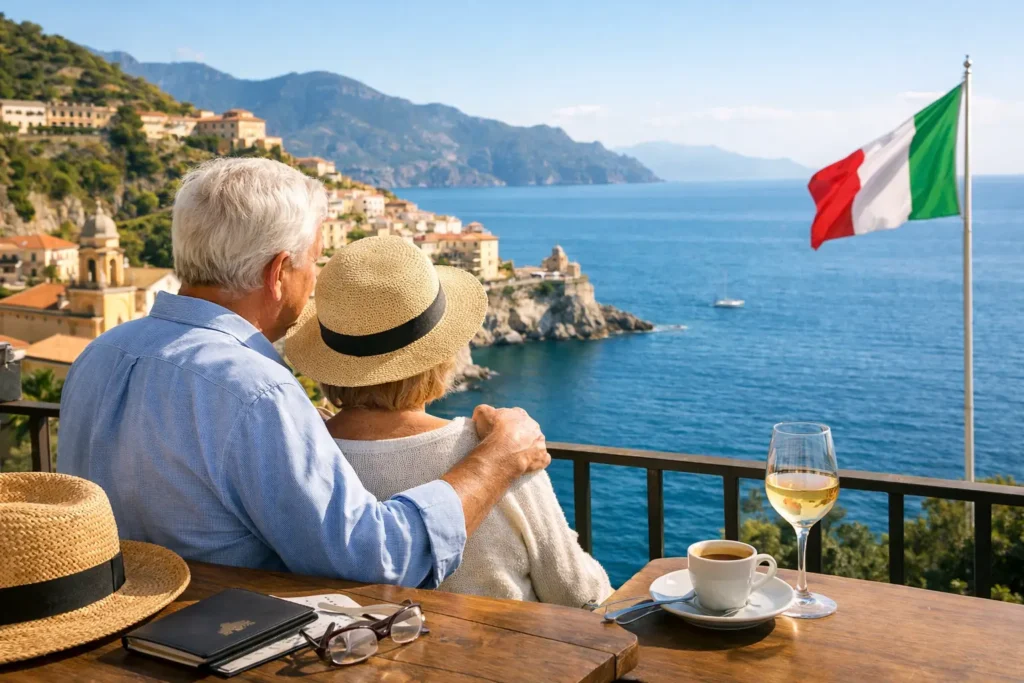
If you’re asking whether a German pensioner can live in Italy, the short answer is yes.
For many retirees, it’s not only possible but genuinely appealing: better weather, a slower rhythm, beautiful towns, and in many areas, a lower day-to-day cost of living than in Germany.
But the part that catches people off guard is this: loving Italy on vacation and settling into Italy full-time are two very different experiences.
That doesn’t mean the move is unrealistic.
It means the success of it depends less on the dream itself and more on the practical setup behind it — including a genuine cultural adjustment that goes well beyond paperwork.
Is It Possible for a German Pensioner to Live in Italy Long Term?
Yes, in many cases it is.
German citizens benefit from freedom of movement within the EU, which makes relocating to Italy much simpler than it would be for someone moving from outside Europe.
You’re not starting from zero in terms of access.
That’s the good news.
The less glamorous part is that living somewhere legally and living somewhere comfortably are not the same thing.
You’ll still need to:
- Handle residency-related admin
- Prove where you’re living
- And understand how local systems work
Italy is very livable, but it’s rarely quick or intuitive when you’re dealing with official procedures.
For pensioners, the biggest questions are usually not whether the move is allowed, but whether it will feel manageable after the excitement fades:
- Can you find a town that suits your pace?
- Can you access healthcare with confidence?
- Can you manage the language barrier when something goes wrong?
Those are the questions that matter in real life.
What Makes Italy Attractive for German Retirees?
For many German pensioners, Italy offers something that feels hard to quantify until you experience it properly:
- Days tend to unfold more slowly
- Meals still matter
- Small-town life can feel more social and less rushed
In the right area, like Abruzzo, you can have sea, mountains, historic centres, and fresh local food all within easy reach.
Cost is also part of the appeal, although this depends heavily on where you live.
Milan, Florence, and central Rome are a very different story from smaller towns and lesser-known regions.
A pension that feels stretched in a major city may go much further in a place where rent, parking, and everyday expenses are lower.
This is one reason areas like Abruzzo attract attention from retirees who want authenticity without the price tag of Italy’s most famous destinations.
You can still find communities with real local life, access to nature, and a lower-pressure lifestyle.
For someone looking to enjoy retirement rather than spend it fighting crowds and high housing costs, that matters.
Some Abruzzo towns also fall within the population threshold for Italy’s 7% flat tax for foreign pensioners, which can make a real financial difference on top of the lower baseline cost of living.
The Real Question: Can You Afford the Lifestyle You Want?
This is where the answer becomes more personal.
It’s possible for a German pensioner to live in Italy, but not every version of Italy fits every pension.
If your dream is a renovated apartment in a historic centre, regular dining out, and frequent travel around the country, your budget will need to support that.
If you’re happy with a quieter town, a practical rental, and a more local routine, your pension may go much further than you expect.
Housing is usually the biggest variable.
In some places, rent is refreshingly reasonable.
In others, availability is limited, especially if you want long-term security, easy parking, modern heating, or walkable access to shops and services.
Retirees often focus on the charm of a property and only later realise they should have asked different questions:
- Is it cold in winter?
- How far is the pharmacy?
- Are there stairs?
- Is the internet stable?
- Can I manage here without driving every day?
That’s often the difference between a romantic idea and a good retirement setup.
Healthcare and Daily Peace of Mind
Healthcare is one of the first concerns people raise, and understandably so.
Retirement moves feel much lighter when you know how to handle doctor visits, prescriptions, and basic local services.
The practical side here matters more than broad assumptions.
Even if access exists, you still need to know:
- where to go
- which office handles what
- what documents are expected
- and how to navigate appointments in a language that may not be your own
Many retirees are comfortable with some Italian in restaurants or shops, but medical and administrative settings are another matter entirely.
This is why support on the ground can make such a difference.
Not because moving to Italy is impossible alone, but because the stressful parts tend to arrive all at once.
You may be trying to sort out a home, get registered, understand utilities, organise internet, and adjust to a different pace of administration all in the same month.
Bureaucracy Is Usually the Hardest Part
Most people don’t abandon the idea of retiring to Italy because they stop wanting it.
They get overwhelmed by the process.
Italian bureaucracy is famous for a reason:
- Offices may require appointments
- paper copies
- extra documents
- or follow-up visits that weren’t mentioned the first time
Requirements can vary by municipality.
What worked for one expat in one town may not be enough in another.
This is especially frustrating for retirees who are trying to make sensible, careful decisions.
You may have all the right intentions and still end up losing time because a form was incomplete, a translation was misunderstood, or one office sends you to another.
That doesn’t mean the system is impossible.
It means patience helps, and local guidance can save a great deal of stress.
Having someone explain the sequence of steps in plain language often changes the entire experience.
The Cultural Adjustment Nobody Warns You About
This is the part we want to be genuinely honest about, because it surprises German retirees more consistently than almost anything else — and it’s rarely mentioned in standard relocation guides.
Germany runs on structure.
Ruhezeiten (legally recognised quiet hours, typically 22:00–06:00 and often a midday quiet period too) are taken seriously — in some German municipalities, courts have ruled on exactly how long a dog is allowed to bark.
Rules exist, and the general expectation is that people follow them.
As The Traveler’s guide to German cultural norms describes it, this rule-based, structured approach to daily life and civic order runs deep in German culture.
Italy operates very differently, and Abruzzo is no exception.
Quiet hours work on a different clock
There is no real Sunday “Ruhe Tag” in Italy, the way there is in Germany.
Weekends and holidays are often when people are most active — gardening, cleaning, having animated conversations in the street, running errands with the radio on.
As Margit Rüdiger at CultureAndCream’s comparison of German and Italian culture puts it, Germans tend to value quiet as a near-civic right, while in Italy, people live with noise from every direction as a simple matter of course.
Genuine “quiet time” in most Italian neighbourhoods doesn’t really begin until around 11pm or midnight — and even then, it’s a social norm rather than a strictly enforced rule.
Queueing is more flexible than you’d expect
Whether you’re waiting to buy bread or just having a coffee at the bar, the orderly, sequential queue culture common in Germany is often simply absent.
People may approach the counter at what feels like the “wrong” moment, conversations may cut across waiting customers, and what looks like disorder is, for most Italians, just normal social rhythm.
It can be genuinely jarring at first if you’re used to a more rule-governed system.
It’s worth adjusting your expectations here rather than your patience.
Invoices and contracts aren’t always automatic
This is important and worth taking seriously: it is unfortunately common in Italy for service providers to complete work without issuing a formal invoice (fattura) or receipt (ricevuta) — not just tradespeople like electricians or plumbers, but sometimes even lawyers or other professionals.
Some may even seem mildly offended if you ask for one.
Our strong recommendation: before paying for anything sensitive — a renovation, a legal service, insurance, significant repair work — get a signed contract and/or a proper invoice or receipt.
If anything goes wrong later, without that paperwork, you’ll have very little ground to stand on if you need to make a claim or dispute a charge.
It’s entirely your decision how to proceed in any given situation, but having something written and signed, or a formal invoice for work completed, is the safest approach — especially for anything involving real money.
And then there’s driving
We’ll keep this brief, because it deserves its own conversation entirely: Italian driving culture, road rule interpretation, and general traffic behaviour are noticeably more relaxed than what most Germans are used to.
A forward-looking, defensive driving style — anticipating rather than assuming compliance from others — genuinely helps here.
None of this means Italy is chaotic or untrustworthy.
It means the system of trust and order works differently — built more on relationships, reputation, and personal judgement than on rules and documentation.
Going in with that understanding, rather than expecting German-style structure, removes a significant source of frustration before it even starts.
Choosing the Right Place Matters More Than Choosing Italy
One of the biggest mistakes retirees make is treating Italy as if it were one lifestyle.
It is not.
A move that works beautifully in one region may feel isolating or expensive in another.
- If you want convenience, regular services, and a decent expat-friendly rhythm without the intensity of a major city, your ideal location may be a well-connected town rather than a remote hilltop village.
- If you want complete peace and lower housing costs, a smaller town may be perfect — but only if you’re comfortable with fewer English or German speakers and less immediate access to everything.
This is where a region like Abruzzo often makes sense for retirees.
It offers:
- a quieter lifestyle
- beautiful landscapes
- and many towns that still feel lived-in rather than purely touristic
You can build a life here, not just spend a nice week.
And that distinction matters more in retirement than people think.
You’re not choosing a backdrop.
You’re choosing your grocery store, your neighbours, your routine, and the place you’ll need to function well in every season.
What Surprises German Pensioners After the Move?
Usually, it’s not the big things.
It’s the everyday friction.
People are often prepared for the paperwork, but not for how tiring it feels to do simple tasks in another language.
They expect a slower pace, but not the emotional effect of waiting longer for things to happen — or the noise levels that follow no fixed schedule.
They imagine beautiful town squares and relaxed lunches, but not the challenge of figuring out heating systems, waste collection, internet installation, or where to buy the one practical item they suddenly need.
None of this means they made the wrong decision.
It simply means that relocating in retirement still counts as a major life transition.
Even a positive move comes with moments of uncertainty — and a genuine cultural recalibration.
That’s why realistic expectations are so helpful.
If you know the first phase may feel messy and quite different from what you’re used to, you’re far less likely to panic when it does.
So, Is It Possible for a German Pensioner to Live in Italy and Enjoy It?
Yes, very much so.
But the version that works best is usually the one built on realism, not fantasy.
If you choose a location carefully, understand your budget, prepare for admin, get comfortable with a different cultural rhythm, and give yourself support where needed, retirement in Italy can feel deeply rewarding.
It can offer more calm, more beauty, and a stronger sense of everyday enjoyment than many people have had in years.
If you’re considering the move and feeling torn between excitement and overwhelm, that’s normal.
Big changes often come with both.
The trick is not to wait until you feel fearless.
It’s to make the move in a way that leaves room for clarity, patience, and practical help when you need it.
Sometimes the dream works best when it’s treated like a real plan.
—
Considering Retirement in Abruzzo and Want Honest, German-Speaking Support?
The legal side of moving from Germany to Italy is genuinely simple.
The practical and cultural side is where good local guidance makes the real difference — from finding the right town to understanding how things actually work here, day to day.
At Wanderlust Abruzzo, we help German- and English-speaking retirees navigate every stage of the move: housing, residency, healthcare registration, and the kind of cultural orientation that prevents avoidable frustration.
Personal, bilingual, and on the ground.
Get in touch today and let’s talk about your move to Abruzzo
—
Frequently Asked Questions
Can a German pensioner legally retire in Italy?
Yes, easily. As an EU citizen, you have full freedom of movement and the legal right to live in Italy without a visa. After 90 days, you’ll need to register your residency at your local town hall (Comune), but this is an administrative step rather than a legal barrier. The bigger considerations are practical: housing, healthcare access, and budgeting for your chosen location.
How does healthcare work for German retirees in Italy?
Once you’ve registered your residency, you can register with the Italian national health service (SSN) and access public healthcare. Many retirees also maintain supplemental private insurance for shorter wait times and broader coverage. The administrative side — registration, choosing a local GP, understanding how prescriptions work — is where most people benefit from local guidance, especially in the first months.
Why don’t Italian tradespeople always provide an invoice?
It’s an unfortunately common practice, particularly for smaller jobs or informal work, where some providers skip issuing an invoice (fattura) or receipt (ricevuta). This isn’t universal, and many professionals do everything by the book, but it happens often enough to be worth real caution. Always request a signed contract or formal invoice before paying for significant work — without it, you have very limited recourse if something goes wrong.
Is Italy noisier than Germany, and is that a problem for German retirees?
Often, yes, particularly compared to Germany’s structured “Ruhezeiten” culture. Italy doesn’t observe the same kind of strict quiet hours, especially on weekends and holidays, when activity often increases rather than decreases. Genuine quiet typically doesn’t begin until late evening. This isn’t a flaw in the system — it’s simply a different cultural relationship with noise, community, and shared space, and it’s worth adjusting expectations for rather than fighting it.
Is Abruzzo a good region for German retirees specifically?
Yes, for many people. Abruzzo offers a notably lower cost of living than much of Germany and Italy’s more famous regions, genuine landscape variety (coast and mountains within the same region), and several towns eligible for Italy’s 7% flat tax for foreign pensioners. It’s also a region where daily life still feels authentically local rather than built around tourism, which appeals strongly to retirees seeking a genuine, grounded lifestyle rather than a polished postcard version of Italy.

 English
 Deutsch