
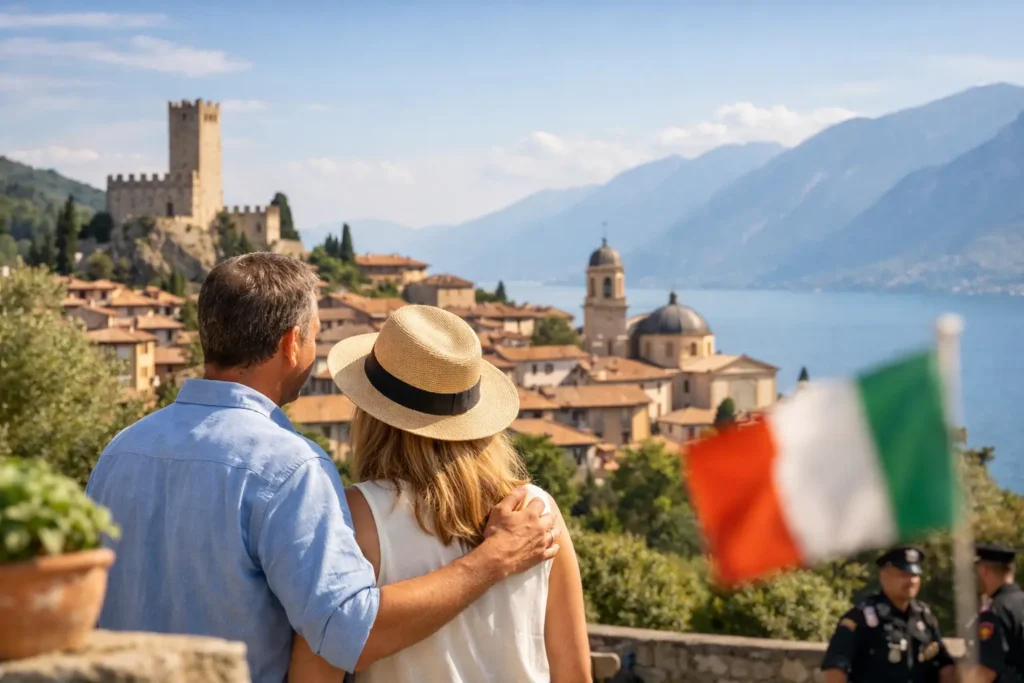
If you’re asking where Italy is safest, you’re probably not looking for a glossy travel answer.
You’re trying to figure out where daily life will feel calm, manageable, and secure when you don’t yet know the language, the systems, or the neighbourhood rhythms.
That’s a very different question, and it deserves a more honest answer than a simple ranked list.
The short version: Italy is generally considered one of the safer countries in Europe, especially compared with many larger urban centres in the US.
But safety in Italy is uneven, in the way it is almost everywhere.
A place can have low violent crime and still feel stressful if it’s chaotic, poorly connected, or difficult to navigate as a newcomer.
For expats, retirees, remote workers, and families, the safest place is often not the one with the flashiest name.
It’s the one where everyday life actually works.
What “Safety” Actually Means for Expats
When people think about safety, they often jump straight to crime statistics.
That matters, but for relocation, it’s only one part of the picture.
As Idealista’s 2026 guide to the safest places to live in Italy puts it, serious violent crime is rare across most of the country — the more common concerns are:
- pickpocketing
- bag-snatching in tourist zones
- and opportunistic theft around train stations
For residents, safety is less about avoiding rare violent incidents and more about daily-life factors: feeling comfortable walking home in the evening, knowing your area is well-kept, being able to ask for help, and not feeling isolated when something goes wrong.
That’s why many expats end up feeling safest in smaller cities and well-connected towns rather than in the biggest, most visited destinations.
The Data: Where Crime Is Actually Highest in Italy
It’s worth looking at the real numbers rather than assumptions.
According to ISTAT data published via Statista, Milan recorded the highest crime rate of any Italian province in 2024, with 6,989 felonies per 100,000 inhabitants — driven primarily by shop burglaries and theft.
Florence followed at roughly 6,567 cases, and Rome at around 6,434.
These are the country’s largest, most tourist-heavy, most economically dense areas — exactly where opportunistic property crime concentrates.
This doesn’t mean Milan, Florence, or Rome are unsafe to live in.
Millions of people live in all three cities comfortably and happily.
It means the type of crime risk in these cities is overwhelmingly property-related rather than violent, and it’s concentrated in specific high-traffic areas — train stations, major tourist sites, and crowded commercial districts — rather than spread evenly across residential life.
The Cities Most Consistently Ranked Safest
On the other end of the scale, certain Italian cities consistently appear at the top of safety and quality-of-life rankings.
International Insurance’s 2026 ranking of safest cities for expats highlights:
- Trento — widely considered one of Italy’s safest cities, with low crime rates, efficient public services, and a strong sense of community. Popular with families and remote workers for its clean environment and relaxed pace.
- Bolzano — combines Alpine scenery, bilingual Central European culture, and consistently low crime levels. Attracts professionals, families, and retirees seeking stability.
- Verona — frequently ranked among Italy’s safest and most peaceful cities, offering a high quality of life and a calmer lifestyle than larger hubs, while still being culturally rich and well connected.
- Turin — a larger northern city that remains comparatively safe by European standards, with most residential areas described as stable, affordable, and well-connected.
These cities share a pattern: medium size, strong public services, and enough infrastructure to feel functional without the density and tourist pressure of Italy’s largest metropolitan areas.
Why Abruzzo Often Surprises People
Abruzzo deserves a serious look in this conversation because it offers something many expats are quietly searching for: a sense of normal life.
Not performance.
Not tourism.
Just a place where people genuinely live.
For newcomers who want a slower, more grounded move, many parts of Abruzzo feel reassuringly safe.
The region has mountains, coastline, small cities, and towns with strong local identity.
It’s often more affordable than the most internationally famous parts of Italy, and that matters because financial pressure can make any move feel less secure, regardless of the crime statistics.
Places such as Pescara, Chieti, and smaller towns along the coast or inland can offer a good balance of calm and convenience.
You’re not dealing with the same level of tourist churn you’d find in Rome, Venice, or central Florence.
In many areas, daily life feels local, visible, and familiar — exactly the kind of environment that can be especially comforting when you’re settling in from abroad and trying to build confidence step by step.
You can read more about the actual crime statistics for Abruzzo’s provinces for a detailed regional breakdown.
That said, Abruzzo is not one single experience.
Some villages are wonderfully peaceful but may feel too quiet if you want an instant social network or frequent public transit.
Some coastal areas are lively in summer and much quieter in the off-season.
The best choice depends on whether you want walkability, community, access to schools, or an easier path through your first year in Italy.
Big Cities Versus Smaller Towns: The Real Trade-Off
This is where many relocation decisions get more emotional than practical.
What big cities offer
Big cities can feel safer to some expats because they offer anonymity, larger international communities, and easier access to services.
If you don’t speak much Italian yet, that can genuinely reduce stress.
You may find more English spoken, more coworking spaces, and more options if something doesn’t work out.
But bigger cities also come with problems most newcomers underestimate:
- Crowds create opportunities for petty crime.
- Traffic and noise wear people down over time.
- Bureaucratic tasks may involve longer waits and more confusion simply because of the population scale.
You can be surrounded by people and still feel genuinely unsupported.
What smaller towns offer
Smaller towns often do the opposite.
They can feel physically safer, quieter, and more community-oriented.
Neighbours notice things.
Shopkeepers remember you.
There’s less rush, less anonymity, and often less of the opportunistic crime associated with heavy tourism.
The trade-off is that small-town life asks more of you socially and practically.
If your Italian is limited and you’re handling housing, residency steps, utilities, or school matters on your own, a charming town can quickly stop feeling simple.
This is one of the reasons why local relocation support matters so much.
A place may be objectively safe, but if every task feels confusing, your overall sense of security still drops.
The Places That Feel Less Safe to Newcomers
This is not about labelling entire cities as bad — Italy is too varied for that, and most places have safer and less safe pockets.
Still, there are patterns worth knowing.
The areas that tend to feel less safe to expats are usually the ones:
- around major train stations
- heavily touristed historic centres
- nightlife districts late at night
- and places with high seasonal turnover
In these areas, the main issue is usually theft, scams, and general overstimulation rather than danger.
Rome is the clearest example.
Many people love living there, and for good reason.
But if you arrive without local knowledge, certain parts can feel chaotic and draining before they feel familiar.
Milan can be similar: efficient in many ways, but not everyone experiences it as calm.
Naples also gets a mixed reputation: some of that is exaggerated, and many residents are deeply loyal to the city, but for a first move to Italy, especially if you want quiet and predictability, it may not feel like the easiest place to start.
How Expats Should Judge Safety Before Moving
If you’re trying to compare areas, ask better questions than “Is it safe?”.
Ask what daily life looks like on an ordinary Tuesday.
- Can you walk to essential services?
- Are streets active without feeling chaotic?
- Do you see families, older residents, and year-round local life, or is the area dominated by short-term visitors?
- Is public transport reliable enough that you won’t feel stranded?
- If you work remotely, does the area feel calm and functional outside peak tourist season?
It also helps to look at your own stage of life.
- A solo remote worker may prioritise social ease and transport.
- A retiree may care more about quiet streets and healthcare access.
- A family may focus on schools, routine, and neighbourhood stability.
The safest place for one person can feel limiting to another.
A Practical Answer for Most Movers
For many people relocating from abroad, the safest choice in Italy is not the most famous city nor the most isolated village.
It’s a well-connected smaller city or town where you can build a routine without constant friction.
That’s why regions like Abruzzo often make sense.
You can find places that feel grounded, neighbourly, and easier on the nervous system, while still having access to the essentials that make relocation workable.
If your goal is to enjoy Italy rather than simply survive the admin and culture shock, that balance matters more than people expect.
If you’re still asking where Italy is safest, try reframing it slightly.
The better question may be: where will I feel safe enough to actually settle?
For many expats, that answer comes from a mix of low day-to-day stress, a supportive local environment, and practical help during the first months.
A place feels safer when you understand how it works.
And when you don’t have to figure out every single piece alone, Italy starts to feel a lot less intimidating and a lot more like home.
—
Looking for a Genuinely Safe, Manageable Place to Settle in Italy?
Safety isn’t just a statistic — it’s how a place feels once you actually live there, day to day.
We help people find that fit, not just the prettiest listing or the most famous postcode.
At Wanderlust Abruzzo, we support English- and German-speaking expats in finding the right town, the right home, and the right pace of settling in — with honest, local guidance every step of the way.
Get in touch today and let’s talk about your move to Abruzzo, Italy
—
Frequently Asked Questions
What is the safest city in Italy for expats?
Trento, Bolzano, and Verona consistently rank among the safest Italian cities for expats, combining low crime rates, strong infrastructure, and stable community life. They tend to suit families, retirees, and remote workers looking for a calm, well-organised daily life without sacrificing culture or accessibility.
Which Italian cities have the highest crime rates?
According to 2024 ISTAT data, Milan, Florence, and Rome have the highest reported crime rates among Italian provinces, driven mainly by property crime — burglary and theft — rather than violent crime. These are also Italy’s busiest, most tourist-heavy areas, so the elevated statistics partly reflect population density and visitor numbers rather than a uniquely dangerous environment.
Is Abruzzo a safe place for expats to move to?
Yes, generally. Abruzzo’s provinces report crime rates well below the national average for Italy’s largest cities, and the region’s smaller, close-knit towns tend to feel particularly calm and secure for newcomers. The main safety considerations are practical rather than criminal — choosing a location with the right balance of services, transport, and community for your specific needs.
Is it safer to live in a big city or a small town in Italy?
It depends on what kind of safety matters most to you. Big cities offer more anonymity, services, and an international community, but more exposure to petty crime in busy areas. Small towns tend to have lower crime and a stronger sense of community, but require more self-sufficiency and local language ability for everyday tasks. Many expats find the best balance in well-connected medium-sized towns rather than either extreme.
How should I judge whether an Italian town is safe before moving there?
Look beyond crime statistics to daily-life factors: walkability to essential services, whether the area has year-round local residents rather than just seasonal visitors, reliability of public transport, and how calm the area feels outside peak tourist season. Visiting at different times of year, and ideally speaking with current residents or expats already living there, gives a far more accurate picture than online rankings alone.

 English
 Deutsch