
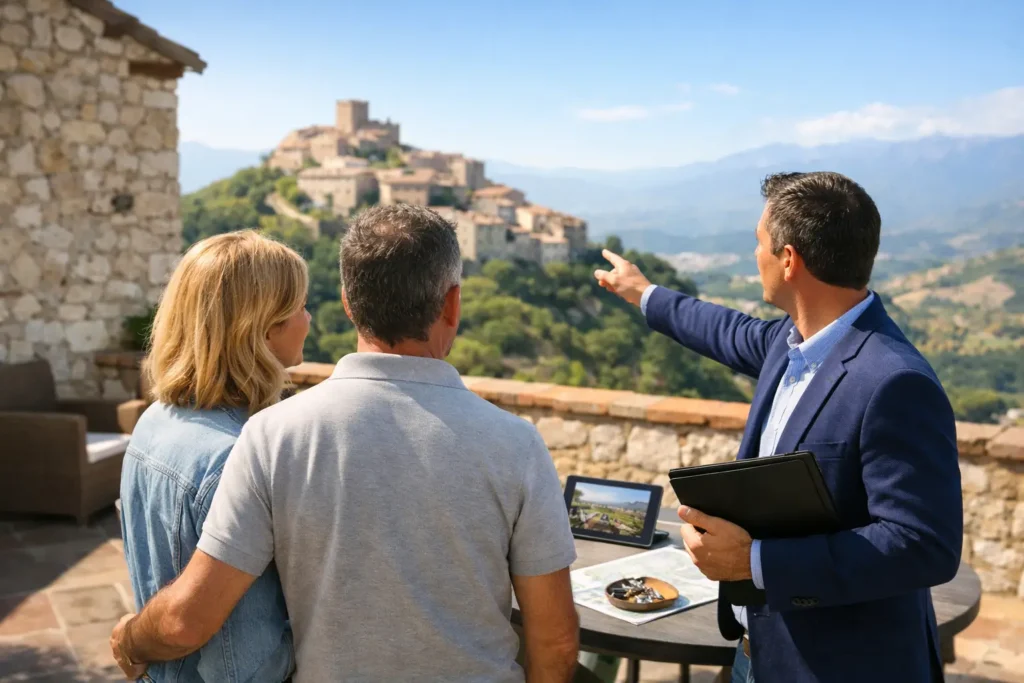
You can love a stone house, a sea view, and the idea of starting over in Italy — and still walk into a property viewing with no idea what you should actually be checking.
That’s exactly where property viewing support in Abruzzo can make a real difference.
It’s not about taking the excitement out of the search.
It’s about making sure excitement doesn’t drown out the practical details that matter once the viewing is over.
For many English- and German-speaking movers, the hardest part isn’t finding listings.
It’s knowing what a listing doesn’t tell you.
- A town can seem peaceful online and feel too isolated when you arrive.
- A home can look charming in photos and feel completely different in person.
- A seller or agent can speak quickly, skip key details, or assume you understand the local process when you don’t.
If you’re viewing property in a second language, in an unfamiliar region, those gaps add up fast.
Why Property Viewing Support in Abruzzo Matters
Abruzzo attracts people for good reasons.
You get mountain villages, coastal towns, smaller cities, and a slower pace of life that feels refreshing if you’re coming from somewhere more hectic.
But that variety also means one viewing is never just about the house or apartment itself.
It’s also about location, access, practical daily life, and whether the place fits the version of life you’re actually moving for.
- A property may be beautiful, but too far from the services you need.
- A village home may feel idyllic in spring but much less convenient in winter.
- An apartment near the coast may be perfect for short stays, yet less comfortable for year-round living.
None of this means the property is wrong.
It means context matters.
That’s where relocation support on the ground becomes useful.
Instead of trying to absorb everything at once, you have someone helping you translate not just the language, but the reality of what you’re seeing.
That support can reduce misunderstandings, help you ask smarter questions, and give you a more balanced view when emotions are running high.
What Good Property Viewing Support in Abruzzo Actually Looks Like
A lot of people imagine viewing support as a simple interpretation during an appointment.
That can be part of it, but good support goes further.
Before the viewing
You may need help:
- narrowing down areas
- planning a sensible route between viewings
- or deciding which properties are worth your time
If you’re flying in for only a few days, that planning matters.
A packed schedule sounds productive, but too many viewings in one day can leave everything blurring together.
This is also the stage to start gathering documentation.
As Idealista’s 2025 buyer guide explains, it’s worth requesting the visura catastale (cadastral extract) and planimetria (official floor plan) for any property you’re seriously considering.
These documents show the property’s officially registered size, layout, and ownership — and comparing them against what you actually see during the viewing can reveal enclosed balconies, converted lofts, or extensions that were never properly registered.
This matters enormously, because unregistered changes can complicate the purchase, delay utility setup, or create problems if you ever want to renovate or sell.
During the appointment
Support should help you stay focused.
That might mean making sure your questions are answered clearly, helping you notice practical details, and checking that you’re comparing properties on the same basis.
One home may include features that another doesn’t.
One may need more work than the photos suggest.
One may have easier parking, better access, or a more livable layout for your needs.
Afterward
The value is often in the debrief.
Once you leave a property, the conversation gets clearer.
- What stood out?
- What felt off?
- What do you need to confirm before taking the next step?
A calm second perspective can stop you from dismissing a good option too quickly — or rushing toward one that only felt right in the moment.
What to Look For During a Viewing
The obvious things matter.
Natural light, room sizes, noise, storage, and overall condition all deserve attention.
But if you’re relocating, your checklist should be wider than appearance.
The approach and surroundings
- Is the road easy to drive?
- Is parking realistic every day, not just during a quiet viewing time?
- If stairs are involved, are they manageable for groceries, luggage, or future guests?
Check the surrounding area as carefully as the interior.
A lovely home can feel very different depending on what’s next door, how close services are, and how connected you feel to the town.
Inside the property
Try to shift from holiday mode to real-life mode.
- Where will you dry laundry?
- Is the kitchen practical or just photogenic?
- Does the heating setup suit how you plan to live in colder months?
- Are there signs of moisture, poor ventilation, or deferred maintenance?
In older Italian properties, character and quirks often come together.
Some quirks are part of the charm.
Others become expensive, stressful, or simply inconvenient if you weren’t expecting them.
As Your Overseas Home’s property checks guide notes, structural cracks, outdated wiring, unregistered constructions, or plumbing issues may not be visible at first glance but can lead to significant repair bills later.
A specific consideration for parts of Abruzzo
This is genuinely important and often overlooked: some areas of Abruzzo, particularly L’Aquila province, sit in zones with strict anti-seismic building regulations due to earthquake risk.
According to the same guide, knowing whether a property meets these standards before you buy can save thousands of euros — and matters for safety, not just compliance.
If you’re considering a property in this part of the region, this is a question worth raising directly, ideally with a technical professional involved.
Lifestyle fit
If you work remotely, internet reliability matters.
If you plan to live year-round, seasonal towns may feel different outside peak months.
If you don’t drive confidently in Italy, distance from shops and services matters more than it might on paper.
None of these points are dramatic, but they shape day-to-day happiness.
Beyond the Viewing: Why a Technical Survey Matters
A viewing tells you how a property looks and feels.
It doesn’t tell you what’s behind the walls, whether the building complies with planning regulations, or whether what you’re seeing matches what’s officially on record.
This is where a geometra (a licensed Italian building surveyor) becomes genuinely valuable.
As Alfredo Esposito’s real estate checklist for Italy explains, a geometra can verify the property’s legal ownership and title through a 20-year notarial report, confirm urban planning compliance, and check for unauthorised renovations or extensions — issues that are more common in older or rural properties than most buyers expect.
Italy doesn’t legally require a formal building survey as part of the transaction, but skipping one is rarely wise, particularly for older stone properties or anything described as needing renovation.
A proper technical assessment, sometimes called a perizia tecnica, gives you either peace of mind or real negotiating leverage — and either outcome is worth the cost.
The Hidden Value of Local Perspective
Photos tell you how a property is staged.
A local perspective tells you how an area works.
That difference matters a lot in Abruzzo because the region offers very different ways of living within relatively short distances.
A place that looks ideal on a map may feel too remote once you understand the road conditions, the hill access, or how daily errands actually work.
Another area may not stand out online, but turns out to be far more practical and enjoyable for full-time living.
Local relocation support can also help you interpret the small details that outsiders often miss.
- Is it a quiet area pleasantly calm, or inconveniently empty?
- Is a renovation project realistic for your timeline and stress tolerance, or likely to become overwhelming?
- Is a coastal location lively enough in the off-season, or does it become too still for your taste?
This is where a service like Wanderlust Abruzzo can be especially helpful.
The goal is not to push you toward a decision.
It’s to give you grounded, human guidance so you can decide with more clarity and less pressure.
Property Viewing Support for Remote Buyers
Some buyers begin the search from abroad and only travel over for a short window.
Others try to assess options remotely before committing to flights.
As MondoExpat’s step-by-step guide notes, budgeting four to eight weeks for identifying suitable properties and conducting in-person viewings is realistic — and while remote purchases are legally possible, they’re genuinely not recommended without strong local representation.
This doesn’t mean buying blind.
It means making your in-person time count.
If you already have a shortlist, local support can help structure those appointments, so you’re not scrambling with directions, timing, and translation all at once.
If you’re still uncertain about areas, it can help you compare locations more realistically before you get attached to the wrong kind of property.
Remote buyers especially benefit from honest feedback.
When you’re not on the ground regularly, it’s easy to romanticise distance, underestimate practical challenges, or assume every charming village offers the same experience.
They don’t.
Some will suit you beautifully.
Some won’t.
Knowing the difference early can save a lot of frustration.
A Viewing Is Not Just a House Tour
One of the biggest mindset shifts for expats is realising that a viewing is not simply a chance to see whether you like a home.
It’s your chance to gather information, test assumptions, and understand what living there would really involve.
That means asking questions even when you feel awkward.
It means taking notes when everything starts to blur.
It means accepting that a place can be attractive and still not be right for you.
It also means giving yourself permission to slow down.
There is a lot of emotion in an international move.
People are often searching not just for a property, but for relief, belonging, and a new chapter that finally feels possible.
That emotional layer is real, and it deserves respect.
But it helps to have local, bilingual support that brings you back to the practical side when needed.
A good viewing experience leaves you feeling more informed, not more confused.
You should come away with a clearer sense of the property, the area, and the next questions to ask.
You should feel less alone in the process, not more dependent on guesswork.
If you’re planning viewings in Abruzzo, the best support is not flashy.
It’s calm, local, and honest.
It helps you see beyond first impressions, understand what daily life might look like, and move forward with more confidence.
Starting over in a new country already asks a lot of you.
Your property search shouldn’t have to feel like a leap in the dark.
The right home often reveals itself slowly, once the stress drops and the noise clears.
Having the right person beside you during viewings can make that moment easier to recognise.
—
Planning Property Viewings in Abruzzo and Want Someone Beside You?
Viewings go better with the right local support — someone who can ask the practical questions, spot what photos don’t show, and help you compare properties clearly, without the pressure of deciding everything in the moment.
At Wanderlust Abruzzo, we accompany English- and German-speaking buyers to property viewings across the region, helping you make informed, calm decisions about one of the biggest steps in your move.
Get in touch today and let’s talk about your property search in Abruzzo
—
Frequently Asked Questions
What should I check during a property viewing in Abruzzo?
Beyond the obvious — light, condition, noise, storage — check road access and parking, heating systems and insulation, signs of moisture or deferred maintenance, and proximity to services you’ll actually use. Request the visura catastale and planimetria to confirm the property matches its official registration, and for properties in earthquake-prone areas like L’Aquila province, ask specifically about anti-seismic compliance.
Do I need a geometra when buying property in Abruzzo?
It’s not legally required, but it’s strongly recommended, especially for older or rural properties. A geometra (licensed building surveyor) checks the property’s structural condition, confirms it matches official land registry records, and identifies any unauthorised renovations or extensions. This protects you from inheriting legal or financial problems and gives you real negotiating leverage if issues are found.
Can I view and buy property in Abruzzo remotely, without travelling?
It’s legally possible but not generally recommended. Most guidance suggests budgeting four to eight weeks for property research and in-person viewings, since photos and video calls can’t substitute for seeing a property and its surroundings firsthand. If travel is limited, having strong local representation — someone who can view properties, gather documentation, and give you honest, detailed feedback — becomes essential.
Why does property viewing support matter more in a region like Abruzzo specifically?
Because the region offers such varied ways of living within short distances — coastal towns, hill villages, mountain communities — that a property’s suitability depends heavily on local context a listing can’t convey. Road access, seasonal changes, internet reliability, and how isolated an area actually feels day-to-day all vary significantly between towns that might look similar on a map.
What documents should I request before committing to a property in Abruzzo?
At minimum, the visura catastale (cadastral extract, showing official ownership and size) and planimetria (official floor plan). For condominium properties, ask to review recent meeting minutes for any planned major works or disputes. A 20-year notarial report from a notary confirms legal ownership and checks for liens or mortgages attached to the property. These documents protect you from costly surprises after the purchase is complete.

 English
 Deutsch