
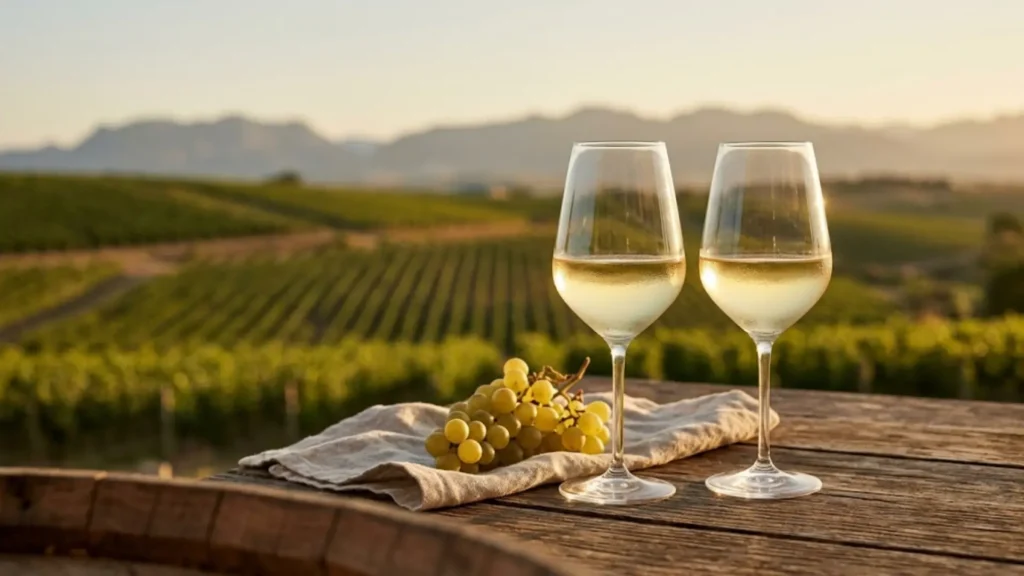
Montepulciano d’Abruzzo gets most of the international attention, and understandably so — but Abruzzo’s white wines have their own genuinely compelling stories, including one grape that was thought completely extinct until it was found growing wild decades later.
Here’s what’s actually in the glass.
Trebbiano d’Abruzzo: The Region’s Traditional White
Trebbiano d’Abruzzo is the region’s own DOC dedicated exclusively to white wine — and it’s a genuinely significant one, producing roughly 14 million litres annually.
It’s often described as the white counterpart to Montepulciano d’Abruzzo, and the comparison holds:
- both are named after the region
- both represent Abruzzo’s most historically established wine styles
What’s actually in the bottle
The DOC rules require a minimum of 85% Trebbiano Toscano and/or Trebbiano Abruzzese (also sometimes just called Trebbiano d’Abruzzo) and/or Bombino Bianco — a genuinely tangled naming situation, since the exact relationships between these grape varieties remain somewhat disputed among ampelographers.
The remaining 15% can include other native white grapes, including Passerina, Cococciola, or white Malvasia.
In the glass, Trebbiano d’Abruzzo is typically golden in colour, dry, and fruit-forward, with a delicate bouquet and refreshing, crisp acidity — flavours of lemon, green apple, and almond, with a subtle mineral edge.
Most examples are made for straightforward, easy drinking, though a smaller number of quality-focused producers use barrel fermentation or maturation to create more complex, genuinely age-worthy versions.
Pecorino: The Grape That Came Back From the Dead
This is, without question, the most genuinely remarkable story among Abruzzo’s white wines.
Pecorino is a native grape that was considered practically extinct by the mid-20th century — until cuttings were discovered growing wild in the neighbouring Marche region in the 1980s and successfully replanted.
Where the name comes from
The name comes from pecora, the Italian word for sheep — a reference to the region’s historic transhumance tradition, when shepherds moved flocks along mountain routes.
Pecorino grapes ripen earlier than most other local varieties, which meant they were often the only grapes still available on the vine — and therefore edible by sheep — by the time flocks passed through on their seasonal migration.
An extraordinary recovery
Since its rediscovery, Pecorino’s growth has been genuinely remarkable: the area under cultivation in Abruzzo expanded from just 22 hectares in 2000 to 1,080 hectares by 2015 — reportedly the fastest growth recorded anywhere in the world for a single grape variety over that period.
Sommeliers took real notice in the mid-2000s, drawn to its fruit intensity and striking natural acidity, and quality has continued to improve as more producers refine their approach.
In the glass, Pecorino is highly aromatic, with citrus and saline notes, naturally high acidity, and real structure.
Genuinely vibrant wines that pair beautifully with seafood, and a strong argument for why Abruzzo’s white wine scene deserves more international attention than it currently receives.
Passerina: The Delicate, Underrated Third Grape
Passerina is the least internationally known of Abruzzo’s three main white grapes, but it has its own quiet appeal.
Like Pecorino, it’s an ancient variety historically grown along the border between Abruzzo and Marche, and it was similarly overtaken for decades by the more productive Trebbiano varieties before experiencing its own modern revival.
Passerina wines tend to be fresh, light, and lively, with delicate citrus, pear, and floral tones — often made in an easy-drinking, approachable style, though a growing number of producers are working to give it more texture and depth.
It’s frequently used as a blending component within Trebbiano d’Abruzzo, but increasingly bottled and celebrated on its own.
A Fourth Grape Worth Knowing: Cococciola
Less commonly encountered but increasingly appreciated, Cococciola is another native Abruzzo white grape, most often used as a minority blending component in Trebbiano d’Abruzzo, though a small but growing number of producers now bottle it as a standalone wine.
If you spend any real time exploring Abruzzo’s smaller, quality-focused wineries, it’s worth asking whether they produce one.
Visiting Abruzzo’s Wineries
Most of Abruzzo’s wineries are concentrated in the coastal hills and hinterland of Teramo and Chieti provinces, where the majority of the region’s wine production takes place.
A typical winery visit with tasting runs roughly 1-2 hours and often costs surprisingly little compared to more famous Italian wine regions — commonly in the €30-35 range, frequently guided by the winemaker themselves rather than a hired host.
A few starting points if you’re planning a visit:
- Winalist’s Abruzzo wine region guide — a good overview of the region’s wine route, with bookable tastings across Teramo and Chieti
- Winedering’s list of Abruzzo wineries — including estates like Cantina Mazzarosa, offering guided tastings covering both Montepulciano and Pecorino side by side
- Podere Castorani, in the province of Pescara — frequently cited among visitors as one of the region’s top-rated winery experiences
Wine tastings here are often paired with local specialities worth trying alongside the wine itself — arrosticini (grilled lamb skewers), maccheroni alla chitarra, and Abruzzo’s own pecorino cheese, a fitting pairing given the wine grape shares its name and its shepherding history.
Why This Matters Beyond the Glass
Abruzzo’s wine story — a globally exported red, a rediscovered-from-extinction white, and two further native grapes still finding their audience — is a fairly accurate snapshot of the region as a whole:
- genuinely excellent
- historically deep
- and still relatively undiscovered compared to what it deserves
Our post on Montepulciano d’Abruzzo covers the region’s most famous red in the same depth, and our post on what Abruzzo is known for covers the broader picture.
—
Falling for Abruzzo Through Its Food and Wine?
It’s a common starting point — a good bottle, a good meal, and the sense that this region has more depth than it gets credit for.
For some people, that curiosity turns into something bigger.
At Wanderlust Abruzzo, we help English- and German-speaking expats relocate to, and settle into life in Abruzzo.
Personal, bilingual, and on the ground.
Get in touch today and let’s talk about your move to Abruzzo.
—
Frequently Asked Questions
What is the difference between Trebbiano d’Abruzzo and Pecorino?
Trebbiano d’Abruzzo is the region’s traditional, higher-volume white — light, crisp, and citrus-driven, made from a blend dominated by Trebbiano grape varieties. Pecorino is a distinct native grape, once nearly extinct, now prized for its aromatic intensity, saline notes, and naturally high acidity, generally considered a more premium and structured style than standard Trebbiano.
Why was Pecorino considered extinct?
By the mid-20th century, Pecorino had been almost entirely replaced by more productive grape varieties like Trebbiano, and cultivation had dwindled to the point of practical extinction. It was rediscovered in the 1980s when cuttings were found growing wild in the neighbouring Marche region and successfully replanted, sparking a genuine revival.
Why is it called Pecorino, like the cheese?
Both the grape and the cheese take their name from pecora, the Italian word for sheep, though for different reasons. The grape’s name references its early ripening — it was often the only grape variety still available for sheep to eat during seasonal transhumance migrations through the region.
Is Passerina the same grape used in Trebbiano d’Abruzzo?
Passerina can legally be used as a minority blending component (up to 15%) within Trebbiano d’Abruzzo DOC wines, but it’s also increasingly bottled and sold on its own as a distinct varietal wine, with its own lighter, more floral and citrus-driven character.
How much does a winery visit cost in Abruzzo?
Typically in the range of €30-35 for a guided tour and tasting, which is notably good value compared to more internationally famous Italian wine regions. Prices vary depending on the length of the visit and the number of wines tasted, and many smaller estates are guided directly by the winemaker rather than dedicated tour staff.


 English
 Deutsch