
If you’ve ever seen “Montepulciano” on two completely different Italian wine labels and wondered whether they’re related, you’re not alone.
This is genuinely one of the most common points of confusion in Italian wine.
Here’s the clear answer, plus what actually makes Abruzzo’s version of this wine distinctive.
What Is Montepulciano d’Abruzzo?
Montepulciano d’Abruzzo is a red wine made primarily from the Montepulciano grape.
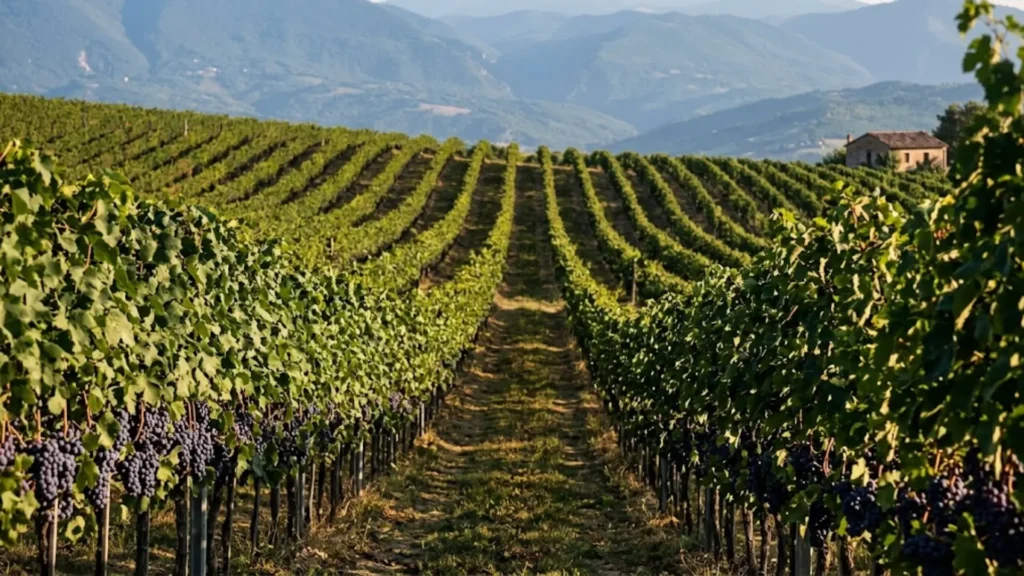
A thick-skinned, deeply coloured variety that thrives across Abruzzo’s varied terrain, from coastal plains to hillside vineyards in the Apennine foothills.
It’s a medium-to-full-bodied wine, typically showing notes of red plum, sour cherry, boysenberry, oregano, and tobacco, with firm tannins and naturally high acidity.
The wine received DOC status (Denominazione di Origine Controllata) in 1968, and today it’s produced across all four Abruzzo provinces — Teramo, Pescara, Chieti, and L’Aquila — covering nearly 10,000 hectares of vineyard and accounting for roughly 80% of the region’s total DOC wine production.
Is Montepulciano d’Abruzzo the Same as Tuscany’s Montepulciano?
No — and this is worth clarifying clearly, because the confusion is genuinely common.
Vino Nobile di Montepulciano is a completely different wine, made in the Tuscan town of Montepulciano from the Sangiovese grape (locally called Prugnolo Gentile).
It has no connection to Abruzzo’s Montepulciano grape at all — the shared name is essentially a historical coincidence, not a shared origin.
To make it even more confusing: the Montepulciano grape used in Abruzzo isn’t actually native to the Tuscan town of Montepulciano either.
The grape is believed to have originated in central Italy, with the first documented historical reference dating to 1793, and it found its true home in Abruzzo’s hills and valleys — particularly the Valle Peligna — rather than in Tuscany at all.
If you remember one rule:
- Montepulciano d’Abruzzo = Montepulciano grape, made in Abruzzo
- Vino Nobile di Montepulciano = Sangiovese grape, made in Tuscany
Same word in the name, entirely different wines.
Colline Teramane: Abruzzo’s Only DOCG Wine
Within the broader Montepulciano d’Abruzzo DOC sits a smaller, stricter subzone: Colline Teramane (“the Teramo hills”), located in the northern province of Teramo.
First established as its own DOC in 1995, it was promoted to DOCG status in 2003 — Denominazione di Origine Controllata e Garantita, Italy’s highest wine classification, and currently the only DOCG designation in the entire Abruzzo region.
Colline Teramane wines must contain a minimum of 90% Montepulciano grapes (compared to 85% for standard DOC), come from just 30 specific communes within Teramo province.
In addition to that, they undergo considerably longer minimum ageing — at least one year, extending to three years (including one in oak) for a Riserva designation.
The northern provinces of Teramo and Pescara are generally considered to produce the region’s most prestigious, quality-focused expressions, thanks to less fertile, mineral-rich soils and higher elevations where the Apennines draw closer to the coast.
Cerasuolo d’Abruzzo: The Rosé Made From the Same Grape
One more wine worth knowing: Cerasuolo d’Abruzzo, a distinctive cherry-red rosé also made from the Montepulciano grape, using shorter skin contact during fermentation.
It became its own separate DOC designation in 2010, having previously been produced as a style within the main Montepulciano d’Abruzzo classification.
Cerasuolo tends to be medium-bodied and notably hearty for a rosé, with characteristic notes of orange peel, cinnamon, strawberry, and dried cherry.
A genuinely distinctive style compared to the lighter, more delicate rosés found elsewhere in Italy.
Where the Best Montepulciano d’Abruzzo Comes From
While all four provinces produce Montepulciano in significant volume, quality and character vary meaningfully by area:
- Teramo — home to the Colline Teramane DOCG, generally considered the region’s finest and most age-worthy expressions, with naturally high acidity, firm tannin, and elevated alcohol from the cooler hillside terroir
- Pescara — also among the most favoured provinces for quality-driven producers, sharing similar mineral-rich, higher-elevation growing conditions
- Chieti — produces the largest overall volume of DOC wine, spanning a wide range of styles from everyday drinking wines to more serious bottlings
- L’Aquila — the smallest producing province by volume, with vineyards concentrated in valleys including the Valle Peligna, historically significant as one of the grape’s original homes
Tasting It for Yourself
Most of Abruzzo’s Montepulciano producers are concentrated in the coastal hills and hinterland of Teramo and Chieti provinces, and visiting one is far more accessible — and often far less expensive — than a comparable experience in Tuscany or Piedmont.
A typical guided tour and tasting runs roughly €30-35, frequently hosted by the winemaker themselves.
A few starting points if you’re planning a visit:
- Winalist’s Abruzzo wine guide — a good overview of the region’s wine route, with bookable tastings across Teramo and Chieti
- Winedering’s list of Abruzzo wineries — including estates like Cantina Mazzarosa, which pairs Montepulciano tastings with the region’s white wines side by side
- Podere Castorani, in the province of Pescara — frequently cited among visitors as one of the region’s top-rated winery experiences
If you’re curious about what else is in the glass beyond the region’s famous red, our post on Abruzzo’s white wines — including the remarkable story of a grape once thought extinct — covers the rest of the region’s wine identity.
Why This Matters Beyond the Wine Itself
Abruzzo’s wine industry is a genuine reflection of the region’s broader character:
- quietly excellent
- historically deep-rooted
- and considerably less internationally hyped than its output deserves
Montepulciano d’Abruzzo is one of Italy’s most widely exported indigenous wines by volume, sitting just behind Sangiovese in international recognition.
Yet the region itself remains far less visited and far less associated with wine tourism than Tuscany, Piedmont, or even nearby Puglia.
For anyone exploring or considering Abruzzo more seriously — not just for a glass of wine, but for the region itself — this pattern repeats across nearly everything the region offers: genuine substance, historically well-established, without the price tag or crowds that international fame usually brings. Our post on what Abruzzo is known for covers this broader identity in more detail.
—
Curious What Else Abruzzo Has to Offer?
Great wine is often one of the first things that draws people to a region — and, for many, one of the reasons they end up considering it as a place to actually live.
At Wanderlust Abruzzo, we help English- and German-speaking expats relocate to, and settle into life in Abruzzo.
Personal, bilingual, and on the ground.
Get in touch today and let’s talk about your move to Abruzzo.
—
Frequently Asked Questions
Is Montepulciano d’Abruzzo the same wine as Vino Nobile di Montepulciano?
No. They share a name but nothing else. Montepulciano d’Abruzzo is made from the Montepulciano grape in the Abruzzo region. Vino Nobile di Montepulciano is made from the Sangiovese grape in the Tuscan town of Montepulciano. The naming overlap is one of the most common points of confusion in Italian wine.
What does Montepulciano d’Abruzzo taste like?
Typically medium-to-full-bodied, with notes of red plum, sour cherry, boysenberry, oregano, and tobacco. It has firm tannins, naturally high acidity, and an alcohol content usually between 11.5% and 13.5%, though quality-focused expressions from Colline Teramane can run slightly higher with more structure and ageing potential.
What is Colline Teramane, and why is it special?
Colline Teramane is a DOCG subzone within the broader Montepulciano d’Abruzzo appellation, located in Teramo province. It’s currently the only DOCG (Italy’s highest quality wine classification) in the entire Abruzzo region, requiring stricter grape composition, lower yields, and longer ageing than standard Montepulciano d’Abruzzo DOC wines.
What is Cerasuolo d’Abruzzo?
Cerasuolo d’Abruzzo is a distinctive cherry-red rosé wine made from the same Montepulciano grape, using shorter skin contact than the red wine version. It became its own separate DOC designation in 2010 and is known for being noticeably fuller-bodied and more structured than most Italian rosés.
Which Abruzzo province produces the best Montepulciano d’Abruzzo?
Teramo and Pescara are generally considered to produce the highest-quality, most age-worthy expressions, thanks to higher elevations and less fertile, mineral-rich soils. Teramo specifically is home to the region’s only DOCG subzone, Colline Teramane. Chieti produces the largest overall volume, spanning a wide range of styles and quality levels.



 English
 Deutsch