
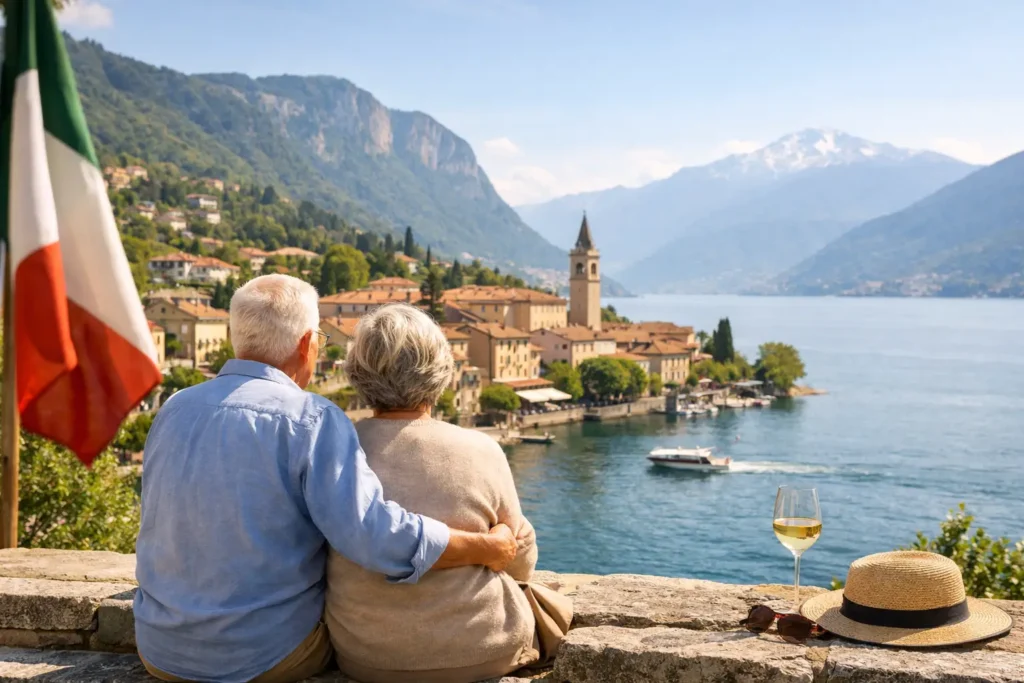
When people ask whether it’s safe to retire in Italy, they’re usually asking more than one question at once.
They want to know:
- if daily life feels secure
- if healthcare is dependable
- if they’ll be taken seriously when something goes wrong
- and if moving abroad in later life is exciting or simply exhausting
That mix of hope and worry is completely normal.
The short answer is yes — for many expats, Italy is a very safe place to retire.
But safety isn’t only about crime statistics.
It’s also about:
- how easy it is to understand the system
- how isolated you feel without the language
- how confident you are driving on local roads
- and whether your chosen town actually fits the life you want to live
What the Data Actually Says About Safety in Italy
Before getting into the lived experience, it’s worth starting with the numbers — because they’re more reassuring than many people expect.
According to International Insurance’s 2026 retirement guide, Italy ranks 33rd out of 163 countries on the 2025 Global Peace Index, with a rating of “high”.
Its violent crime rate sits at just 0.51 per 100,000 inhabitants — compared with a global average of 5.61.
As Idealista’s January 2026 analysis confirms, Italy has roughly twice as many police officers per capita as the United States, and road fatalities per 100,000 people are at less than half the US rate.
On the healthcare side, Italy’s National Healthcare System (Servizio Sanitario Nazionale) ranks 22nd globally on the 2025 CEOWORLD Healthcare Index — a genuinely strong position for a universal public system that covers all legal residents.
These are not just marketing claims.
They’re measured indicators used by serious international rankings — including International Living, which placed Italy 6th on its 2026 list of safest places to retire globally.
Is It Safe to Retire in Italy for Expats Day to Day?
In broad terms, yes.
Violent crime is relatively low compared with many other places, and many smaller towns offer a calm, community-oriented pace of life that appeals to people ready to trade pressure for peace.
In much of the country — especially outside major tourist hubs — daily life can feel slower, more personal, and less anonymous.
That said, retirement safety in Italy depends a lot on where and how you live.
A busy city centre with heavy traffic, seasonal crowds, and pickpocketing risks feels very different from a hill town where neighbours know each other and the loudest problem is church bells at 8am.
If your dream is a quiet, manageable place with a strong sense of community, parts of Italy absolutely offer that.
If your plan involves buying a remote property without understanding the area, the paperwork, or the services nearby, the picture changes considerably.
For most German- or English-speaking retirees, the real challenge isn’t personal danger.
It’s friction — confusing appointments, utility setup delays, documents you don’t fully understand, and not knowing who to call when something stops working.
These things can make a place feel less safe than it actually is.
Healthcare: Where Safety Becomes Personal
For most retirees, healthcare is where the safety conversation becomes real.
Italy’s SSN is a genuine asset — once you’re properly registered and understand how it works, many expats feel very well cared for.
As Impatria’s 2026 healthcare guide for foreign retirees explains in detail, the SSN operates on principles of universality and equity, guaranteeing comprehensive care to all legally residing foreigners.
EU retirees with an S1 form can access it essentially for free.
Non-EU retirees register through a voluntary contribution system after establishing residency.
The part many people underestimate is the practical setup, not the quality of care itself.
Knowing how to register with your local ASL, choose a General Practitioner (medico di base), book appointments, interpret medical instructions, and handle follow-up procedures in Italian takes real preparation.
If you already feel vulnerable because of age, mobility, or an existing health condition, confusion itself becomes a source of stress.
Many expat retirees in Italy use a blended approach:
- public SSN for major and ongoing medical needs
- supplemental private insurance for faster access, English-speaking doctors, and broader specialist coverage
Private plans typically cost €800–1,500 per year for an adult, depending on age and coverage.
You can read more about the specific healthcare registration process in our tessera sanitaria guide.
This is also where location matters enormously.
A beautiful rural property may feel less beautiful if every specialist appointment requires a 40-minute drive and real logistical energy.
If easy access to healthcare services is part of your safety picture — and for many retirees it should be — that should shape where you retire, not just what it looks like.
The Less Obvious Risks Retirees Should Think About When Retiring in Italy
Most articles answer “is it safe to retire in Italy?” with a quick yes and move on.
That skips over the things that actually catch people off guard.
Driving
Roads in some areas are easy and familiar.
In others, they’re narrow, steep, poorly lit, or fast-moving in ways that feel stressful if you’re used to a different driving culture.
If you know you dislike driving, be honest about that early.
A town that looks charming on paper can become limiting — or genuinely exhausting — if you can’t comfortably get around independently.
Italy also has its own road culture: less formal adherence to lanes, more reliance on assertive driving, and parking norms that take some adjustment.
Road fatalities per capita are lower than in the US, so the system isn’t dangerous by objective measures — but the style of driving takes getting used to.
Property decisions
Retirees are often drawn to old houses with character, lower prices, and dramatic views.
There’s nothing wrong with that.
But older properties can come with maintenance issues, heating challenges, or complicated setup steps that are harder to manage from abroad.
Safety includes choosing a home that supports daily life, not just a weekend fantasy.
A beautiful property that’s cold in winter, requires constant maintenance, or puts every errand at the end of a steep hill is a practical challenge that compounds over time.
Isolation
Many retirees move for a slower life, but there’s a significant difference between peaceful and lonely.
If you don’t speak much Italian yet, and you settle in a place where few people around you speak English or German, simple tasks can become draining.
Over time, that affects confidence and wellbeing more than people expect.
Social connection is part of feeling safe, and it’s worth planning for it as deliberately as you plan for utilities.
Scams and Feeling Exposed in an Unfamiliar System
Retirees aren’t usually at high risk of violent crime in Italy, but they can feel exposed in a different way when they don’t understand the system.
Miscommunication around rentals, deposits, residency steps, or service activation can leave people feeling vulnerable.
Sometimes the issue isn’t dishonesty — it’s that Italian processes are more local, more paper-based, and more relationship-driven than newcomers expect.
What feels straightforward in one country can feel opaque in another.
When you don’t know the language or the unwritten rules, your margin for error gets smaller.
This is why practical, bilingual support matters so much for retirees specifically.
Having someone local like Wanderlust Abruzzo explain what’s happening, help you ask the right questions, or accompany you through administrative appointments can be the difference between feeling grounded and feeling constantly off-balance.
Why Abruzzo Specifically Makes Sense for Retirees
Within Italy, Abruzzo offers a particularly strong case for retirees looking at the safety question from a practical rather than statistical angle.
Many of Abruzzo’s smaller towns and cities fall under the 30,000-resident threshold for Italy’s 7% flat tax for foreign pensioners — which can meaningfully reduce the tax burden on foreign-sourced income for up to 10 years.
The region’s crime rates are well below Italy’s already low national average.
Its healthcare infrastructure — through ASL Pescara, ASL Chieti, ASL Teramo, and ASL L’Aquila — provides solid coverage across the region.
The lifestyle offer is also genuinely retiree-friendly in the right towns.
Some people find in Abruzzo the combination they were looking for: quieter living with access to the coast, countryside, and mountain air — and a less frantic pace than larger Italian cities.
English-speaking expat communities are active in several towns, including Pescara, Vasto, and Sulmona, which helps with the social safety net that long-term retirement genuinely requires.
But even within one region, one town can suit you beautifully while another leaves you feeling stranded.
This is where the location decision matters more than the country decision.
Choosing the Right Place Matters More Than Choosing Italy
If you’re asking whether Italy is safe, the better question might be:
Is your specific retirement plan safe?
Italy contains busy cities, remote villages, elegant coastal towns, mountain communities, and everything in between.
The country is not one experience.
A good retirement location usually gives you a few key things at once:
- reliable day-to-day services
- a home that’s manageable and practical
- healthcare access that feels realistic
- and enough community to keep life from becoming lonely
Affordability matters too — but cheap should never be the only filter.
A lower-cost home can become expensive in stress if the location makes daily life harder.
This is where local, on-the-ground guidance like the one provided by Wanderlust Abruzzo becomes genuinely valuable.
Not because you need someone to make the decision for you, but because retirement moves carry less room for trial and error.
It helps to understand what a neighbourhood feels like in November, how long errands actually take, and whether a lovely property is practical beyond the first impression.
So, Is It Safe to Retire in Italy?
Yes, it can be — and the data backs that up clearly.
Many retirees build a happy, secure life here and wonder why they didn’t do it sooner.
They enjoy walkable town centres, strong community rhythms, excellent food, family-oriented culture, and a pace of life that feels kinder than what they left behind.
But the safest retirement in Italy is usually not the most impulsive one.
It’s the one planned with clear eyes.
That means looking beyond the postcard version of Italy and thinking carefully about access, language, services, mobility, and support.
It means understanding that feeling safe comes from both the place itself and your ability to function confidently within it.
If Italy keeps calling to you, take that seriously.
Just pair the dream with practical groundwork.
A retirement move should feel exciting, yes — but also steady enough that you can exhale once you arrive.
—
Thinking About Retiring in Abruzzo (Italy) and Want to Get It Right?
Safety in retirement is built on practical foundations:
- the right town
- the right home
- and the right support during the first months
That’s exactly what we help with.
At Wanderlust Abruzzo, we support English- and German-speaking retirees through every stage of settling into the region — from choosing where to live and handling residency, to healthcare registration, utilities, and feeling genuinely settled. Personal, bilingual, and on the ground.
Get in touch today and let’s talk about your retirement move to Abruzzo
—
Frequently Asked Questions
Is Italy a safe country to retire in?
Yes, by objective measures. Italy ranks 33rd on the 2025 Global Peace Index (rated “high”), 6th on International Living’s 2026 list of safest places to retire, and has a violent crime rate of 0.51 per 100,000 inhabitants — well below the global average of 5.61. The main risks for most expat retirees are petty theft in tourist-heavy areas and the frustrations of an unfamiliar system, not personal danger.
What is the healthcare system like for retirees in Italy?
Italy’s Healthcare System (Servizio Sanitario Nazionale or SSN) ranks 22nd globally on the 2025 CEOWORLD Healthcare Index and provides universal coverage for all legal residents, including expats. Once registered, most retirees have access to GP visits, specialist referrals, hospital care, and subsidised prescriptions. Many expats supplement this with private health insurance for faster access and English-speaking doctors. The quality of care is generally good; the challenge is navigating the registration and administrative processes in Italian.
What are the biggest risks of retiring in Italy as an expat?
The most consistent challenges are not crime-related. They are: language barriers in administrative and healthcare settings; isolation if you choose a remote location without a strong community; property decisions based on holiday impressions rather than year-round practicality; driving conditions in some areas; and the bureaucratic complexity of setting up residency, utilities, and healthcare. These are manageable with preparation and local support, but they catch many people off guard.
Is Abruzzo a good region to retire in for safety and quality of life?
Yes, for many retirees. Abruzzo’s crime rates are well below Italy’s already low national average; its towns offer a calmer, more community-oriented pace than major Italian cities, and many qualifying towns fall under the 7% flat tax threshold for foreign pensioners. Healthcare is accessible through four ASL territories. The region offers a genuine combination of sea, mountains, and affordable everyday life — with active English-speaking expat communities in several towns.
Do I need private health insurance to retire in Italy?
Not necessarily, but many expat retirees choose to supplement the public SSN with private insurance. The SSN provides comprehensive coverage once you’re registered — including GP visits, specialist consultations, hospital care, and subsidised medications. Private insurance adds value mainly for faster appointments, English-speaking doctors, and dental/vision coverage not well covered by the SSN. Costs for supplemental private plans vary, but typically run €800–1,500 per year for an adult depending on age and coverage level.

 English
 Deutsch