
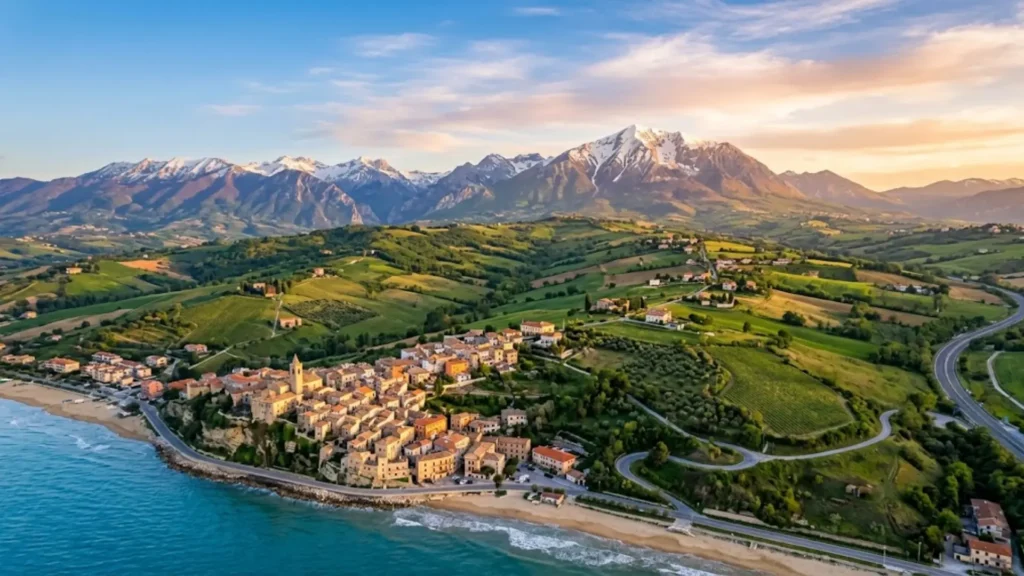
If you’ve been searching for “what is Abruzzo” online, you’ve probably noticed the questions get surprisingly basic fast:
- Is it a region or a province?
- A city or a country?
- North or south?
This confusion is genuinely common.
Abruzzo isn’t as globally recognised as Tuscany or Sicily, even though it’s one of Italy’s most striking and least-crowded regions.
Here’s the clear picture.
Is Abruzzo a Region, a Province, or a City?
Abruzzo is a region — one of Italy’s 20 official administrative regions, alongside better-known names like Tuscany, Puglia, Umbria, and Sicily.
It is not a city, and it’s not a single province.
The 4 provinces of Abruzzo
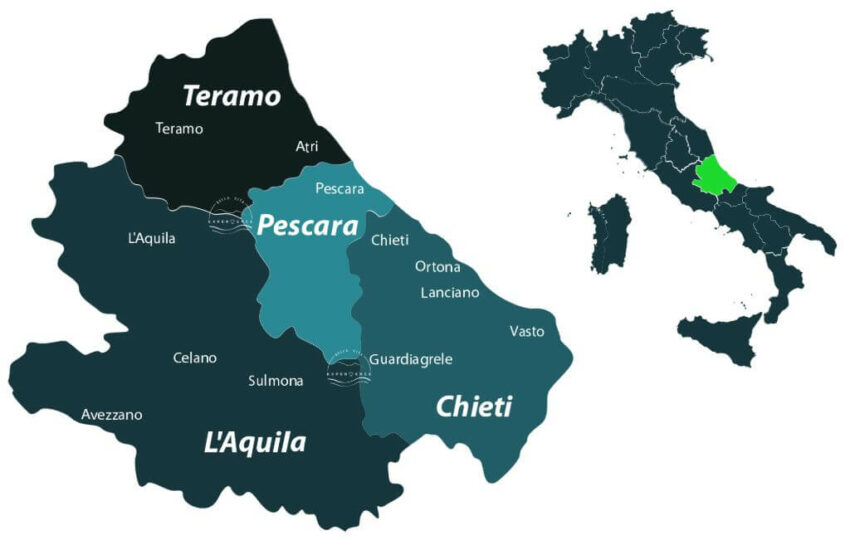
Within the region, Abruzzo is divided into four provinces:
- L’Aquila — the largest and most mountainous province, comprising roughly half of Abruzzo’s total landmass, with a 2026 population of approximately 286,765 across 108 municipalities
- Teramo — the northernmost province, home to the “seven sisters” coastline and some of Italy’s highest-density Blue Flag beaches, with a population of approximately 299,835 across 47 municipalities
- Pescara — the smallest province by area but the most densely populated, with roughly 311,563 residents across 46 municipalities
- Chieti — the largest province by population, with approximately 369,059 residents across 104 municipalities
Together, these four provinces contain 305 municipalities (comuni) — the individual towns and villages that make up daily life in the region, ranging from Pescara’s roughly 120,000 residents down to tiny mountain villages with fewer than 200 people.
Where Is Abruzzo Located in Italy?
Abruzzo sits on the central-eastern coast of Italy, facing the Adriatic Sea, roughly 90 minutes to two hours east of Rome by car or train.
It borders Marche to the north, Lazio to the west, Molise to the south, and the Adriatic Sea to the east.
Is Abruzzo in northern, central, or southern Italy?
This is one of the most searched questions about the region, and the honest answer is: it depends who’s asking, and why.
Administratively and statistically, Italy’s national institute (ISTAT) classifies Abruzzo as part of southern Italy, largely for historical and economic-classification reasons dating back to unification-era regional groupings.
Geographically and culturally, however, Abruzzo sits at a genuine crossroads — its landscape, cuisine, and pace of life often feel closer to central Italy than to the deep south.
Many Italians themselves describe it as a transitional region rather than firmly one or the other.
How Big Is Abruzzo, and How Many People Live There?
The Abruzzo region covers approximately 10,832 km² (4,182 sq mi) — making it a mid-sized Italian region, larger than Molise or Liguria but considerably smaller than Tuscany or Sicily.
Its total population as of 2026 is approximately 1.27 million people, giving it a population density of roughly 117 people per km².
Noticeably less dense than most of central and northern Italy, which is part of what gives the region its spacious, uncrowded feel even in its coastal towns.
What Is the Capital of Abruzzo?
The official regional capital is L’Aquila, a historic university city in the mountainous interior, sitting at over 700 metres elevation.
L’Aquila also serves as Italy’s Capital of Culture for 2026, bringing renewed national attention and investment to the city following its long recovery from the devastating 2009 earthquake.
However, Pescara is Abruzzo’s largest city, and functions as the region’s practical commercial and transport hub.
Home to the region’s main airport, its busiest train connections, and the largest concentration of both Italian and international residents.
Many newcomers are surprised to learn the capital and the largest city aren’t the same place.
This is actually fairly common in Italy (Sicily’s capital is Palermo, but Catania is nearly as large; similarly, Abruzzo splits its “official capital” and “practical hub” roles between two different cities).
What Does the Name “Abruzzo” Mean?
The exact etymology is debated among linguists, with several competing theories tracing the name to Latin or pre-Roman roots.
The region was historically also known as Abruzzi (plural form), a name still occasionally used in older texts and by some English speakers today.
Though “Abruzzo” (singular) has been the standard official form for decades.
We cover this naming history in more detail in our dedicated post on Abruzzo vs Abruzzi.
What Makes Abruzzo Different From Other Italian Regions?
A few things consistently surprise first-time visitors and researchers:
- The mountains-to-sea distance is remarkably short. You can genuinely swim in the Adriatic in the morning and be skiing in the Apennines by early afternoon — a combination very few Italian regions can offer.
- It’s one of Italy’s greenest regions, with roughly a third of its territory under some form of environmental protection, including three national parks.
- It’s still relatively undiscovered by international tourism compared to Tuscany, Puglia, or Sicily — which is exactly why property prices and cost of living remain considerably lower here than in Italy’s more famous regions.
What Is Abruzzo Known For?
Beyond the basics of geography and administration, Abruzzo has built a real identity around a few specific things:
- its wildlife-rich national parks (home to the Marsican brown bear and Apennine wolf)
- its mountain-to-sea landscape
- its distinctive regional cuisine
- and — for the growing number of foreign residents discovering it — a genuinely more affordable, less touristy alternative to Italy’s headline destinations
Our dedicated post on what Abruzzo is known for goes deeper into each of these.
—
Thinking About Visiting or Moving to Abruzzo?
Now that you know where it is, the real question is what it’s actually like to live here.
We help English- and German-speaking expats relocate to, and settle into life in Abruzzo.
At Wanderlust Abruzzo, we support every practical stage of relocating to the region.
Personal, bilingual, and on the ground.
Get in touch today and let’s talk about your move to Abruzzo
—
Frequently Asked Questions
Is Abruzzo a region or a country?
Abruzzo is a region of Italy, not a country. It’s one of Italy’s 20 official administrative regions, comparable in status to Tuscany, Umbria, or Sicily.
Is Abruzzo north or south Italy?
Administratively, Abruzzo is classified as southern Italy by Italy’s national statistics institute. Geographically and culturally, it sits at a transitional point between central and southern Italy, and many describe its character as closer to central Italy than the deep south.
How many people live in Abruzzo?
Approximately 1.27 million people, as of 2026, across four provinces and 305 municipalities.
What is the capital of Abruzzo?
L’Aquila is the official regional capital. Pescara, however, is the largest city and the region’s main commercial, transport, and population hub — the two roles are split between different cities.
How far is Abruzzo from Rome?
Roughly 90 minutes to two hours by car or train, depending on your specific starting and ending points within each region. Our dedicated guide to travelling between Abruzzo and Rome covers train times, driving routes, and airport options in detail.

 English
 Deutsch